
High Flow Filter Cartridges for Data Center Cooling Water Filtration
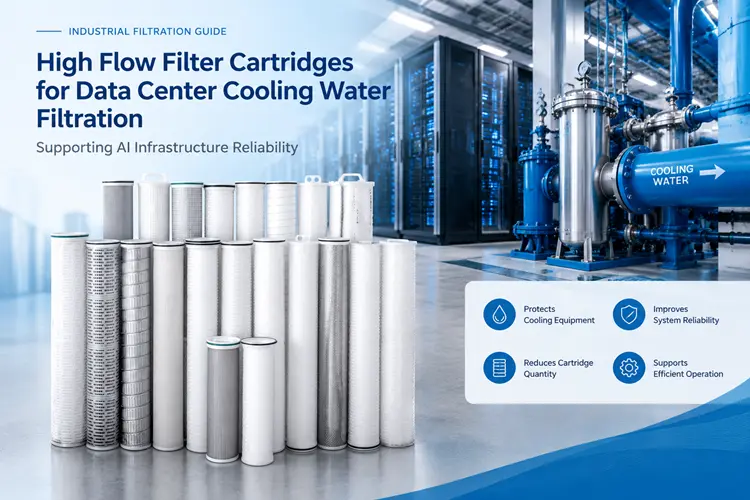
The rapid growth of artificial intelligence (AI), cloud computing, and high-performance computing (HPC) is driving demand for larger and more powerful data centers. As computing density increases, effective heat removal becomes increasingly important for maintaining reliable data center operations.
To manage this heat, data centers may use chilled water systems, cooling towers, liquid cooling technologies, and other heat-rejection solutions. These systems have different water quality requirements, but particulate control can be an important consideration in many cooling water applications.
High Flow Filter Cartridges offer a filtration option for suitable data center cooling water systems, particularly where relatively high flow rates, efficient cartridge configurations, and manageable maintenance requirements are important.
This article explores where High Flow Filter Cartridges may be used in data center infrastructure, their potential benefits, and the key factors to consider when selecting a filtration solution for cooling water applications.
Why Is Cooling Water Filtration Important for AI Data Centers?
AI servers and GPU clusters can generate substantial amounts of heat during intensive computing operations. As rack power density increases, data center operators must carefully manage cooling capacity, heat transfer, and equipment reliability.
Depending on the facility design, cooling infrastructure may include:
· Chilled water systems
· Cooling towers
· Heat exchangers
· Chillers
· Cooling water circulation loops
· Direct-to-chip liquid cooling
· Rear-door heat exchangers
These systems do not all use the same fluid or filtration arrangement. However, particulate contamination in applicable water circuits can contribute to equipment fouling, blocked passages, increased maintenance, or reduced heat transfer performance.
Potential sources of particulate contamination include:
· Rust and corrosion products from piping
· Suspended solids in incoming water
· Construction debris remaining after installation
· Deposits released during system operation
· Particles introduced during maintenance
A properly designed filtration system can help control these contaminants and support reliable cooling infrastructure operation.
The appropriate filtration method depends on the cooling system design, fluid quality requirements, and equipment manufacturer's recommendations.
Where Can High Flow Filter Cartridges Be Used in Data Centers?
High Flow Filter Cartridges may be suitable for selected filtration points in data center cooling infrastructure. Their suitability depends on the circuit design, required flow rate, filtration rating, and compatibility with the circulating fluid.
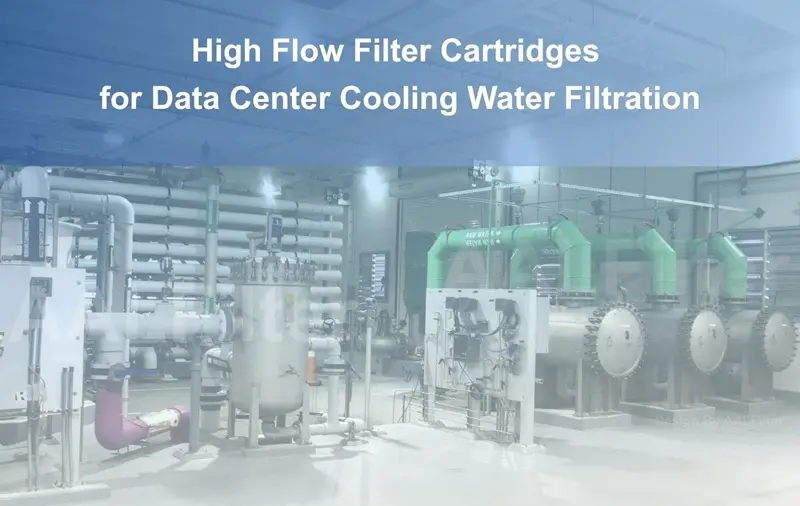
Cooling Tower Water Filtration
Cooling towers are used in many data centers to reject heat from cooling systems. Their circulating water can collect suspended solids from incoming makeup water, airborne dust, corrosion, and other sources.
A side-stream filtration system treats a portion of the circulating water rather than the entire cooling tower flow. This approach can help control suspended particulate matter and reduce the accumulation of solids in the system.
High Flow Filter Cartridges may be considered for suitable side-stream filtration applications where cartridge filtration meets the required flow and water quality targets.
The selection should account for solids loading, filtration rating, pressure drop, and expected cartridge replacement frequency.
Cartridge filtration does not replace the chemical treatment, blowdown control, biological control, or other water management measures that a cooling tower may require.
Chilled Water System Filtration
Chilled water systems circulate water between chillers, heat exchangers, and cooling equipment. In closed-loop systems, particulate contamination may originate from corrosion products, installation debris, or deposits released from piping and equipment.
Depending on the system design, filtration may be installed during initial flushing, as part of a side-stream arrangement, or at a designated equipment protection point.
High Flow Filter Cartridges can be evaluated when a relatively high filtration flow rate is required and cartridge filtration is appropriate for the system.
For closed-loop chilled water applications, the filtration solution should be selected according to the loop's cleanliness requirements, water chemistry, operating conditions, and equipment specifications.
Heat Exchanger Protection
Heat exchangers transfer heat between different fluids and are important components in many data center cooling architectures.
Particulate contamination may accumulate in heat transfer equipment or restrict narrow flow passages, depending on the exchanger design and contaminant characteristics.
A suitable upstream filtration system can help reduce the amount of particulate matter reaching downstream equipment.
High Flow Filter Cartridges may be used where their filtration rating, flow capacity, pressure drop, and material compatibility meet the application requirements.
The actual filtration rating should be based on the equipment manufacturer's recommendations and the characteristics of the circulating fluid.
Liquid Cooling Infrastructure for AI Servers
Direct-to-chip liquid cooling and other liquid cooling technologies are increasingly relevant to high-density computing environments.
However, not every liquid cooling circuit is suitable for conventional High Flow Filter Cartridges.
Some direct-to-chip systems use specially formulated coolants, tightly controlled fluid specifications, fine internal channels, or dedicated filtration arrangements. Filtration must be compatible with the coolant and approved by the cooling system manufacturer.
High Flow Filter Cartridges may be appropriate for certain upstream water circuits, facility water loops, or heat rejection systems associated with liquid-cooled data centers. Their use within a server-side coolant loop should only be considered when the system design and manufacturer specifications permit it.
This distinction is important when selecting filtration products for AI data center infrastructure.
Why Consider High Flow Filter Cartridges for Data Center Cooling Water?
For suitable high-flow applications, High Flow Filter Cartridges can offer several practical advantages over configurations using large numbers of conventional cartridges.
Higher Flow Capacity per Cartridge
High Flow Filter Cartridges are designed to handle relatively high flow rates per element under specified operating conditions.
This can be useful in cooling water applications where the required filtration flow would otherwise require many conventional cartridges.
Actual capacity depends on the cartridge design, filter media, micron rating, fluid properties, contaminant loading, and allowable pressure drop.
Fewer Individual Filter Elements
When the design flow per cartridge is higher, fewer elements may be needed to achieve a target filtration capacity.
Reducing the number of elements can simplify cartridge installation and replacement. The actual reduction should be calculated using application-specific design flow data rather than maximum advertised flow rates.
Efficient Housing Configuration
A high-flow filtration arrangement may reduce the number of cartridge positions required for a given design flow.
Depending on the selected housing, this can help simplify piping arrangements and make more efficient use of equipment space.
The overall footprint should be evaluated at the complete system level, including the housing, access for cartridge replacement, piping, and maintenance clearance.
Maintenance Planning
Cartridge quantity, contaminant loading, and service life all affect maintenance requirements.
Where a high-flow configuration uses fewer elements and provides an appropriate service life, replacement work may become easier to manage.
However, longer service life should not be assumed solely because a cartridge has a larger filtration area. It must be evaluated using actual water quality, dirt holding capacity, and operating conditions.
What Contaminants Can High Flow Filter Cartridges Remove?
High Flow Filter Cartridges are primarily designed for particulate filtration. Depending on the filter media and micron rating, they may help capture:
· Suspended solids
· Rust particles
· Corrosion debris
· Fine sediment
· Pipe scale fragments
· Construction debris
· Other particulate contaminants
The appropriate filter depends on the size and nature of the particles, the required filtration performance, and the characteristics of the fluid.
It is important to distinguish particulate filtration from other forms of water treatment.
Conventional particulate filter cartridges do not automatically remove dissolved salts, dissolved corrosion inhibitors, dissolved chemicals, or all microorganisms. They also do not replace cooling tower water treatment or other processes needed to control scaling, corrosion, or biological growth.
For data center cooling systems, filtration should be treated as one component of a broader water quality management strategy.
How to Select High Flow Filter Cartridges for Data Center Applications
Selecting a suitable High Flow Filter Cartridge requires a review of the actual cooling water conditions and system design.
System Flow Rate
Determine the flow rate through the filtration unit, not simply the total circulation rate of the entire cooling system.
For example, a side-stream filter may process only a portion of the circulating water. Its required filtration flow can therefore differ significantly from the main loop flow.
Consider:
· Normal operating flow
· Peak flow, where applicable
· Continuous or intermittent operation
· Required side-stream filtration capacity
Filtration Rating
The required micron rating depends on the contaminants to be removed and the protection requirements of downstream equipment.
Potential ratings may include 1, 5, 10, 20, or 50 microns, depending on the available product and application.
These values are examples, not universal recommendations for data center cooling systems.
A finer rating is not always better. It may increase pressure drop or cause more frequent replacement when particulate loading is high.
Pressure Drop
Pressure drop is the difference in pressure across a filter cartridge or filtration assembly.
Both clean-filter pressure drop and the expected pressure drop during service should be evaluated.
A suitable selection should balance filtration performance, required flow, allowable pressure drop, and energy consumption.
Use the manufacturer's flow-versus-pressure-drop data for the selected cartridge and operating conditions.
Dirt Holding Capacity and Service Life
The amount of particulate contamination in the water can have a significant impact on cartridge service life.
When comparing products, consider:
· Dirt holding capacity
· Initial pressure drop
· Final allowable pressure drop
· Contaminant concentration
· Required filtration rating
· Expected replacement interval
Actual service life should be validated under representative operating conditions.
Filter Media and Fluid Compatibility
The cartridge media, support components, end caps, and seals must be compatible with the circulating fluid and operating temperature.
This is particularly important if the system contains water treatment chemicals, glycol mixtures, or specialized coolants.
Do not assume that a cartridge suitable for a conventional water loop is automatically suitable for a direct liquid cooling circuit.
Housing Compatibility
Confirm the following before selecting a replacement cartridge or designing a new filtration system:
· Cartridge length and diameter
· End cap configuration
· Connection type
· O-ring and sealing arrangement
· Flow direction
· Housing capacity
· Operating pressure and temperature
For a more detailed explanation of flow calculations, cartridge quantity, pressure drop, and housing compatibility, read our guide: How to Size High Flow Filter Cartridges: A Practical Guide for Industrial Filtration Systems.
High Flow Filter Cartridges vs. Standard Filter Cartridges
Both High Flow Filter Cartridges and conventional cartridges can be used in appropriate industrial water filtration applications. The best option depends on the flow requirement, water quality, available space, and operating cost.
Comparison Factor | High Flow Filter Cartridges | Standard Filter Cartridges |
Flow capacity per element | Generally higher for comparable intended applications | Generally lower |
Number of elements | May require fewer cartridges | May require more cartridges |
Large-flow filtration | Worth evaluating | May need multiple elements or housings |
Housing arrangement | Designed for compatible high-flow elements | Uses compatible standard cartridge housings |
Replacement work | Potentially fewer elements to handle | May involve more elements |
Space requirements | May reduce the filtration assembly footprint | Depends on the number of elements and housing design |
Smaller filtration systems | Evaluate based on cost and requirements | Often practical |
Overall operating cost | Depends on the complete system | Depends on the complete system |
High Flow Filter Cartridges are not automatically the most economical option for every data center.
For lower flow requirements, conventional cartridges may be sufficient and cost-effective. For larger filtration duties, high-flow configurations are worth comparing based on cartridge quantity, housing requirements, pressure drop, replacement frequency, and total operating cost.
Common Mistakes When Selecting Data Center Cooling Water Filters
Mistake 1: Selecting a Cartridge Based Only on Maximum Flow Rate
Maximum flow ratings may not represent the appropriate continuous design flow under actual operating conditions.
Review the manufacturer's performance data and allow for the required pressure drop and contaminant loading.
Mistake 2: Choosing the Finest Micron Rating Without Evaluating Water Quality
A finer filter may load more quickly or create an unnecessary pressure drop if the upstream system has a high particulate load.
Select the rating based on the actual filtration objective.
Mistake 3: Ignoring the Source of Contamination
Incoming water, cooling tower circulation, closed-loop corrosion, and installation debris can require different filtration approaches.
Identifying the contamination source helps determine where filtration should be installed and what performance is needed.
Mistake 4: Treating All Cooling Loops as the Same
Cooling tower water, chilled water, facility water, and server-side coolant may have different chemical compositions and cleanliness requirements.
Verify the circuit and fluid before selecting a filter.
Mistake 5: Ignoring Housing and Seal Compatibility
A cartridge that appears to fit based on length and diameter may still have an incompatible end cap or sealing configuration.
Confirm all relevant dimensions and interfaces before ordering replacement elements.
Mistake 6: Comparing Cartridge Price Without Considering Operating Cost
A meaningful comparison should include cartridge price, replacement frequency, maintenance labor, pressure drop, housing requirements, and disposal costs.
The lowest unit price does not necessarily provide the lowest total filtration cost.
A Practical Checklist for Data Center Filtration Projects
Before specifying High Flow Filter Cartridges for a data center cooling application, confirm the following:
·  Cooling system type and filtration location
· Fluid type and chemical composition
· Normal and peak filtration flow rates
· Source and characteristics of particulate contamination
· Required micron rating
· Allowable initial and final pressure drop
· Expected contaminant loading
· Required service life
· Cartridge dimensions and end cap
· Seal and material compatibility
· Housing capacity and operating pressure
· Maintenance access and replacement requirements
· Cooling equipment manufacturer's filtration requirements
This checklist helps ensure that cartridge selection is based on the actual application rather than on flow rate alone.
Conclusion: High Flow Filter Cartridges for Data Center Cooling Water Filtration
The growth of AI, cloud computing, and high-performance computing is increasing the importance of reliable cooling infrastructure.
In suitable data center cooling water applications, High Flow Filter Cartridges can provide a practical way to control particulate contamination while potentially reducing the number of individual filter elements required.
Their potential benefits include:
· High flow capacity per cartridge
· Fewer individual elements in suitable systems
· Flexible filtration configurations
· Potentially simpler cartridge replacement
· Efficient filtration equipment arrangements
However, the right filtration solution depends on the cooling circuit, fluid type, required filtration rating, pressure drop, contaminant loading, and equipment specifications.
Flow Rate + Filtration Rating + Pressure Drop + Fluid Compatibility + Filter Life + Housing Compatibility
These factors should be evaluated together when selecting High Flow Filter Cartridges for data center cooling water filtration.
Partner with AALFilter for Data Center Filtration Solutions
AALFilter provides High Flow Filter Cartridges and customized filtration solutions for industrial water treatment and suitable cooling water applications.
Depending on the project requirements, cartridge configurations can be evaluated according to:
· Cartridge dimensions
· Filtration rating
· Filter media
· End cap configuration
· Sealing arrangement
· Required filtration flow
· Housing compatibility
· OEM / ODM requirements
If you are specifying a filtration system for a data center cooling water application or looking for a compatible replacement cartridge, providing the existing model, dimensions, fluid type, flow rate, and filtration requirements can help establish a suitable starting point for evaluation.
Partner with AALFilter for High Flow Filtration Solutions Designed Around Your Cooling Water Requirements.