- 8615521023763,8615975383304
- [email protected]
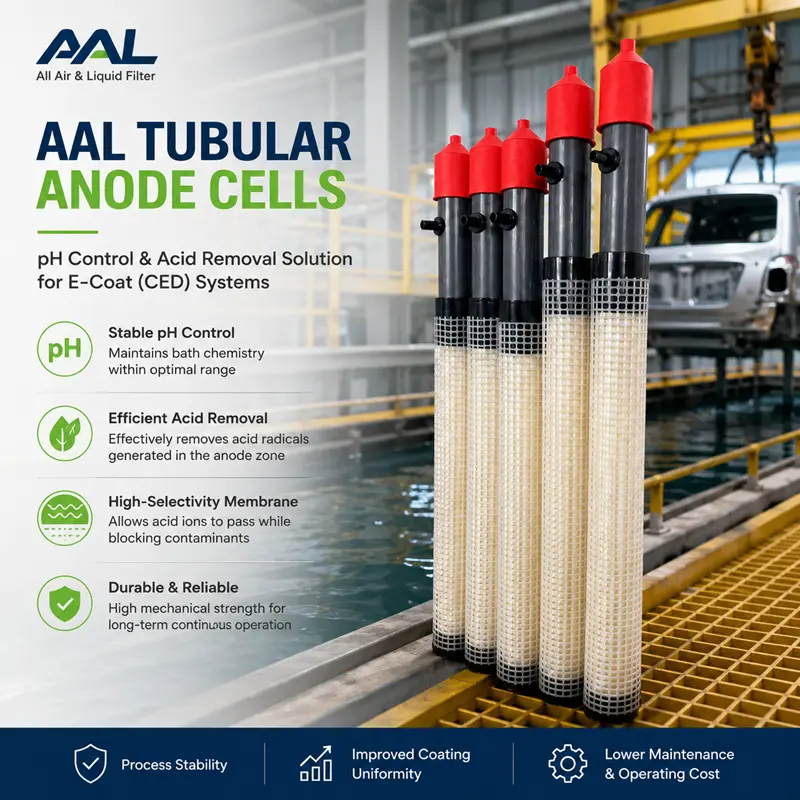
AAL Tubular Anode Cells for E-Coat CED Systems | pH Control & Acid Removal Unit
- High-Selectivity Anion Exchange Membrane
- Low Membrane Surface Resistance
- High Ion Exchange Capacity
- High Mechanical Strength & Current Resistance
- Precise pH Control Capability
- Reduced Maintenance & Extended Service Life
During the cathodic electrocoating (CED) process, organic acids such as acetate and formate ions are continuously generated in the anode compartment. If these acidic by-products are not effectively removed, they will migrate back into the main coating bath, leading to a drop in pH value and causing serious process instability, including reduced throwing power, uneven film thickness, and inconsistent coating quality.
AAL Tubular Anode Cells are engineered with high-performance anion-exchange membrane technology and serve as essential anode units in cathodic electrocoating systems. Beyond establishing a stable electrical circuit, they selectively transfer and remove acid radicals generated during electrodeposition.
Through continuous anolyte circulation and controlled overflow discharge, the system effectively eliminates excess acid accumulation, maintaining bath chemistry within the optimal operating range. This ensures stable deposition behavior, uniform coating thickness, and long-term process reliability.
AAL Tubular Anode Cells are widely used in industrial cathodic electrocoating production lines and play a critical role in maintaining stable and efficient coating operations.
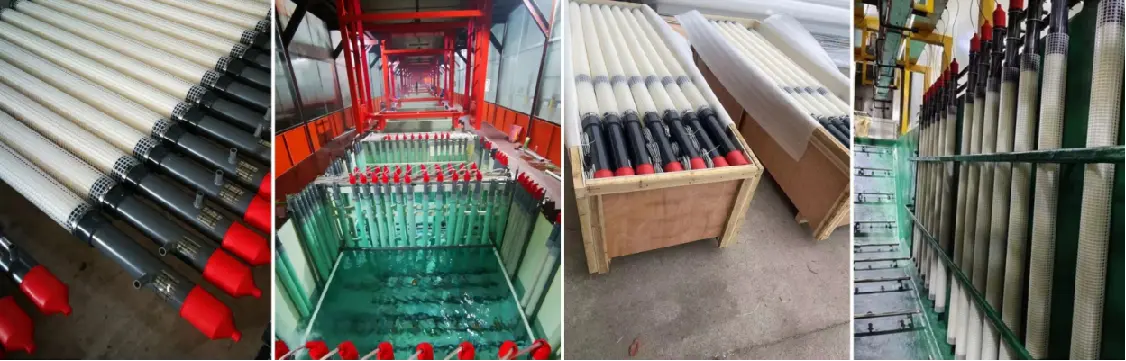
Key Features
1. High-Selectivity Anion Exchange Membrane
Equipped with a high-strength anion-exchange membrane that allows selective migration of acid radicals while preventing resin particles and macromolecular contaminants from entering the anode chamber, ensuring zero cross-contamination risk.
2. Low Membrane Surface Resistance
Membrane surface resistance < 200 Ω·cm² ensures efficient current transfer and stable electric field distribution, improving throwing power and coating uniformity.
3. High Ion Exchange Capacity
Ion exchange capacity > 1.8 mol/kg provides strong and continuous acid removal capability, supporting stable long-term operation in demanding industrial environments.
4. High Mechanical Strength & Current Resistance
The membrane structure offers excellent mechanical durability and resistance to current density fluctuations, making it suitable for continuous high-load industrial operation.
5. Precise pH Control Capability
Combined with anolyte circulation and conductivity monitoring systems, it ensures stable bath chemistry and prevents coating defects such as pinholes, poor adhesion, and rework issues caused by pH fluctuation.
6. Reduced Maintenance & Extended Service Life
Effectively suppresses acid buildup, salt crystallization, and membrane fouling, significantly reducing maintenance frequency and extending service life.
Selection Table
AAL Tubular Anode Cells | |
Item | Specification |
Membrane Type | Anion-Exchange |
Anode Material | SUS304 / SUS316L |
Ion Exchange Capacity | > 1.8 mol/kg |
Water Pressure Differential Diffusion Coefficient | < 0.05 mL/(cm²·h·MPa) |
Water Concentration Differential Diffusion Coefficient | < 0.02 mL/(cm²·h·mol/L) |
Membrane Surface Resistance | < 200 Ω·cm² |
Selectivity | > 89% |
Ion Exchange Area | 0.21 m²/m |
Effective Anode Area | 0.15 m²/m |
Note:Custom design is available according to tank size and project requirements. | |
Typical Applications
AAL Tubular Anode Cells are widely used in cathodic electrocoating systems across multiple industries:
· Automotive body & component e-coating (CED) lines
· Construction and agricultural machinery coating systems
· Home appliance metal housing coating (refrigerators, washing machines, HVAC units)
· Rail transit component corrosion protection systems
· Structural steel anti-corrosion coating applications
· New energy vehicle components and battery tray coating systems
FAQ (Frequently Asked Questions)
Q1: What is the main function of tubular anode cells in electrocoating systems?
They remove acid radicals generated in the anode area while maintaining stable electrical conductivity and bath pH balance in cathodic electrocoating systems.
Q2: How do AAL Tubular Anode Cells prevent bath contamination?
The selective anion-exchange membrane allows only acid ions to pass while blocking resin particles and high-molecular compounds, preventing cross-contamination.
Q3: Are these anode cells suitable for continuous production lines?
Yes, they are designed for continuous industrial operation with high mechanical strength and stable electrochemical performance.
Q4: What factors affect membrane lifespan?
Operating current density, bath chemistry stability, cleaning frequency, and process load conditions.
Q5: Can the system be customized?
Yes, AAL Filter provides customized configurations based on tank design, current requirements, and process flow conditions.
Partner with AAL Filter for Advanced Electrocoating Process Stability Solutions
AAL Filter specializes in high-performance industrial filtration and electrocoating system solutions, widely serving semiconductor manufacturing, electronic chemicals, ultra-pure water systems, and corrosive chemical processing industries.
The AAL Tubular Anode Cells are engineered to enhance bath stability, improve coating uniformity, and significantly increase long-term reliability of cathodic electrocoating production lines.
Whether you require technical datasheets, system design consultation, material compatibility guidance, or customized anode solutions, our engineering team is ready to support your application.
Contact AAL Filter today to request pricing, technical support, or customized electrocoating solutions tailored to your production needs.