
Hydrophilic vs Hydrophobic PTFE Pleated Membranes: A Complete Guide
Introduction
PTFE pleated membranes have become a cornerstone in industrial filtration due to their chemical resistance, durability, and high filtration efficiency. These membranes come in two main types: hydrophilic and hydrophobic, each designed for specific filtration applications. Understanding their differences, applications, and proper handling is crucial for industries ranging from water treatment to pharmaceuticals and chemical processing.
This guide will provide a detailed comparison of hydrophilic and hydrophobic PTFE pleated membranes, covering product features, key applications, similarities, differences, and best practices for use and storage.
What Are PTFE Pleated Membranes?
PTFE, or polytetrafluoroethylene, is a high-performance polymer known for its exceptional chemical stability, heat resistance, and corrosion resistance. Pleated membranes maximize the surface area, which improves filtration efficiency, flow capacity, and dirt-holding capability.
Key advantages of PTFE pleated membranes include:
High chemical and thermal resistance
Long service life and low maintenance
Precise filtration down to micron or submicron levels
Flexibility to filter both liquids and gases, depending on type
These qualities make PTFE pleated membranes highly versatile and widely used in industrial filtration.
Hydrophilic PTFE Pleated Membranes
Product Features
Surface is naturally hydrophilic, easily wetted by water
Excellent chemical compatibility with acids, bases, and solvents
High filtration precision, capable of filtering submicron particles
Stable performance under moderate pressure and temperature conditions
Applications
Hydrophilic PTFE membranes are primarily used for liquid filtration. Common industries include:
Water Treatment: Purification, ultrafiltration, RO pretreatment
Pharmaceutical & Biotechnology: Sterile filtration, clarification, and particle removal
Food & Beverage: Filtration of beverages, dairy, and liquid ingredients
Microelectronics & Semiconductor: Ultrapure water filtration to protect sensitive equipment
Typical Use Cases
Clarifying liquids to remove particulates
End-point filtration to protect downstream equipment
Ensuring sterile conditions in biotech and pharma processes
Hydrophobic PTFE Pleated Membranes
Product Features
Surface is hydrophobic, repelling water and resisting wetting
Ideal for gas and air filtration applications
High thermal and chemical resistance
Can act as a microbial barrier for air and gas streams
Applications
Hydrophobic PTFE membranes are mainly used in gas filtration and venting. Common industries include:
Compressed Air & Industrial Gases: Filtration of moisture and contaminants
HVAC & Cleanroom Ventilation: Particle and microbial control
Chemical & Petrochemical: Venting, gas filtration, and safety systems
Typical Use Cases
Sterile vent filters for liquid containers
Gas filtration in chemical processes
Microbial barrier filtration for compressed air or ventilation systems
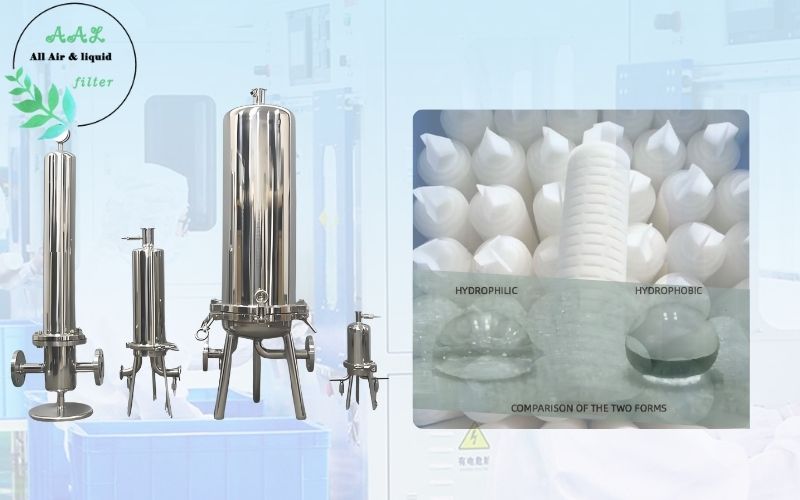
Hydrophilic vs Hydrophobic PTFE Membranes: Comparison
Feature | Hydrophilic PTFE | Hydrophobic PTFE |
Surface Property | Water-attracting (wets easily) | Water-repelling (resists wetting) |
Filtration Medium | Liquids | Gases |
Common Applications | Water, pharmaceuticals, food | Air, gases, venting, HVAC |
Chemical & Thermal Resistance | High | High |
Microbial Barrier | Optional (depends on pore size) | Excellent |
Relationship:
Both types share the same PTFE base material and pleated structure, providing high chemical stability and filtration efficiency. In some cases, hydrophobic PTFE membranes can be surface-treated to become hydrophilic, expanding their application range.
Usage and Maintenance Tips
Installation
Ensure pleats are correctly aligned to maintain full filtration area
Avoid excessive pressure beyond design limits
Check chemical compatibility with the filtered medium
Cleaning & Reuse
Hydrophilic membranes can be wet-cleaned if compatible with the liquid
Hydrophobic membranes are generally used for single-use gas applications, though some can be back-flushed with compatible solvents
Storage
Store in a cool, dry, and clean environment
Keep membranes sealed to prevent contamination
Avoid exposure to direct sunlight or high humidity
Conclusion and Selection Guide
Understanding the difference between hydrophilic and hydrophobic PTFE pleated membranes is crucial for selecting the right filtration solution:
Liquid Filtration → Hydrophilic PTFE
Gas Filtration → Hydrophobic PTFE
Both types offer high chemical resistance, long service life, and precise filtration. Choosing the correct membrane ensures optimal performance, extended equipment life, and compliance with industrial standards.
Investing in the right PTFE pleated membrane tailored to your application will improve efficiency, reduce downtime, and ensure consistent filtration quality.