
Mechanical Filtration vs Reverse Osmosis: Which Water Treatment System is Right for You
Mechanical Filtration vs Reverse Osmosis
In industrial water treatment, two key technologies stand out: mechanical filtration and reverse osmosis (RO). Though both are used to remove impurities from water, they work in different ways and serve distinct purposes. Understanding these differences can help industries select the most suitable system for their needs—whether it's pre-treatment, high-purity process water, or wastewater reuse.
What is the Main Difference Between Mechanical Filtration and Reverse Osmosis?
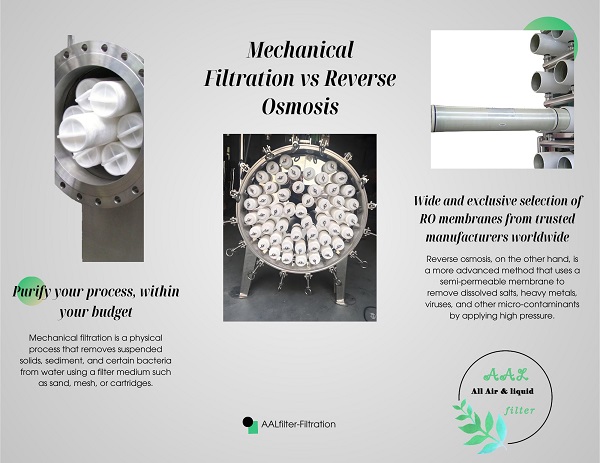
Mechanical filtration is a physical process that removes suspended solids, sediment, and certain bacteria from water using a filter medium such as sand, mesh, or cartridges.
Reverse osmosis, on the other hand, is a more advanced method that uses a semi-permeable membrane to remove dissolved salts, heavy metals, viruses, and other micro-contaminants by applying high pressure.
What is Mechanical Filtration?
Definition
Mechanical filtration involves passing water through a medium that blocks particles larger than its pore size. It is often used as a pre-treatment step to protect downstream equipment like RO membranes or boilers.
How It Works
Water flows through a filter media.
Particles are trapped on or within the filter.
Clean water passes through.
Common Types of Mechanical Filtration Systems
Surface filters (e.g., Y strainers, basket strainers, pleat filter cartridge)
Depth filters (e.g., multimedia, melt blown, string wound cartridge)
Bag filters (pp/nylon/ss liquid filter bags)
Activated carbon filters (adsorb chlorine, organics, odors)
Microfiltration (MF): 0.1–10 µm pore size
Ultrafiltration (UF): 0.01–0.1 µm pore size
Note: This article focuses on mechanical filtration methods that primarily remove suspended particles. Technologies like NF and RO, which target dissolved substances, are outside this category.
Limitations
Cannot remove dissolved salts or metals
Not suitable for high-purity water needs
What is Reverse Osmosis (RO)?
Definition
Reverse osmosis uses high-pressure pumps to force water through a semi-permeable membrane with 0.0001-micron pores. It removes almost all dissolved impurities and produces ultra-pure water.
How RO Works
High-pressure pump pushes water through RO membrane
Pure water (permeate) passes through
Contaminants (concentrate) are flushed away
What RO Removes
Dissolved salts
Heavy metals
Bacteria and viruses
Nitrates, sulfates, fluoride
Seawater desalination
Boiler feed water
Industrial wastewater reuse
Electronics, pharmaceuticals, food & beverage
Mechanical Filtration vs Reverse Osmosis: Side-by-Side Comparison
Feature | Mechanical Filtration | Reverse Osmosis |
Separation Method | Mechanical barrier | Semi-permeable membrane |
Removal Range | Suspended solids, turbidity | Dissolved salts, bacteria, viruses |
Pore Size | ≥1 micron | ≤0.0001 micron |
Operating Pressure | Low | High (4–30 bar) |
Use Case | Pretreatment | High-purity water |
Cost | Lower | Higher |
Maintenance | Easy | Requires monitoring & pre-treatment |
Industrial Applications of Mechanical Filtration
Y/Basket Strainers
Remove large debris from pipelines; simple maintenance.
Self-Cleaning Filters
Ideal for high-contaminant systems; no downtime for cleaning.
Bag Filter Systems
Cost-effective for batch processing and intermittent flow.
Multimedia Filters
Layered media removes turbidity and suspended solids.
Activated Carbon (with pre-filtration)
Used to remove chlorine, organics, and taste/odor compounds.
Cartridge Filters
Protect RO systems by capturing fine particles.
Reverse Osmosis in Industrial Use
Seawater Desalination
Converts seawater (35,000 mg/L TDS) into drinkable or process water.
Brackish Water Treatment
Reduces TDS in water containing 1,000–15,000 mg/L salts.
Boiler Feed Water
Removes hardness and minerals to prevent scaling and corrosion.
Pharmaceutical Water
Produces ultra-pure water meeting GMP standards.
Food & Beverage
Ensures taste uniformity and safety in production.
Electronics & Semiconductor
Produces 18 MΩ·cm resistivity ultra-pure water.
Wastewater Reuse
Final polishing step to reclaim and recycle process water.
Expert Tip
Most RO systems require mechanical pre-filtration to prevent membrane fouling and extend service life. Combining both technologies often delivers the best result.
❓ Frequently Asked Questions (FAQ)
Q1: Can RO replace mechanical filtration systems?
✅ No. Mechanical filtration is needed to protect RO membranes from clogging.
Q2: How long does an RO membrane last?
✅ Typically 2–5 years, depending on feedwater and pre-treatment.
Q3: Is mechanical filtration enough for industrial water treatment?
✅ Only for low-purity or pretreatment. High-purity applications require RO.
Q4: What contaminants does RO remove that mechanical filtration can't?
✅ Dissolved salts, fluoride, heavy metals, and viruses.
Final Thoughts: Which System is Right for You?
Use mechanical filtration systems for basic purification, pretreatment, or when dealing with high-sediment water.
Choose reverse osmosis when high-purity, low-TDS water is essential, such as in pharma, electronics, or desalination.
✅ Most industrial systems benefit from a combination of mechanical filtration and RO for cost-effective, long-lasting results.
Need Help Selecting a System?
We specialize in designing and supplying industrial mechanical filtration and reverse osmosis systems tailored to your application.
Contact us water treatment experts today to discuss your specific water quality goals and get a customized solution.