
4 Major Water Treatment Industries: Municipal, Industrial, Desalination & Rural
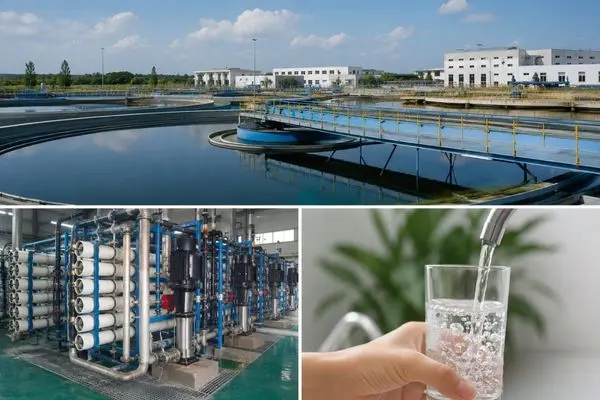
Introduction: How Does the Water We Use Every Day Become Clean and Safe?
Every morning, when we turn on the tap and fill a glass of clear drinking water, or open a bottle of purified beverage, few people think about the journey that water has taken before reaching us.
A single drop of water may have gone through dozens or even hundreds of treatment processes before it becomes suitable for human use.
Although water covers around 71% of the Earth's surface, approximately 97% of it is seawater, which cannot be directly used. Most of the remaining freshwater is locked away in glaciers and polar ice caps. The amount of easily accessible freshwater available for human activities is actually extremely limited.
More importantly, different applications require completely different water qualities:
· Drinking water must be safe and free from harmful contaminants.
· Food and beverage production requires strict hygiene standards.
· Semiconductor manufacturing needs ultra-pure water with almost no impurities.
· Power plants require treated water to prevent scaling and corrosion.
· Industrial processes need stable and reliable water quality.
Therefore, water treatment is not simply about making dirty water clean. It is a comprehensive technology system that involves:
· Purification;
· Separation;
· Water recycling;
· Resource recovery.
If water is the “lifeblood” of our planet, then water treatment systems are the invisible guardians that protect modern civilization.
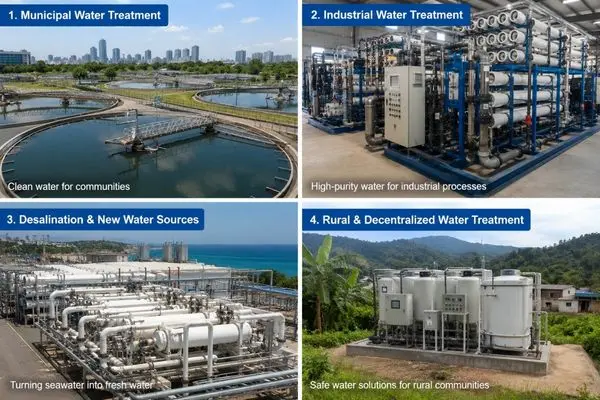
Today, let's explore the four major fields of water treatment.
Part 1: Municipal and Public Water Treatment — The Circulatory System of Cities
If a city is compared to a living organism, its water system functions like a circulatory system, while water treatment facilities act as the city's “kidneys” and “cleaning specialists.”
Every day, municipal water systems process millions of tons of water to provide safe drinking water and treat wastewater generated by households and communities.
1. Municipal Water Supply: How Does Tap Water Become Safe?
The tap water we drink does not come naturally clean. Before reaching our homes, it must go through multiple treatment stages.
A typical drinking water treatment process can be summarized as:
Coagulation & Sedimentation → Filtration → Disinfection
① Sedimentation: Removing Large Particles
Raw water usually comes from rivers, lakes, reservoirs, or groundwater sources. It may contain:
· Sand;
· Suspended solids;
· Organic matter;
· Other impurities.
Water treatment plants add coagulants that help small particles combine into larger clusters called flocs. These heavier particles then settle at the bottom.
② Filtration: Removing Invisible Impurities
After sedimentation, water passes through filtration systems such as:
· Sand filters;
· Activated carbon filters;
· Advanced filtration systems.
These processes remove fine particles, organic compounds, odors, and other contaminants.
It is like giving water a detailed cleaning process.
③ Disinfection: Adding a Protective Shield
The final step is disinfection using:
· Chlorine;
· Ozone;
· Ultraviolet (UV) technology.
Many people dislike the chlorine smell in tap water, but a small amount of residual chlorine plays an important role in preventing bacterial growth during transportation through long pipelines.
It acts like a protective guard for water after it leaves the treatment plant.
2. Municipal Wastewater Treatment: Microorganisms as Natural Cleaners
Every day, households generate large amounts of wastewater containing organic pollutants.
If discharged directly into rivers and lakes, wastewater can consume dissolved oxygen and damage aquatic ecosystems.
Wastewater treatment plants rely on a group of tiny but powerful workers:
Microorganisms
Through the activated sludge process:
· Wastewater enters aeration tanks;
· Microorganisms multiply;
· They consume organic pollutants;
· The water gradually becomes cleaner.
In simple terms, wastewater treatment uses nature's own biological processes to remove pollution.
3. Sludge Treatment: Where Does the Waste Go After Water Becomes Clean?
Many people do not realize that:
Treating wastewater does not eliminate all pollutants.
Instead, many pollutants are transferred into sludge.
Therefore, sludge requires further treatment, including:
· Dewatering: Reducing moisture content for easier transportation;
· Anaerobic digestion: Producing biogas energy;
· Resource recovery: Converting sludge into useful materials;
· Incineration: Generating energy.
Modern wastewater treatment is no longer only about pollution control — it is becoming a way to recover valuable resources.
Part 2: Industrial Water Treatment — Customized Water Solutions for Extreme Requirements
If municipal water treatment focuses on safety, industrial water treatment focuses on precision.
Different industries require completely different water qualities.
Industrial water treatment is like a highly customized manufacturing workshop designed specifically for water.
1. Semiconductor Industry: Ultra-Pure Water Beyond Purification
Producing a semiconductor chip requires hundreds or even thousands of manufacturing steps.
During wafer cleaning, manufacturers use ultra-pure water.
Why?
Because semiconductor circuits are extremely tiny. Even trace amounts of:
· Metal ions;
· Particles;
· Organic contaminants;
can damage chips and reduce production yield.
Ultra-pure water requires:
· Extremely low conductivity;
· Minimal ion concentration;
· Very low particle levels;
· Low organic contamination.
It is almost pure H₂O molecules only.
Semiconductor facilities typically use advanced systems including:
· Reverse Osmosis (RO);
· Electrodeionization (EDI);
· Ultrafiltration (UF);
· Precision filtration.
2. Power Generation and Petrochemical Industries: Preventing Scale Problems
Why can't power plants use ordinary water for boilers?
Because natural water contains minerals such as:
· Calcium ions;
· Magnesium ions;
· Dissolved salts.
When heated, these minerals form scale deposits.
Just like the white buildup inside a household kettle, industrial scale can:
· Reduce heat transfer efficiency;
· Increase energy consumption;
· Damage equipment.
Therefore, industries use:
· Water softening;
· Demineralization;
· Reverse osmosis systems;
to produce high-quality process water.
3. Pharmaceutical and Food Industries: Water Quality at the Highest Level
For pharmaceutical, food, and beverage industries, water is not only a processing medium — it is often a critical raw material.
For example, pharmaceutical-grade water must control:
· Microorganisms;
· Endotoxins;
· Pyrogens.
Even dead microorganisms can leave behind substances that affect product safety.
Therefore, these industries rely on:
· Multi-stage filtration;
· Reverse osmosis;
· Ultrafiltration;
· Sterilization systems.
to ensure every drop meets strict quality requirements.
4. Zero Liquid Discharge (ZLD): Making Industrial Wastewater Disappear
Traditional wastewater treatment focuses on:
Meeting discharge standards.
Modern industries are moving toward:
Zero Liquid Discharge (ZLD).
ZLD systems use:
· Membrane concentration;
· Evaporation;
· Crystallization;
to recover water while converting dissolved salts into solid waste.
The result:
· More water recycling;
· Less environmental impact;
· Potential resource recovery.
Part 3: Desalination and Alternative Water Sources — Turning Seawater into Freshwater
As global water demand continues to rise, humans are searching for new water resources.
One of the most important technologies is:
Seawater Desalination
1. Reverse Osmosis: A Super-Fine Filter for the Ocean
Reverse osmosis (RO) is one of the world's most widely used desalination technologies.
The principle is simple:
A special membrane allows water molecules to pass through while blocking salts and contaminants.
Under high pressure:
· Water molecules pass through the RO membrane;
· Salt ions and impurities are rejected.
The result:
· Fresh water is produced;
· Concentrated seawater is discharged.
Today, RO desalination is widely used for:
· Coastal city water supply;
· Industrial water production;
· Island communities.
2. Rainwater Harvesting and Sponge Cities: Making Cities Absorb Water Again
Rapid urban development has replaced natural surfaces with:
· Roads;
· Buildings;
· Concrete structures.
As a result, rainwater runs off quickly, causing water shortages and flooding.
The concept of “sponge cities” aims to make urban areas behave like natural systems:
· Absorb rainwater;
· Store and treat it;
· Reuse it when needed.
Recovered rainwater can be used for:
· Landscape irrigation;
· Toilet flushing;
· Industrial applications;
· Urban ecological projects.
Part 4: Rural and Decentralized Water Treatment — The Microcirculation of Water Resources
Large cities have centralized water plants and underground pipelines.
However, many rural and remote areas cannot afford complex infrastructure.
This is where decentralized water treatment becomes essential.
1. Decentralized Wastewater Treatment: Small but Effective Solutions
Rural wastewater usually has:
· Low flow rates;
· Dispersed locations;
· High pipeline construction costs.
Therefore, flexible treatment solutions are developed.
Constructed Wetlands
These systems use:
· Plants;
· Soil;
· Microorganisms;
to naturally remove pollutants.
Integrated Wastewater Treatment Units
These compact systems combine multiple treatment processes into one unit:
· Wastewater enters;
· Treatment occurs automatically;
· Clean water is discharged safely.
They are ideal for:
· Rural villages;
· Tourist areas;
· Remote communities.
2. Rural Drinking Water Safety: Bringing Clean Water to Everyone
For remote areas, small-scale water purification systems play an important role.
Through:
· Filtration;
· Disinfection;
· Membrane treatment;
these systems remove:
· Suspended solids;
· Bacteria;
· Odors;
· Harmful substances.
They help ensure safe drinking water even in areas without large-scale infrastructure.
Conclusion: Water Treatment — The Invisible Foundation of Modern Civilization
From the moment a person turns on a tap, to the production of advanced semiconductor chips; from transforming seawater into freshwater, to recycling industrial wastewater:
Water treatment quietly supports the development of modern society.
In the future, water treatment will continue evolving in three major directions:
1. Smart Water Management
Using:
· Artificial intelligence;
· Sensors;
· Data analytics;
to achieve smarter water monitoring and management.
2. Lower-Energy Membrane Technologies
Future filtration membranes will become:
· More efficient;
· Less energy-intensive;
· More environmentally friendly.
3. Resource Recovery from Wastewater
Wastewater will no longer be considered only waste.
Instead, it can become a valuable source of:
· Energy;
· Nutrients;
· Recoverable materials.
Water treatment is evolving from pollution control into a complete resource recycling system.
The next time you drink a glass of water, remember:
It is not just water — it is the result of countless technologies, engineering innovations, and human efforts working together to protect one of Earth's most precious resources.