
Data Center Cooling Water Filtration: Key Applications and System Requirements
1. Introduction
The rapid growth of AI computing, cloud services, and high-density data centers is increasing the demand for reliable cooling infrastructure. As cooling systems become more complex, maintaining water quality is essential for protecting heat exchangers, pumps, valves, and other critical equipment.
Particles such as sediment, corrosion products, and installation debris can contribute to fouling, blockages, and increased maintenance requirements. Appropriate filtration helps control these contaminants and supports the stable operation of data center cooling systems.
However, filtration requirements vary depending on the water source, cooling system design, and operating conditions. This article explores the key applications of data center cooling water filtration, explains the filtration requirements at different stages, and outlines the factors that influence filtration system selection.
2. Where Is Filtration Needed in Data Center Cooling Systems?
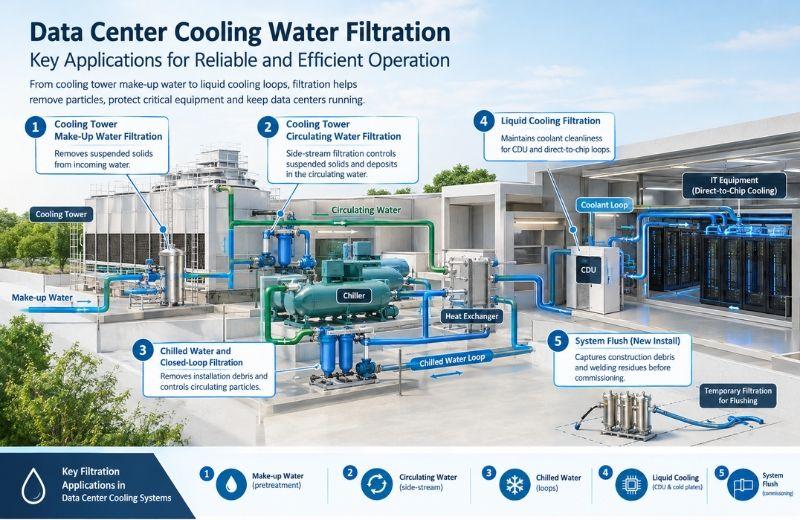
Filtration can be required at several points in a data center's water infrastructure. The main applications include cooling tower make-up water, circulating cooling water, chilled water loops, system flushing, and liquid cooling infrastructure.
2.1 Cooling Tower Make-Up Water
Cooling towers lose water through evaporation, drift, and blowdown. Make-up water is added to compensate for these losses and maintain the required operating level.
Depending on the water source, make-up water may contain suspended solids, sand, silt, rust, and other particulate contaminants. If these particles enter the cooling system, they may accumulate in the basin, contribute to deposits, or increase the solids load on downstream treatment equipment.
Filtration can help reduce suspended particles before make-up water enters the cooling tower system or subsequent treatment stages. The appropriate configuration depends on whether the source is municipal water, groundwater, reclaimed water, or another supply.
For systems using reclaimed or other variable-quality water, filtration may form part of a broader treatment process that includes additional technologies selected according to the water analysis and operating requirements.
Key consideration: Make-up water filtration should be designed around the source water quality and the requirements of downstream treatment. Particle filtration does not remove dissolved salts or replace necessary chemical treatment.
2.2 Cooling Tower Circulating Water
Cooling tower circulating water is exposed to airborne dust and other environmental contaminants. As water evaporates, dissolved minerals become more concentrated, while suspended solids can accumulate or enter through the surrounding environment.
These conditions may contribute to sediment buildup, fouling, and reduced heat-transfer efficiency. Corrosion products and other particles generated within the system can add to the contaminant load.
One common approach is side-stream filtration, in which a portion of the circulating water is continuously diverted through a filtration unit and then returned to the system. Rather than filtering the entire circulation flow, side-stream filtration focuses on gradually reducing suspended solids in the water.
The required side-stream flow and filtration performance depend on factors such as cooling tower capacity, solids loading, water quality, and operating conditions.
Filtration is only one part of cooling tower water management. It does not remove dissolved minerals and should not be considered a replacement for blowdown control, scale and corrosion management, or appropriate water treatment chemicals.
Key consideration: Evaluate the suspended-solids load, side-stream flow rate, required particle removal, and maintenance requirements when designing a cooling tower filtration system.
2.3 Chilled Water and Closed-Loop Systems
Chilled water systems circulate water between chillers, pumps, and heat exchangers to support data center cooling. Unlike open cooling tower systems, closed-loop systems are generally less exposed to continuous contamination from the external environment.
Nevertheless, particles can enter during installation, maintenance, equipment replacement, or system repairs. Welding debris, rust, scale, and construction residues may remain in the pipework if flushing and cleaning are inadequate.
During initial commissioning, temporary filtration may be used to capture debris released during system flushing. Once the system is operating, strainers, separators, or other filtration devices may help control particles generated by corrosion or introduced during maintenance.
The filtration strategy should distinguish between two different objectives:
Initial flushing: Removing construction debris and contaminants before the system enters normal operation.
Ongoing particle control: Managing particles that may accumulate or be generated during long-term operation.
The equipment selected for initial flushing may not be the same as the equipment required for continuous operation. Temporary flushing arrangements should also be checked for adequate flow capacity, pressure drop, and solids-holding capacity.
Key consideration: Follow the cooling system designer's and equipment manufacturer's commissioning requirements. Filtration should support the specified cleanliness target rather than rely on a generic micron rating.
2.4 Liquid Cooling Systems for AI Data Centers
AI servers and other high-density computing equipment are increasingly using liquid cooling to manage heat loads that are difficult to address with air cooling alone.
In direct-to-chip cooling, coolant circulates through cold plates attached to heat-generating components. A Coolant Distribution Unit (CDU) typically manages coolant circulation and heat transfer between the technology cooling loop and the facility cooling system.
Filtration requirements depend on the architecture. The facility water loop and the technology cooling loop may have different coolant compositions, cleanliness requirements, and equipment constraints.
Particles in a liquid cooling circuit can potentially obstruct narrow flow passages, affect valves and pumps, or contribute to fouling of heat-transfer surfaces. However, the acceptable particle size and filtration configuration must be determined according to the cooling equipment design and coolant specifications.
A filtration solution suitable for a conventional cooling water loop should not automatically be considered suitable for a direct-to-chip cooling circuit. Coolant compatibility, seal materials, pressure drop, flow requirements, and maintenance procedures all need to be verified.
Some systems may also include filtration during filling, flushing, or maintenance before the cooling loop is placed back into service.
Key consideration: Confirm the required cleanliness level and filtration arrangement with the CDU, cold-plate, and coolant suppliers before selecting filtration equipment.
3. How Do Filtration Requirements Differ Across These Applications?
Although all these applications involve water or liquid filtration, their objectives and operating conditions are different. Understanding these differences helps engineers identify the appropriate filtration location and configuration.
Application | Main filtration objective | Key consideration |
Cooling tower make-up water | Reduce incoming suspended solids | Source water quality and pretreatment requirements |
Cooling tower circulating water | Control suspended solids and reduce particulate buildup | Side-stream flow rate and solids loading |
Chilled water and closed loops | Remove installation debris and control circulating particles | Initial flushing versus continuous operation |
Liquid cooling loops | Maintain coolant cleanliness and protect sensitive equipment | Coolant compatibility and manufacturer requirements |
The table provides a general overview rather than a universal design specification. Actual filtration requirements depend on system design, water quality, operating conditions, and the cleanliness targets established for the equipment.
For example, a cooling tower supplied with relatively clean municipal water may require a different approach from a system using reclaimed water. Similarly, temporary filtration during commissioning has different operating priorities from a permanently installed filtration unit.
Identifying the contamination source and the purpose of filtration should therefore come before selecting a filter type.
4. Selecting a Suitable Filtration Approach
Once the application and filtration objective have been established, several technical factors should be evaluated.
4.1 Flow Rate and System Configuration
The required flow rate depends on where filtration is installed and how the system operates.
A make-up water line, a cooling tower side-stream loop, and a temporary flushing circuit may have very different flow requirements. The filtration unit should be sized for the actual design flow, allowable pressure drop, and expected operating conditions.
For side-stream applications, the required filtration flow is only part of the calculation. The system designer must also consider how quickly suspended solids need to be reduced and how contaminants enter the circulating water.
4.2 Particle Size and Contaminant Loading
Filtration performance should match the contaminants that need to be removed.
Large particles such as sand, rust flakes, and construction debris may require a different filtration approach from fine suspended solids. A finer filtration rating is not automatically better: it may increase pressure drop, shorten service intervals, or require more frequent maintenance if the contaminant load is high.
Water analysis, particle characteristics, and equipment protection requirements should guide the selection of filtration efficiency.
4.3 Pressure Drop and Maintenance
Pressure drop affects pump energy consumption and overall system performance. As particles accumulate in a filter, the pressure drop typically increases, indicating that cleaning or replacement may be necessary.
Maintenance access is particularly important in data centers, where cooling infrastructure must support reliable operation. Filter changeout procedures, isolation arrangements, spare-part availability, and the consequences of maintenance downtime should all be considered during system design.
The expected solids load is also important because it affects service life and maintenance frequency.
4.4 Water Chemistry and Material Compatibility
Filtration equipment must be compatible with the operating environment.
Relevant factors include water temperature, operating pressure, chemical additives, corrosion potential, and the materials in contact with the fluid. For liquid cooling systems, the coolant may have different chemical and material compatibility requirements from conventional water-based cooling systems.
The housing, filter media, seals, and other wetted components should be checked against the actual fluid and operating conditions. Manufacturer requirements should take priority where specific equipment or coolant specifications apply.
4.5 Choosing Between Different Filtration Technologies
There is no single filter type suitable for every data center cooling application. The most appropriate solution depends on the required flow rate, contaminant characteristics, available installation space, maintenance strategy, and system design.
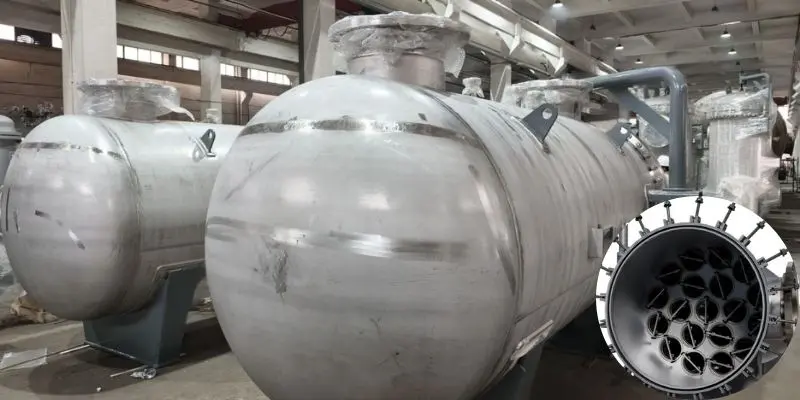
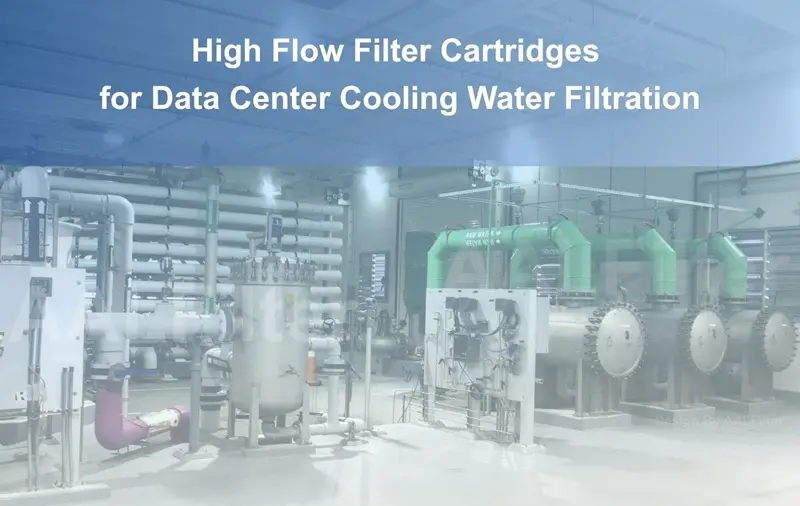
For selected water treatment and circulating water applications, bag filtration may be considered where the required particle removal and solids-holding characteristics are suitable. High-flow cartridge filtration may be worth evaluating in high-capacity applications where flow requirements and installation constraints favor this configuration.
Neither approach should be selected based on flow rate alone. Required filtration efficiency, pressure drop, contaminant loading, material compatibility, and operating costs must also be evaluated.
For applications with different or more demanding requirements, other technologies—such as strainers, centrifugal separators, automatic self-cleaning filters, or specialized coolant filtration systems—may be more appropriate.
The goal is to select a filtration solution that meets the actual system requirements, rather than to apply the same technology across every water circuit.
5. Conclusion
Data center cooling water filtration supports the reliability and cleanliness of several important systems, from cooling tower make-up water and circulating water to chilled water loops, commissioning operations, and liquid cooling infrastructure.
Each application has its own contamination sources and operating requirements. Effective filtration begins by identifying where particles enter or accumulate, determining what needs to be removed, and establishing the required flow rate and cleanliness level.
By evaluating water quality, system configuration, pressure drop, maintenance requirements, and material compatibility, data center operators and system designers can develop filtration strategies suited to their specific cooling infrastructure.
As data centers continue to adopt higher-density computing and advanced liquid cooling technologies, application-specific filtration design will remain an important part of reliable cooling system operation.