
High Flow Filter Housing Selection Guide: How to Choose the Right Housing for Industrial Filtration
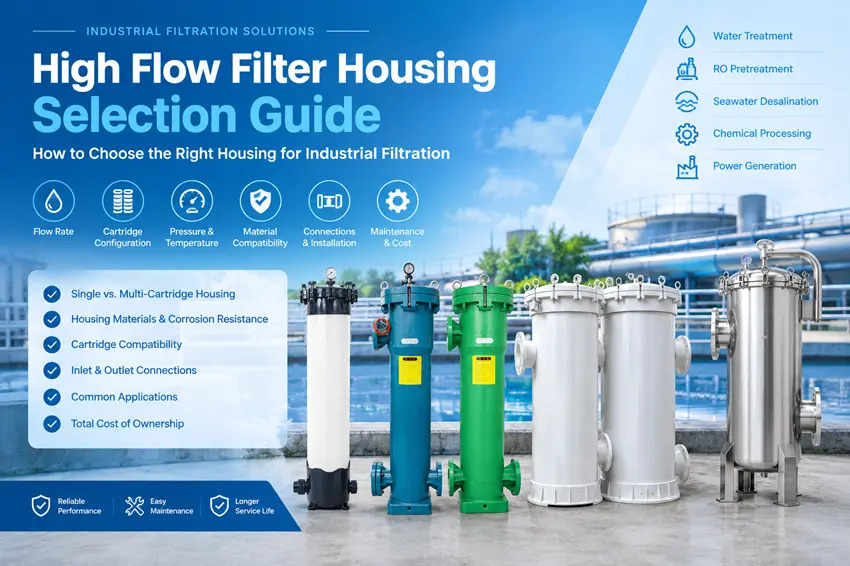
As industrial water treatment, reverse osmosis (RO) pretreatment, seawater desalination, power generation, and other liquid filtration applications demand higher processing capacities, high flow filtration systems have become an important option for many industrial facilities.
A High Flow Filter Housing is more than an enclosure for filter cartridges. Its configuration, pressure rating, material, connection design, and cartridge compatibility all influence filtration system performance, operational reliability, and maintenance efficiency.
However, selecting the right high flow filter housing involves more than matching the pipeline size or choosing the number of cartridges. Engineers and procurement professionals must consider the required flow rate, operating pressure, filtration requirements, fluid compatibility, installation space, and maintenance needs.
How do you choose a suitable high flow cartridge filter housing for an industrial filtration system? What is the difference between single-cartridge and multi-cartridge housings? Which housing materials are suitable for different applications?
This guide explains the key factors to consider when selecting an industrial high flow filter housing, helping engineers, system integrators, and purchasing teams make informed decisions.
1. What Is a High Flow Filter Housing?
A High Flow Filter Housing is a filtration vessel designed to accommodate high flow filter cartridges for industrial liquid filtration applications.
Compared with conventional filtration systems that use numerous standard-sized cartridges, high flow filtration systems can process substantial liquid volumes using larger-capacity cartridges. Depending on the application and system design, this arrangement may reduce the number of cartridges required and simplify cartridge replacement and maintenance.
A typical high flow filter housing consists of a pressure-bearing vessel, cartridge mounting structures, sealing components, inlet and outlet connections, and other internal components required by its design.
The exact construction depends on the housing model, compatible cartridge type, material, and operating requirements.
When selecting a housing, the cartridge and housing should be evaluated as one filtration system. Even if a cartridge meets the required filtration rating, incompatible end connections, sealing structures, or differential-pressure limits can prevent the system from operating as intended.
2. Key Factors in High Flow Filter Housing Selection
2.1 System Flow Rate Requirements
Flow rate is one of the most important factors when selecting a high flow filter housing.
Before choosing a housing, determine the actual operating flow rate, design flow rate, and whether the system experiences significant flow fluctuations. For continuous industrial processes, also consider operating schedules, standby equipment, and filtration requirements during maintenance.
Importantly, the total system flow rate is not always the same as the design flow rate through an individual filter housing.
In systems using parallel filtration vessels, side-stream filtration, or other circulation arrangements, the required flow rate for each housing should be determined from the actual piping configuration.
Once the target flow rate is established, the required cartridge quantity and housing configuration can be evaluated.
However, a cartridge's rated or recommended flow rate should not be treated as a universal value for every application. Actual performance depends on cartridge specifications, filtration rating, fluid viscosity, contaminant loading, and allowable pressure drop.
For additional guidance, see our article: How to Size High Flow Filter Cartridges: A Practical Guide for Industrial Filtration Systems.
2.2 Number of Cartridges and Housing Configuration
High flow filter housings are available in different configurations to accommodate varying filtration capacities and system layouts.
Common arrangements include:
· Single-cartridge high flow filter housings
· Multi-cartridge high flow filter housings
· Multiple filter housings installed in parallel
A single-cartridge housing may be suitable for a filtration branch with a relatively modest flow requirement, limited installation space, or a dedicated filtration process.
Multi-cartridge housings accommodate several cartridges within one vessel and may be appropriate when a larger filtration capacity is required. For large industrial projects, the configuration should be evaluated against the required flow rate, pressure drop, piping layout, and cartridge maintenance requirements.
The objective should not simply be to minimize the number of cartridges. Each cartridge must operate within its intended performance range, and the system must accommodate pressure-drop increases as contaminants accumulate.
The final configuration should be based on the actual operating conditions and the technical specifications of the selected cartridges and housing.
2.3 Working Pressure and Differential Pressure
Pressure rating is a critical safety and performance consideration in high flow filter housing selection.
Three pressure-related terms should be distinguished:
· Design Pressure: The pressure condition used as the basis for the vessel's design.
· Maximum Working Pressure: The maximum operating pressure specified for the product, as defined in the manufacturer's technical documentation.
· Cartridge Differential Pressure Limit: The allowable pressure difference between the inlet and outlet sides of the filter cartridge.
These parameters are not interchangeable.
When selecting a housing, confirm that its pressure rating is suitable for the normal operating pressure and relevant pressure variations expected in the system. The filter cartridge's differential-pressure limit and the system's recommended cartridge replacement pressure should also be checked.
For pump discharge lines, circulation systems, or applications with potential pressure fluctuations, the design should account for the relevant operating conditions and applicable safety requirements.
Always refer to the housing manufacturer's technical documentation for the applicable pressure and temperature limits.
2.4 Housing Materials and Corrosion Resistance
The housing material affects corrosion resistance, mechanical strength, pressure capability, and service life. The appropriate material depends on the process fluid, operating temperature, pressure conditions, and application requirements.
AALFilter offers high flow filter housing solutions in multiple materials to address different industrial filtration needs.
Housing Material | Key Characteristics | Selection Considerations |
Mechanical strength and general corrosion resistance | Verify suitability for the process fluid, especially in chloride-containing environments | |
Improved corrosion resistance in many environments compared with 304 stainless steel | Evaluate fluid composition, chloride concentration, temperature, and operating conditions | |
Duplex Stainless Steel | High mechanical strength and enhanced resistance to certain forms of corrosion | Confirm the specific duplex grade and suitability for the intended environment |
Corrosion resistance and fiber-reinforced construction | Check rated pressure, temperature limits, resin compatibility, and process-fluid suitability | |
Chemical compatibility with many aqueous liquids | Verify operating pressure, temperature, and compatibility with the specific chemicals | |
Polypropylene-based material used in industrial liquid and chemical filtration | Confirm the product's pressure and temperature ratings and chemical compatibility | |
Chemical resistance for many demanding liquid filtration applications | Evaluate compatibility with the specific chemicals and operating conditions | |
Corrosion-resistant thermoplastic material for suitable liquid filtration applications | Check chemical compatibility, pressure rating, temperature limits, and connection requirements |
Material selection should not be based on the material name alone. Actual performance depends on the specific grade, product construction, process-fluid composition, operating temperature, and pressure.
For seawater desalination, high-salinity water, and chemical filtration applications, the material should be evaluated carefully against the actual process conditions.
For a more detailed comparison, read our guide:UPVC, FRP, PPH, PVDF, Stainless Steel & Carbon Steel – Complete Comparison of Filter Housing Materials
This article provides additional information to help compare common filter housing materials and evaluate their suitability for different industrial applications.
2.5 Filter Cartridge Compatibility and Internal Mounting Design
Cartridge compatibility is an important consideration that is sometimes overlooked during housing selection.
Different manufacturers may use different end-cap configurations, sealing arrangements, locking mechanisms, and internal mounting designs. Therefore, cartridges with similar lengths and outside diameters are not necessarily interchangeable.
Before selecting a housing, verify the following:
· Cartridge length and outside diameter
· End-cap and connection configuration
· O-ring quantity, position, and dimensions
· Cartridge locking and retention mechanism
· Required flow direction, where specified
· Available internal clearance and support structure
If a project uses cartridges from Pall, 3M, Parker, or another manufacturer, compatibility should be confirmed using the specific model's technical documentation.
Cartridge compatibility must be verified at the model level rather than assumed from brand names or visual similarity.
For further guidance, see our article: Pall / 3M / Parker High Flow Filter Cartridge Alternatives: A Practical Selection Guide.
2.6 Inlet and Outlet Connections and Piping Layout
Connection design affects installation, maintenance, and the integration of a high flow filter housing into an existing system.
Important considerations include:
· Inlet and outlet nominal sizes
· Flange standards and pressure ratings
· Flange-face types or other connection requirements
· Inlet and outlet orientation
· Piping support and installation clearance
· Drain, vent, and discharge connections, where required
The pipeline connection size alone does not determine the filtration capacity of a housing. Actual capacity also depends on the cartridge configuration, internal flow path, pressure drop, and operating conditions.
For retrofit projects, review the existing piping drawings, connection dimensions, and available installation space before placing an order. This can help reduce the risk of unexpected installation modifications.
3. Single-Cartridge vs. Multi-Cartridge High Flow Filter Housings
Single-cartridge and multi-cartridge housings serve different system requirements. Neither configuration is universally better for every application.
Comparison Factor | Single-Cartridge Housing | Multi-Cartridge Housing |
Cartridge configuration | Holds one high flow filter cartridge | Holds multiple high flow filter cartridges |
Filtration capacity | Depends on the selected cartridge and operating conditions | Can accommodate higher capacity through multiple cartridges, subject to system design |
Equipment footprint | Depends on the housing dimensions and piping layout | Requires evaluation of vessel dimensions and cartridge removal space |
Maintenance | Fewer cartridges to handle per housing | Requires management and replacement of multiple cartridges |
Initial investment | Depends on housing specifications and supporting equipment | Depends on vessel construction, cartridge quantity, and system configuration |
Typical selection approach | Suitable when one cartridge meets the required filtration duty | Suitable when a multi-cartridge configuration is needed to meet the required filtration duty |
When comparing these configurations, consider the required flow rate, allowable pressure drop, equipment layout, maintenance strategy, and total cost of ownership.
For high-capacity applications, a multi-cartridge housing may consolidate filtration equipment. However, whether it reduces the overall project cost depends on the housing design, piping configuration, cartridge requirements, and maintenance needs.
4. Common Applications of High Flow Filter Housings
High flow filter housings are used in industrial liquid filtration systems where particulate control is required and the selected housing and cartridge meet the relevant operating conditions.
4.1 Reverse Osmosis (RO) Pretreatment
In reverse osmosis systems, pretreatment helps control suspended particles entering downstream equipment and can reduce particulate-related fouling risks.
High flow filter housings can be used in RO pretreatment applications when the selected cartridges, filtration ratings, housing materials, and operating conditions are suitable for the system.
Selection should take into account raw water quality, required flow rate, cartridge filtration rating, allowable pressure drop, and downstream membrane requirements.
Filter cartridges do not replace a complete water pretreatment process. Dissolved salts and other dissolved contaminants require appropriate treatment methods based on the water quality and system design.
Learn more in our guide: High Flow Filter Cartridges for RO Pre-Filtration: A Practical Guide.
4.2 Seawater Desalination and Seawater Pretreatment
Material selection is particularly important in seawater desalination projects.
Seawater and high-salinity liquids can create challenging corrosion conditions for certain materials. Housing materials should therefore be evaluated according to the fluid composition, temperature, pressure, and project specifications.
High flow filter housings can be used in suitable seawater pretreatment and related industrial filtration stages. The final configuration depends on the required flow rate, filtration performance, material compatibility, and system design.
4.3 Industrial Circulating Water and Cooling Water Filtration
Industrial circulating water systems may contain suspended particles, corrosion products, sediment, and other particulate contaminants.
In suitable filtration branches, high flow filter housings can accommodate cartridges designed to remove these particles and help control suspended solids.
Selection should be based on circulating water quality, contaminant loading, required filtration rating, and operating pressure drop.
For cooling tower systems, filtration is only one part of water management. It does not replace the chemical treatment, blowdown, or microbial control measures required by the overall cooling water program.
4.4 Power Generation and Other Industrial Liquid Filtration
High flow filter housings may also be used in power generation and other industrial processes that require particulate filtration.
The appropriate configuration depends on the process fluid, operating temperature, pressure, contaminant characteristics, cartridge compatibility, and maintenance requirements.
Rather than selecting a housing based solely on the industry, evaluate the actual filtration duty and product specifications.
5. How to Optimize a High Flow Filtration System
Housing selection affects more than equipment installation. It also influences cartridge replacement, operating management, and long-term maintenance costs.
5.1 Select the Housing Based on the Actual Filtration Flow Rate
Determine the flow rate that the filter housing must handle before choosing the cartridge quantity and housing configuration.
For side-stream filtration, parallel systems, or installations with standby equipment, calculate the required flow through each housing based on the actual piping and operating arrangement.
Avoid treating the total circulation flow as the design flow for an individual housing unless the system configuration requires it.
5.2 Evaluate the Cartridge and Housing Together
The filter cartridge and housing should be assessed as an integrated system.
In addition to filtration rating and cartridge flow performance, verify the housing pressure rating, internal mounting structure, sealing design, differential-pressure limits, and piping connections.
Focusing only on cartridge purchase price while overlooking housing compatibility may lead to installation difficulties, maintenance problems, or unsuitable operating performance.
5.3 Allow Adequate Space for Cartridge Replacement
Multi-cartridge housings may require additional space for equipment installation and maintenance.
During system design, consider the cartridge installation and removal direction, top or side access, lifting requirements where applicable, and the working space needed by maintenance personnel.
For installations inside buildings, containers, or other space-constrained environments, these requirements should be addressed before the housing is selected.
5.4 Compare Total Cost of Ownership
The purchase price of a filter housing is only one part of the overall filtration system cost.
A more complete evaluation should include:
· Initial housing and supporting equipment costs
· Cartridge quantity and replacement costs
· Routine maintenance labor
· Cartridge replacement frequency
· Spare-parts availability and delivery lead times
· Installation, servicing, and potential downtime costs
Comparing the total cost of ownership can help industrial users evaluate the long-term economic implications of different filtration configurations.
6. High Flow Filter Housing Selection Checklist
Before finalizing a housing specification or placing a purchase order, review the following checklist:
· Normal operating flow rate and design flow rate
· Filter installation location and piping arrangement
· Required cartridge quantity and specific cartridge model
· Cartridge dimensions, end connections, and sealing structure
· Housing design pressure, maximum working pressure, and allowable temperature
· Cartridge differential-pressure limit and system replacement-pressure criteria
· Housing material compatibility with the process fluid
· Inlet and outlet sizes, flange standards, and connection types
· Equipment installation space and cartridge maintenance clearance
· Drain, vent, and discharge connection requirements, where applicable
· Relevant technical drawings, product data sheets, and applicable design standards
For critical industrial projects, the technical specifications should be reviewed by the equipment supplier, system integrator, or relevant engineering personnel before the housing is ordered.
7. AALFilter High Flow Filter Housing Solutions
AALFilter provides high flow filter housing solutions in multiple materials for industrial liquid filtration applications. The appropriate product depends on the required cartridge configuration, operating conditions, process fluid, and system specifications.
Available material options include:
· Stainless Steel 304
· Stainless Steel 316L
· Duplex Stainless Steel
· FRP (Fiberglass Reinforced Plastic)
· PP (Polypropylene)
· PPH (Polypropylene Homopolymer)
· PVDF (Polyvinylidene Fluoride)
· UPVC (Unplasticized Polyvinyl Chloride)
These material options allow customers to evaluate housing solutions for different industrial filtration requirements, including suitable water treatment, RO pretreatment, seawater pretreatment, and chemical liquid filtration applications.
The actual availability of each material and configuration depends on the relevant product series and technical specifications.
When evaluating an AALFilter High Flow Filter Housing, consider the following factors:
· Housing material: Select a suitable material according to fluid compatibility, corrosion resistance, and operating conditions.
· Flow capacity and cartridge configuration: Confirm the required flow rate, cartridge model, and number of cartridges.
· Pressure and temperature: Verify the rated working pressure and allowable operating temperature of the selected housing.
· Connections and installation: Check inlet and outlet dimensions, flange standards, and available installation space.
· Maintenance requirements: Ensure adequate clearance for cartridge installation, removal, and routine servicing.
For replacement projects or systems using specified high flow filter cartridges, provide the existing housing model, cartridge specifications, operating pressure, and connection details to support the technical evaluation.
The final material selection, cartridge configuration, and operating limits should always be confirmed against the relevant product documentation.
Partner with AALFilter for High Flow Filter Housing Solutions in Multiple Materials. Evaluate a suitable housing solution for your industrial filtration system based on your process fluid, flow requirements, pressure conditions, and installation needs.
Conclusion: Choose the Right High Flow Filter Housing for Your System
Selecting a High Flow Filter Housing requires a comprehensive evaluation of flow rate, cartridge configuration, pressure rating, material compatibility, connection design, and maintenance requirements.
A suitable housing should meet the current filtration requirements while remaining compatible with the selected cartridges and the overall process system.
By reviewing these factors before purchasing, industrial users can reduce selection risks and plan equipment operation and long-term maintenance more effectively.
Partner with AALFilter to evaluate a suitable high flow filter housing for your industrial filtration system. Provide your flow requirements, cartridge model, operating pressure, material preference, and connection specifications to support the selection process.