
Dead End Filtration vs. Cross Flow Filtration: A Complete Comparison
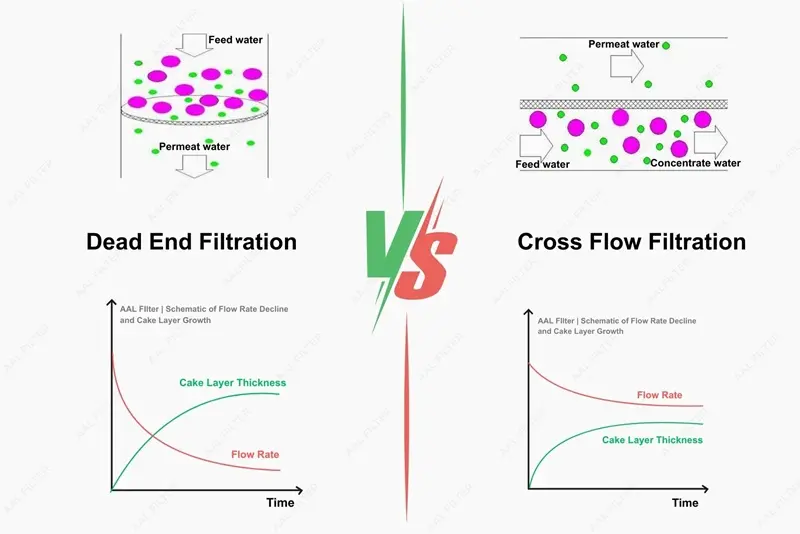
Filtration is a critical step in industrial water treatment, pharmaceuticals, food & beverage, and many other applications. Among the most common methods are Dead End Filtration and Cross Flow Filtration. Choosing the right method directly impacts efficiency, filter lifespan, energy consumption, and overall operating costs.
In this article, AAL Filter provides a detailed comparison between these two filtration techniques to help you make the right choice for your application.
Working Principle
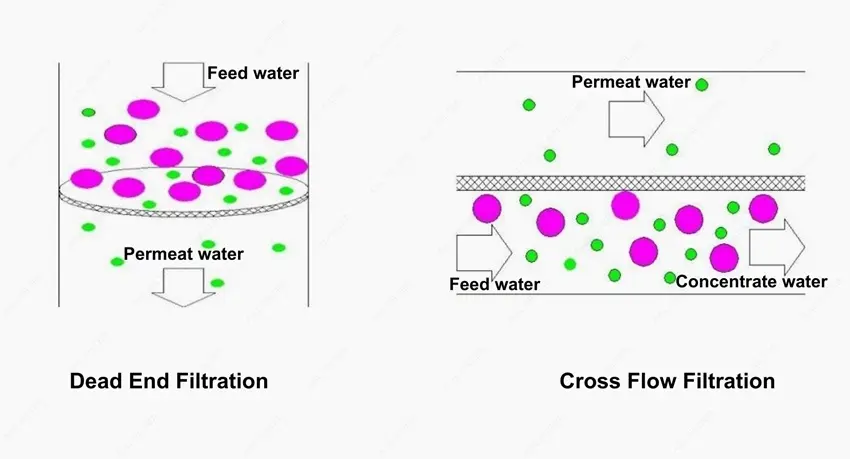
Dead End Filtration: In this method, the liquid flow direction is the same as the filtration direction. Solid particles larger than the pore size remain on the filter media surface, forming a “filter cake.” Only the clean filtrate passes through.
Cross Flow Filtration: The liquid flows tangentially across the membrane surface. Particles are partly retained on the surface and partly flushed away with the concentrate flow, reducing clogging and maintaining higher flow rates over time.
Flow Direction & Cake Formation
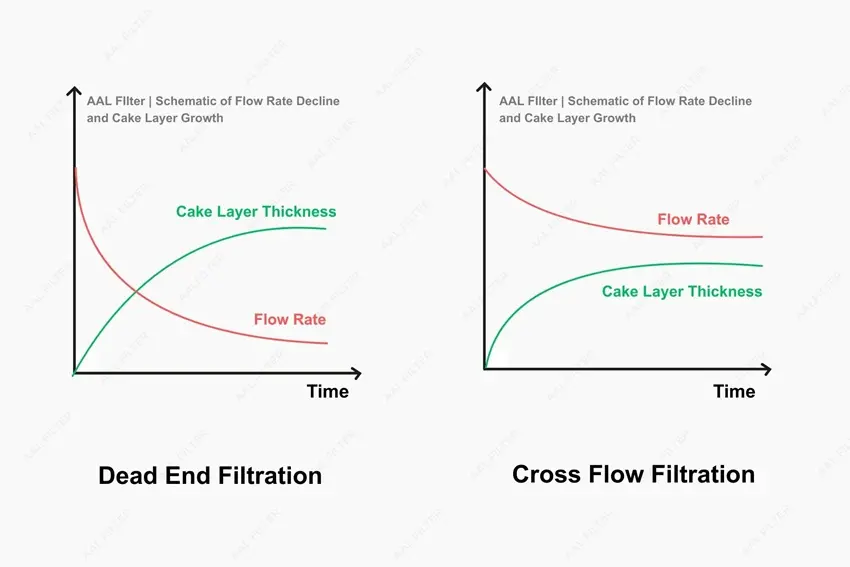
Dead End Filtration results in rapid accumulation of filter cake, leading to higher pressure drop and more frequent cleaning or replacement.
Cross Flow Filtration maintains a thinner cake layer because tangential flow washes away particles. This results in more stable flux and longer filter lifespan.
Pressure on Filter Media
Dead End Filtration: As the filter cake thickens, the pressure difference across the filter increases significantly, requiring greater energy for backwashing or replacement.
Cross Flow Filtration: Lower pressure drop due to less buildup, which means reduced energy consumption and easier maintenance.
Water Recovery & Efficiency
Dead End Filtration achieves higher apparent recovery rates (up to ~95%) since all liquid must pass through the membrane.Cross Flow Filtration typically has 2–9% bleed due to concentrate discharge, but it ensures stable operation and prevents irreversible fouling.
When to Choose Each Method?
Use Dead End Filtration when:
● Solid concentration in feed water is <0.5%
● Small-scale or low-cost systems are required
● Energy saving and high recovery are priorities
Use Cross Flow Filtration when:
● Solid concentration in feed water is >0.5%
● Consistent flow and longer filter life are needed
● Applications require reduced fouling and higher reliability
Applications
Dead End Filtration Applications
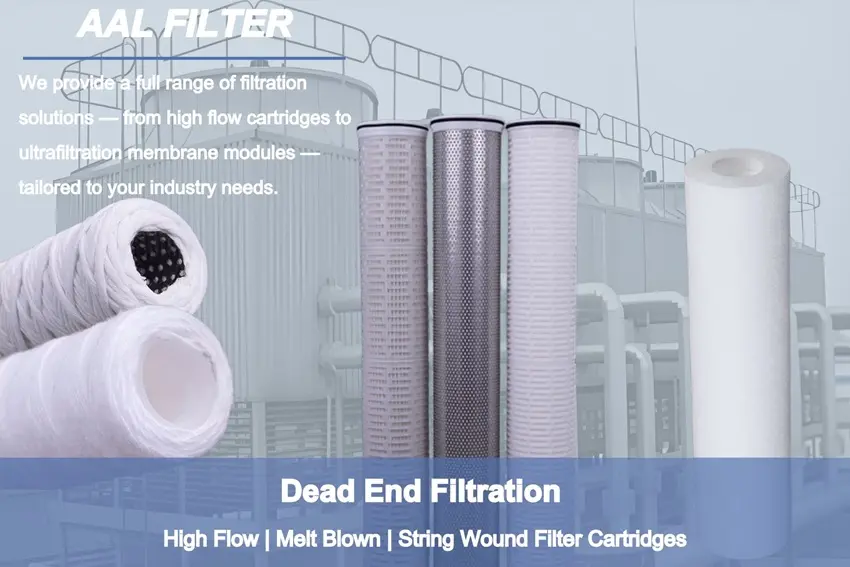
Main products: High Flow Filter Cartridges, Melt Blown Filters, String Wound Cartridges
Typical industries & scenarios:
● Municipal and industrial water treatment (as pre-filters before UF/RO)
● Boiler feed water and cooling tower side-stream filtration
● Laboratory, pharmaceutical, and small-scale food & beverage operations
Cross Flow Filtration Applications
Main products: PVC Ultrafiltration Membrane Modules, PVDF Ultrafiltration Membrane Modules, Reverse Osmosis Membranes

Typical industries & scenarios:
● Municipal wastewater and seawater desalination
● Reverse osmosis pre-treatment for power and petrochemical plants
● Bioprocessing (protein concentration, enzyme purification, cell culture clarification)
● Food & beverage industry (juice, beer, wine, dairy clarification)
Frequently Asked Questions (FAQ)
Q1: What is the main difference between dead-end filtration and cross-flow filtration?
A1: Dead-end filtration captures particles on the filter surface until clogging occurs, making it ideal for low-solid liquids. Cross-flow filtration allows part of the fluid to flow tangentially across the membrane surface, reducing fouling and enabling continuous operation—suitable for high-solid or complex fluids.
Q2: Which industries typically use dead-end filtration?
A2: Dead-end filtration is widely applied in municipal and industrial water treatment, boiler feed water, cooling towers, laboratories, pharmaceuticals, and small-scale food & beverage production.
Q3: Where is cross-flow filtration most beneficial?
A3: Cross-flow filtration is essential for large-scale applications such as seawater desalination, RO pretreatment, power generation, petrochemical plants, bioprocessing, and food & beverage clarification (e.g., juice, beer, dairy).
Q4: How do I choose between dead-end and cross-flow filtration?
A4: The choice depends on feedwater quality, solid concentration, and process requirements. For low-solid liquids and cost-effective setups, dead-end filtration is sufficient. For high-solid, continuous, or high-purity applications, cross-flow membrane systems are recommended.
Q5: Does AAL Filter provide both cartridge filters and membrane modules?
A5: Yes. AAL Filter offers a full portfolio, including melt blown, string wound, and high flow cartridges for dead-end systems, as well as PVC/PVDF ultrafiltration modules and RO membranes for cross-flow applications, ensuring comprehensive solutions across industries.
Conclusion
Both Dead End Filtration and Cross Flow Filtration play an important role in industrial water treatment and liquid separation. The right choice depends on feed water quality, system scale, and performance requirements.
At AAL Filter, we provide a full range of filtration solutions — from high flow cartridges to ultrafiltration membrane modules — tailored to your industry needs. Contact us today to discuss the most efficient solution for your application.