
High Flow Filter Cartridges vs Sediment Filter Cartridges: Flow Capacity, Performance & Applications
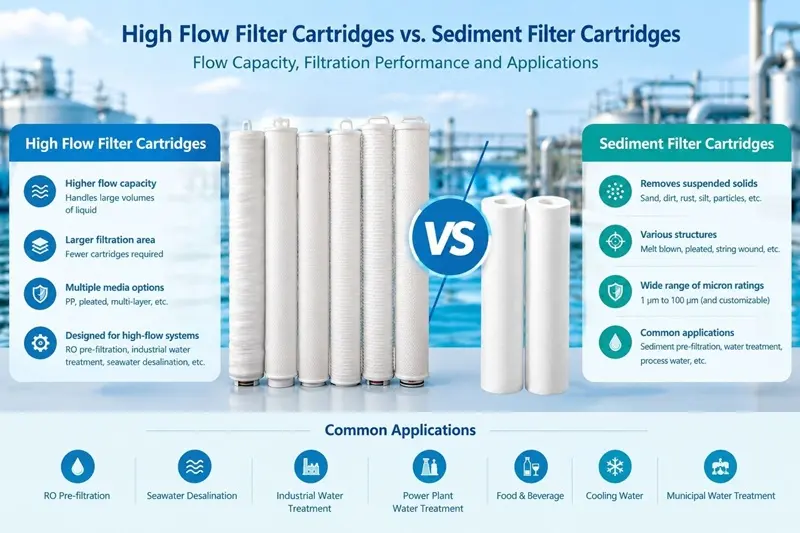
When selecting a filter cartridge for industrial water treatment, RO pretreatment, or general liquid filtration, buyers often come across two different terms: High Flow Filter Cartridges and Sediment Filter Cartridges.
At first glance, these may appear to be two competing types of filter cartridges. However, they actually describe different aspects of filtration.
A High Flow Filter Cartridge primarily describes the cartridge's ability to handle a relatively high liquid flow rate, while a Sediment Filter Cartridge describes a cartridge designed to remove suspended solids, particles, dirt, rust, sand, and other particulate contaminants.
This means a cartridge can be both:A High Flow Filter Cartridge and a Sediment Filter Cartridge.
Understanding this distinction is important when selecting a filtration solution for industrial water treatment, RO pre-filtration, seawater pretreatment, and other applications.
In this guide, we compare High Flow Filter Cartridges vs. Sediment Filter Cartridges from the perspectives of flow capacity, filtration performance, filter media, pressure drop, service life, and application requirements.
What Is a High Flow Filter Cartridge?
A High Flow Filter Cartridge is a large-capacity filter cartridge designed to handle high liquid flow rates while reducing the number of cartridges required in a filtration system.
Compared with conventional small-diameter filter cartridges, high flow cartridges generally have a larger filtration area and are designed for higher-volume liquid filtration.
Typical features may include:
l Large-diameter construction
l High filtration area
l High flow capacity
l Polypropylene filter media
l Pleated or multi-layer filtration media
l Inside-to-outside flow configuration
l Customized end caps and connections
l Compatibility with high flow filter housings
High Flow Filter Cartridges are commonly considered for:
l RO pre-filtration
l Industrial water treatment
l Seawater desalination
l Process water filtration
l Cooling water filtration
l Power plant water treatment
l Municipal water treatment
l Large-scale liquid filtration
The key point is that "High Flow" describes the flow capacity and cartridge configuration rather than a specific type of contaminant.
What Is a Sediment Filter Cartridge?
A Sediment Filter Cartridge is designed primarily to remove suspended particulate matter from liquids.
Depending on the filter media and construction, sediment filtration can target contaminants such as:
l Sand
l Dirt
l Rust particles
l Silt
l Suspended solids
l Pipe scale
l Other particulate contaminants
Common sediment filter cartridge types include:
Melt Blown PP Filter Cartridges
Melt blown polypropylene cartridges are widely used for general sediment filtration.
They can use a graded-density structure in which larger particles are captured toward the outer layers while smaller particles are captured deeper within the filter media.
Pleated Sediment Filter Cartridges
Pleated cartridges provide a large filtration surface area within a relatively compact cartridge.
They are commonly used when higher dirt-holding capacity or a lower initial pressure drop is required.
String Wound Filter Cartridges
String wound cartridges use a wound filtration material around a core.
The winding structure can provide different filtration characteristics depending on the material and construction.
Therefore, Sediment Filter Cartridge is more closely related to the cartridge's filtration purpose, while the specific construction determines how it performs.
High Flow vs. Sediment: What Is the Actual Difference?
The most important distinction is simple:
High Flow describes how much liquid the cartridge can handle. Sediment describes what the cartridge is designed to remove.
This means the two terms are not necessarily mutually exclusive.
A high flow cartridge can be designed specifically for sediment removal.
For example:High Flow + PP Media + 5 μm Filtration
can be used as a high-capacity sediment filtration solution.
The following table summarizes the difference:
Factor | High Flow Filter Cartridge | Sediment Filter Cartridge |
Main Definition | High liquid flow capacity | Particle and sediment removal |
Primary Focus | Flow capacity and system configuration | Filtration of suspended solids |
Typical Contaminants | Depends on filter media | Sand, dirt, rust, silt, particles |
Filter Media | PP, pleated media, multi-layer media, etc. | PP, polyester, string wound media, etc. |
Flow Rate | Designed for higher-flow applications | Depends on cartridge size and structure |
Filtration Rating | Application dependent | Commonly specified by micron rating |
Typical Application | Large-scale liquid filtration | Sediment and particulate filtration |
Can It Be Used for Sediment Filtration? | Yes, when properly designed | Yes |
This distinction is important because a buyer should not choose between "high flow" and "sediment" as if they were always two completely different product categories.
Can a High Flow Filter Cartridge Be Used as a Sediment Filter?
Yes.
This is one of the most important points to understand.
If a High Flow Filter Cartridge uses suitable sediment filtration media and has an appropriate micron rating, it can be used to remove particulate contaminants.
For example, a High Flow Filter Cartridge with polypropylene media can be designed for:
l Sand removal
l Suspended solids reduction
l Dirt removal
l Rust particle removal
l RO pretreatment
l Industrial water filtration
The difference is that a high flow design allows the system to process a larger volume of liquid with fewer cartridges.
Therefore, the correct question is not:
"Should I choose a High Flow Filter Cartridge or a Sediment Filter Cartridge?"
A better question is:
"Do I need a high-flow cartridge designed for sediment removal, or is a conventional sediment cartridge sufficient for my flow rate and application?"
Flow Capacity: When Does High Flow Matter?
Flow rate is one of the most important factors when selecting a filter cartridge.
For a small water filtration system, a conventional sediment filter cartridge may provide sufficient capacity.
However, as system flow increases, the number of conventional cartridges required may also increase.
This can result in:
l More cartridges
l Larger filter housings
l More replacement work
l Greater installation space
l Higher cartridge inventory
l More maintenance requirements
High Flow Filter Cartridges are designed to address this problem by providing higher filtration capacity per cartridge.
For large industrial systems, the key consideration is therefore not simply the micron rating.
It is:Required Flow Rate + Required Filtration Rating + Filter Life + Pressure Drop
Sediment Filtration Performance: What Should You Consider?
For sediment filtration, micron rating is one of the most commonly discussed specifications.
Typical sediment filtration ratings may include:
l 1 μm
l 3 μm
l 5 μm
l 10 μm
l 20 μm
l 50 μm
l 75 μm
l 100 μm
However, micron rating alone does not fully describe filtration performance.
You should also consider:
1. Particle Size Distribution
What type of particles are actually present in the liquid?
Sand, silt, rust, and other particles may have very different size distributions.
2. Dirt Holding Capacity
How much contaminant can the cartridge retain before reaching its replacement pressure drop?
3. Initial Pressure Drop
A filter with a very fine rating may produce a higher initial pressure drop depending on its construction and operating conditions.
4. Filter Life
A cartridge that provides excellent initial filtration but loads quickly may not be the most practical solution for continuous industrial operation.
5. Flow Rate
The same cartridge may perform differently at different flow rates.
For this reason, sediment filter cartridge selection should always consider the complete operating condition rather than micron rating alone.
High Flow Filter Cartridges for Sediment Pre-Filtration
The term sediment pre-filter is commonly used when a filter is installed upstream of another treatment stage.
The purpose is generally to remove particulate contaminants before the liquid enters more sensitive downstream equipment.
For example:
Raw Water→ Sediment Pre-Filter→ High Flow Filtration→ RO System
In another system, the High Flow Filter Cartridge itself may perform the sediment pre-filtration function:
Raw Water→ High Flow Sediment Filter Cartridge→ RO Membrane
The correct configuration depends on:
l Raw water quality
l Flow rate
l Suspended solids concentration
l Required filtration rating
l RO system requirements
l Allowable pressure drop
l Expected cartridge life
For high-capacity RO pretreatment systems, a high flow sediment filtration solution can help reduce the number of cartridges required while maintaining the required particulate removal stage.
High Flow Filter Cartridge vs. Conventional Sediment Filter Cartridge
A conventional sediment cartridge can be an effective solution when the system has a relatively low or moderate flow rate.
For example, a standard sediment filter may be suitable for:
l Small water treatment systems
l Point-of-use filtration
l Low-flow process water
l General particulate filtration
l Residential or commercial water filtration
A High Flow Filter Cartridge becomes more relevant when the system requires:
l Higher flow rates
l Large water treatment capacity
l Continuous industrial operation
l Fewer cartridges
l Reduced housing footprint
l Lower cartridge replacement workload
The decision should therefore be based on the complete system rather than simply choosing the cartridge with the highest flow rating.
High Flow Sediment Filtration for RO Pretreatment
One of the most important applications for high flow sediment filtration is RO pretreatment.
Reverse osmosis membranes are sensitive to particulate contamination and require suitable pretreatment to help protect the membrane system.
A sediment filtration stage can reduce:
l Suspended solids
l Sand
l Dirt
l Rust particles
l Other particulate contaminants
For larger RO systems, High Flow Filter Cartridges can be considered when the required flow rate makes a conventional multi-cartridge configuration less practical.
However, cartridge selection should be based on actual feed water conditions.
Important parameters include:
l Feed water flow rate
l SDI
l Suspended solids
l Turbidity
l Particle characteristics
l Required micron rating
l Pressure drop
l Cartridge replacement interval
A high flow cartridge should therefore be considered as part of the overall RO pretreatment system, rather than as an isolated component.
High Flow Filter Cartridges and Filter Media Selection
The filter media has a direct impact on filtration performance.
Polypropylene (PP)
Polypropylene is commonly used for industrial water and liquid filtration.
PP media can be manufactured in different structures, including:
l Melt blown PP
l Pleated PP
l Multi-layer PP
l Gradient-density PP
The appropriate structure depends on the application and required filtration characteristics.
Polyester
Polyester media may also be used in certain high flow or industrial filtration applications where the required chemical and temperature compatibility is different from polypropylene.
String Wound Media
String wound cartridges are commonly used for sediment filtration and can provide depth filtration through their wound structure.
The important point is that filter media should be selected according to the liquid, contaminants, temperature, chemical compatibility, flow rate, and required filtration performance.
Pressure Drop and Filter Life
When comparing High Flow Filter Cartridges and Sediment Filter Cartridges, pressure drop should not be overlooked.
A filter cartridge may have a suitable micron rating but still be unsuitable if the pressure drop becomes too high at the required flow rate.
The main factors include:
Flow Rate
→ Filter Media
→ Filtration Area
→ Particle Loading
→ Pressure Drop
As contaminants accumulate, pressure drop generally increases.
This is why industrial filtration systems usually define a replacement or terminal pressure-drop point.
For a practical filtration design, engineers should consider:
l Initial pressure drop
l Operating flow rate
l Contaminant loading
l Dirt holding capacity
l Terminal pressure drop
l Expected filter life
A cartridge with a larger filtration area may help distribute the flow across more filter media, but actual performance still depends on the cartridge design and operating conditions.
How to Choose Between High Flow and Sediment Filtration Solutions
Instead of starting with the cartridge name, start with the application.
Choose a Conventional Sediment Filter Cartridge When:
l The system flow rate is relatively low
l The primary requirement is particulate removal
l A standard filter housing is already installed
l Cartridge replacement is manageable
l Installation space is not a major limitation
Consider a High Flow Filter Cartridge When:
l The system has a high flow rate
l Large volumes of water need to be filtered
l Many conventional cartridges would otherwise be required
l Filter housing footprint needs to be optimized
l Cartridge replacement workload is significant
l The application is industrial or continuous
Consider a High Flow Sediment Filter Cartridge When:
l You need both high flow capacity and sediment removal
l The system is part of RO pretreatment
l Large quantities of suspended solids must be removed
l The existing system requires fewer high-capacity cartridges
l You want to optimize the overall filtration configuration
High Flow Filter Cartridge Replacement for Existing Systems
If you are replacing an existing cartridge, it is important to check more than the micron rating.
A replacement cartridge should be evaluated for:
Parameter | What to Check |
Cartridge Length | Overall cartridge length |
Outside Diameter | Cartridge OD |
Filter Media | PP, polyester, string wound, etc. |
Micron Rating | Required filtration rating |
End Cap | End cap configuration |
Connection | Connection or adapter |
O-Ring | Seal material and size |
Flow Direction | Required flow direction |
Flow Capacity | Required operating flow |
Housing | Existing housing compatibility |
This becomes particularly important when replacing an OEM cartridge with an alternative product.
A cartridge that has the same nominal length and micron rating may still not be a direct replacement if the end cap, sealing structure, flow direction, or housing interface is different.
High Flow Filter Cartridges vs. Sediment Filter Cartridges: Key Takeaways
The difference can be summarized in one sentence:
High Flow Filter Cartridges are primarily about handling higher liquid flow rates, while Sediment Filter Cartridges are primarily about removing particulate contaminants.
These two concepts can overlap.
A High Flow Filter Cartridge can also be a sediment filter if it is designed with suitable filter media and micron rating.
Therefore, when selecting a filtration solution, consider:
1. What is the required flow rate?
2. What contaminants need to be removed?
3. What micron rating is required?
4. What is the expected cartridge life?
5. What pressure drop is acceptable?
6. What filter housing is already installed?
7. How many cartridges are required?
8. What is the total filtration cost?
This approach provides a more accurate basis for selecting the right filter cartridge.
Conclusion
High Flow Filter Cartridges and Sediment Filter Cartridges are not necessarily competing products.
They describe two different aspects of filtration.
A Sediment Filter Cartridge focuses on removing particulate contaminants such as sand, dirt, rust, silt, and suspended solids.
A High Flow Filter Cartridge focuses on handling larger liquid flow rates with a high-capacity cartridge configuration.
When these two requirements come together, a High Flow Sediment Filter Cartridge can provide a practical solution for large-scale water filtration and RO pretreatment applications.
For small or moderate flow applications, a conventional sediment filter cartridge may be sufficient.
For large industrial systems, however, High Flow Filter Cartridges can help reduce the number of cartridges required and simplify the overall filtration configuration.
The right solution ultimately depends on the relationship between:
Flow Capacity + Filtration Performance + Pressure Drop + Filter Life + Housing Compatibility
Partner with AALFilter for Your High Flow Filtration Solution
AALFilter provides High Flow Filter Cartridges and customized liquid filtration solutions for industrial water treatment, RO pre-filtration, seawater pretreatment, and other high-flow applications.
If you are replacing an existing cartridge or evaluating a High Flow Filter Cartridge for a new project, you can provide:
l Existing cartridge model
l Cartridge dimensions
l Required micron rating
l System flow rate
l Filter housing information
l Application and liquid type
Our team can evaluate the requirements and help develop a suitable High Flow Filter Cartridge or sediment filtration solution for your application.