PPH Bag Filter for Chemical Processing: Electroplating, Paint, Coating & Ink Filtration
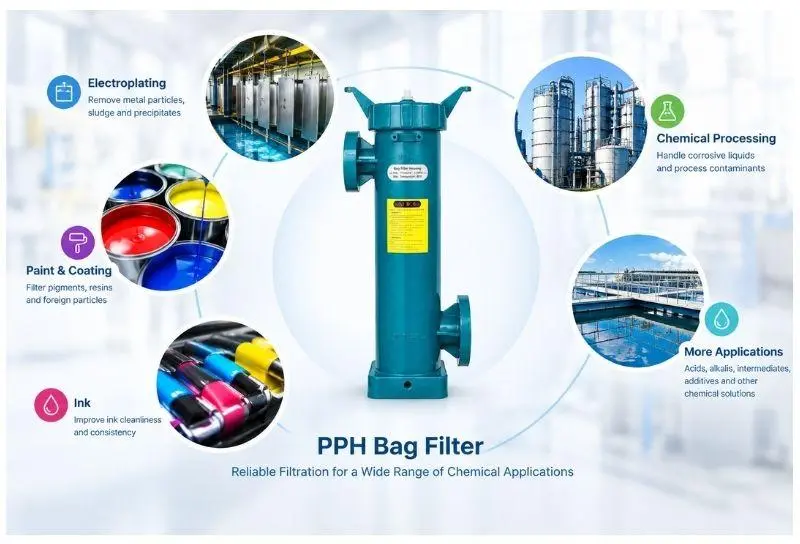
Chemical processing often involves aggressive liquids, suspended solids, pigments, resins, sludge and other process contaminants. At the same time, the filter housing must withstand the chemical environment without becoming a source of corrosion or contamination.
A PPH bag filter system, consisting of a PPH bag filter housing and a suitable filter bag, provides a practical solution for many chemical liquid filtration applications.
PPH bag filter housings are commonly considered for applications such as electroplating, paint, coating, ink and general chemical processing, where corrosion resistance and reliable solid-liquid separation are important.
This article explains the main filtration challenges in these applications and how a PPH bag filter system can address them.
Common Filtration Challenges in Chemical Processing
Although chemical processes vary considerably, many liquid filtration applications share three common challenges.
Corrosion and Material Compatibility
Chemical liquids may be acidic, alkaline or otherwise aggressive toward conventional metal equipment. Choosing a filter housing with appropriate chemical compatibility is therefore an important part of system design.
PPH (Polypropylene Homopolymer) is a non-metallic material commonly used for liquid filtration applications where corrosion resistance is required.
However, material compatibility should always be confirmed based on the actual chemical type, concentration, operating temperature and pressure.
Process Contaminants
Chemical production and surface treatment processes can generate different types of contaminants, including:
· Metal particles
· Sludge
· Precipitates
· Pigment agglomerates
· Resin particles
· Gel particles
· Foreign particles
· Process residues
The filtration objective is to remove these unwanted solids before they affect product quality or downstream equipment.
Pressure Drop and Frequent Filter Replacement
A filtration system that is undersized or poorly matched to the process can experience rapid differential-pressure increases.
This can result in:
High Differential Pressure → Reduced Flow → Frequent Filter Changes → Higher Operating Costs
Proper housing sizing and appropriate filter bag selection are therefore essential for stable operation.
Why Use a PPH Bag Filter System?
A PPH bag filter system combines two important functions: chemical-compatible containment and solid-liquid separation.
PPH Housing for Chemical Compatibility
PPH bag filter housings offer several advantages for suitable chemical applications:
· Non-metallic construction
· Good resistance to many acids and alkalis
· Reduced risk of metal corrosion
· Lightweight construction
· Easy maintenance
This makes PPH a practical alternative to metal filter housings in applications where corrosion is a major concern.
The actual suitability of PPH depends on the process chemistry and operating conditions and should be verified before selection.
Filter Bag for Particle Removal
The filter bag performs the actual particle separation inside the housing.
The appropriate filter bag can be selected according to the process requirements, including:
· Required filtration rating
· Contaminant type
· Dirt loading
· Chemical compatibility
· Operating temperature
· Required service life
For detailed information on filter media, micron ratings, bag sizes and other selection factors, see our How to Choose the Right Filter Bag guide.
A Complete Chemical Filtration System
The basic filtration process is:
Chemical Liquid → PPH Bag Filter Housing → Filter Bag → Cleaner Process Liquid
The PPH housing provides the containment and chemical-resistant structure, while the filter bag removes unwanted solid contaminants.
Together, they form a complete liquid filtration solution for many chemical processes.
PPH Bag Filter for Electroplating
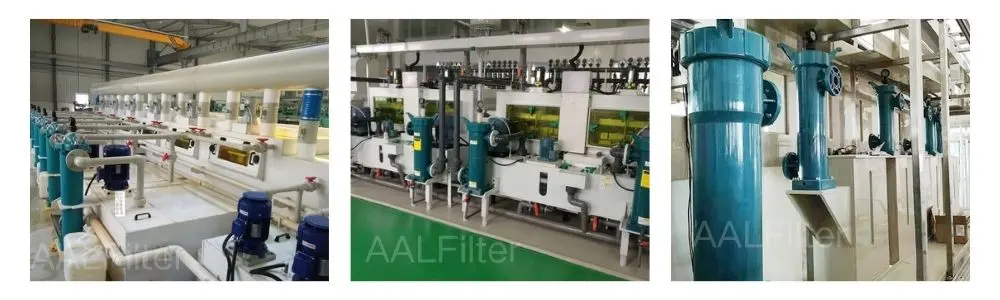
Electroplating solutions are continuously circulated during production. Over time, the solution can accumulate metal particles, anode sludge, suspended solids, precipitates and other process contaminants.
The Filtration Challenge
If these contaminants remain in the plating solution, they may affect surface appearance and plating consistency.
Typical problems include:
· Surface defects
· Rough or uneven finishes
· Particle deposition
· Contaminated plating baths
· Reduced process stability
Where PPH Bag Filtration Fits
A PPH bag filter can be installed in suitable circulation or filtration stages to continuously remove suspended contaminants from the plating solution.
The system can be used for applications such as:
· Plating bath circulation
· Solution recirculation
· Chemical bath filtration
· Rinse water filtration
· Pretreatment and related chemical processes
The exact filtration configuration depends on the plating chemistry, contaminant loading and required filtration level.
Expected Benefits
A properly designed filtration system can help provide:
· Cleaner plating solutions
· More stable bath conditions
· Reduced particle-related surface defects
· More consistent plating quality
PPH Bag Filter for Paint and Coating
Paint and coating production requires effective control of unwanted particles and agglomerated materials.
The Filtration Challenge
Paint and coating liquids may contain:
· Pigment agglomerates
· Resin particles
· Gel particles
· Undissolved materials
· Foreign contaminants
These contaminants can affect the appearance and consistency of the finished coating and may also create problems for downstream application equipment.
Where PPH Bag Filtration Fits
Bag filtration can be used at appropriate stages of the production process, including:
· Paint filtration
· Coating liquid filtration
· Resin filtration
· Pre-filtration
· Final or polishing filtration
The goal is to remove unwanted particles while maintaining the required flow rate and process conditions.
Expected Benefits
A suitable PPH bag filtration system can help achieve:
· Cleaner coating liquid
· Fewer particle-related defects
· More consistent product quality
· Better protection of downstream equipment
PPH Bag Filter for Ink Filtration
Ink manufacturing presents similar filtration challenges, but particle control can be particularly important for maintaining consistent printing performance.
The Filtration Challenge
Ink formulations may contain:
· Pigment agglomerates
· Resin particles
· Gel particles
· Foreign particles
Unwanted particles can affect ink consistency, downstream equipment and final printing performance.
Where PPH Bag Filtration Fits
Bag filtration can be used as a polishing or final filtration stage before filling, packaging or downstream processing.
The filtration system helps remove unwanted particles without unnecessarily complicating the production process.
Expected Benefits
The main objectives are:
· Cleaner ink
· More consistent product quality
· Reduced particle contamination
· Better protection of downstream equipment
PPH Bag Filter for General Chemical Processing
Beyond electroplating, paint, coating and ink, PPH bag filter systems can also be used for a wide range of chemical process liquids.
Typical applications include:
· Acid and alkali solutions
· Chemical intermediates
· Additives
· Process liquids
· Specialty chemicals
· Chemical wastewater and related process streams
Common Filtration Challenges
Depending on the process, the liquid may contain:
· Suspended solids
· Crystals
· Precipitates
· Catalyst particles
· Process residues
In these applications, the filtration system needs to provide both appropriate chemical compatibility and effective solid-liquid separation.
Expected Benefits
A properly selected PPH bag filter system can help:
· Maintain cleaner process liquids
· Protect downstream equipment
· Reduce particle-related process problems
· Improve filtration stability
· Simplify routine filter maintenance
How to Select the Right PPH Bag Filter System
Selecting a PPH bag filter should start with the actual process conditions rather than the housing size alone.
Consider the following parameters:
Parameter | What to Consider |
Chemical / Liquid | Chemical composition and compatibility |
Flow Rate | Required filtration capacity |
Operating Temperature | Housing and filter bag temperature limits |
Operating Pressure | Required housing pressure rating |
Contaminants | Type, concentration and dirt loading |
Micron Rating | Required particle removal level |
Chemical and temperature compatibility | |
Bag Size / Quantity | Flow rate and dirt-holding requirements |
Connection | Existing process piping and installation requirements |
For filter bag material, micron rating and bag configuration, refer to our dedicated [Filter Bag Selection Guide].
The housing and filter bag should be selected as a complete system based on the actual process conditions.
PPH Bag Filter Applications at a Glance
Application | Main Filtration Challenge | Typical Objective |
Electroplating | Metal particles, sludge and precipitates | Maintain cleaner plating solutions |
Paint | Pigment agglomerates and foreign particles | Improve product consistency |
Coating | Resin particles, gels and agglomerates | Reduce particle-related defects |
Ink | Pigment and resin particles | Improve ink cleanliness |
Chemical Processing | Solids, crystals and process residues | Protect downstream processes |
Need a PPH Bag Filter for Your Chemical Process?
Contact us to recommend a suitable PPH bag filter housing + filter bag configuration based on your process requirements.