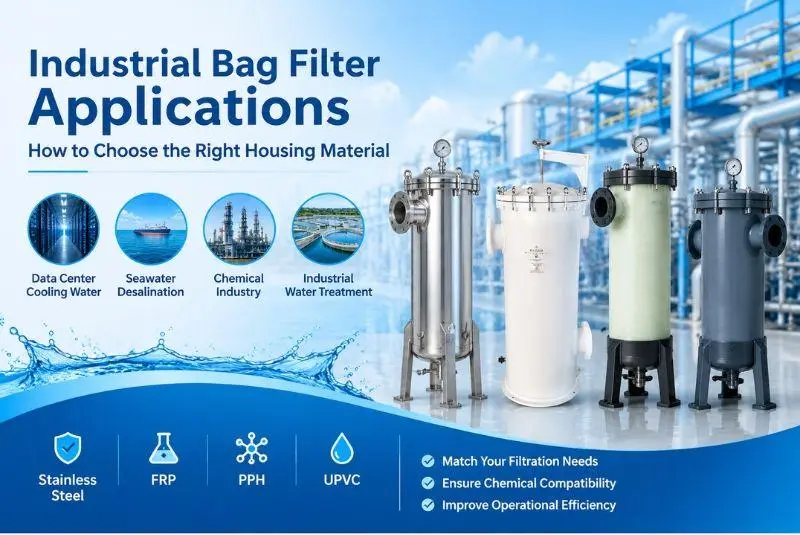
Industrial Bag Filter Applications: How to Choose the Right Housing Material
Industrial liquid filtration plays an important role in maintaining product quality, protecting downstream equipment, and ensuring stable production processes. Across industries such as chemical processing, water treatment, seawater desalination, and data center cooling, different liquids require different filtration solutions.
An industrial bag filter is a widely used solution for removing suspended solids and particulate contaminants from liquid streams. However, choosing the right bag filter involves more than selecting a suitable filtration rating. The housing material must also match the liquid properties, operating conditions, and application requirements.
Stainless steel, FRP, PPH, and UPVC bag filter housings each offer different advantages for specific industrial applications.
This guide explores the main types of industrial bag filters, their typical applications, and the key factors to consider when selecting the right filtration solution.
Why Industrial Bag Filters Are Used in Different Industries
Industrial processes often involve liquids containing suspended particles, sediment, rust, process residues, or other contaminants. If these particles are not properly controlled, they may affect product quality, increase maintenance requirements, and place additional stress on downstream equipment.
Bag filtration provides a practical method of separating suspended solids from liquid streams.
An industrial bag filter system generally consists of a filter housing and a replaceable liquid filter bag. Liquid enters the housing, passes through the filter bag, and exits after particulate contaminants have been retained by the filter media.
Depending on the application and system design, bag filters can help manufacturers:
Remove suspended solids and particulate contaminants from process liquids.
Protect pumps, valves, heat exchangers, and downstream filtration equipment.
Improve the consistency of industrial process water and liquid products.
Reduce the filtration load on subsequent treatment stages.
Simplify routine maintenance through replaceable filter bags.
However, filtration requirements vary considerably between industries. A cooling water system, a seawater desalination plant, and a chemical production line may require completely different housing materials and operating configurations.
Selecting the appropriate housing material is therefore an important part of industrial filtration system design.
Different Types of Industrial Bag Filter Housings
The housing material directly affects the suitability of a bag filter for different operating environments. Four commonly used options in industrial liquid filtration are stainless steel, FRP, PPH, and UPVC.
1. Stainless Steel Bag Filter
Stainless steel bag filters are widely used in industrial applications where mechanical strength, durability, and reliable operation are important.
Depending on the stainless steel grade and equipment design, these housings can be suitable for a wide range of industrial liquids and operating conditions.
Key characteristics:
Good mechanical strength and structural durability.
Available in different configurations for various flow rates and operating pressures.
Suitable for many industrial liquid filtration applications.
Available in different stainless steel grades depending on corrosion and process requirements.
Typical applications:
Data center cooling water filtration.
Food and beverage processing.
Pharmaceutical manufacturing.
Semiconductor-related process water filtration.
General industrial liquid filtration.
For example, data center cooling systems require effective particulate control to help protect cooling equipment and maintain stable water circulation. Stainless steel bag filters can serve as a filtration stage in suitable cooling water systems.
For a closer look at this application, read our article:
Stainless Steel Bag Filter for Data Center Cooling Water
2. FRP Bag Filter
FRP (Fiberglass Reinforced Plastic) bag filter housings are designed for applications where corrosion resistance and material compatibility are important considerations.
They can be a suitable option for selected water treatment environments, particularly when conventional metallic equipment may face corrosion challenges.
Key characteristics:
Non-metallic construction with corrosion resistance in compatible environments.
Suitable for selected saline and industrial water applications.
Available in configurations designed for different filtration requirements.
Provides an alternative to metallic housings in certain corrosive environments.
Typical applications:
Seawater desalination.
Seawater reverse osmosis (SWRO) pretreatment.
Saline water treatment.
Selected industrial water treatment processes.
In seawater desalination, pretreatment is essential for controlling suspended solids before water enters downstream treatment stages. FRP bag filter housings combined with suitable liquid filter bags can provide a particulate filtration stage in an SWRO pretreatment process.
Learn more about this application:
FRP Bag Filter for Seawater Desalination: A Practical Pretreatment Solution for SWRO
3. PPH Bag Filter
PPH (Polypropylene Homopolymer) bag filter housings are used in selected industrial applications where chemical compatibility is a major equipment selection consideration.
Their suitability depends on the chemical composition, concentration, operating temperature, and pressure of the process liquid.
Key characteristics:
Non-metallic construction.
Good chemical resistance to many compatible industrial liquids.
Suitable for selected chemical processing applications.
Available for different liquid filtration requirements.
Typical applications:
Chemical processing.
Electroplating.
Paint and coating production.
Ink manufacturing.
Compatible industrial chemical liquid filtration.
In chemical production, process liquids may contain suspended particles, residues, or other contaminants that need to be removed before subsequent production stages. A properly selected PPH bag filter can provide a practical filtration solution for compatible chemical applications.
Explore the specific industry requirements in our article:
PPH Bag Filter for Chemical Industry
4. UPVC Bag Filter
UPVC (Unplasticized Polyvinyl Chloride) bag filter housings are commonly considered for selected industrial water treatment applications where a non-metallic filtration solution is preferred.
They can be suitable for compatible water-based liquids and certain corrosive water environments, subject to the equipment's rated operating conditions.
Key characteristics:
Non-metallic housing construction.
Corrosion resistance in compatible water treatment applications.
Suitable for selected industrial water filtration processes.
Convenient filter bag replacement for routine maintenance.
Typical applications:
General industrial water treatment.
Reverse osmosis (RO) feed water pretreatment.
Compatible corrosive water filtration.
Selected industrial wastewater treatment processes.
In industrial water treatment, suspended solids can increase the filtration burden on downstream equipment. A UPVC bag filter combined with an appropriately selected filter bag can help remove particulate contaminants before subsequent treatment stages.
Read more about its applications and filtration benefits:
UPVC Bag Filter for Industrial Water Treatment: Solving Corrosion and Filtration Challenges
How to Choose the Right Bag Filter Housing Material
Selecting the right bag filter housing requires evaluating the actual operating conditions rather than choosing a material based only on its general characteristics.
The following factors should be considered before selecting a filtration system.
1. Chemical Compatibility
The process liquid is one of the most important factors in housing selection.
Different materials have different chemical resistance properties. Stainless steel, FRP, PPH, and UPVC are not interchangeable across all applications.
Consider:
Liquid composition and chemical concentration.
Potential exposure to acids, alkalis, salts, and other chemicals.
Compatibility of seals, gaskets, and other wetted components.
Operating temperature and chemical exposure conditions.
Always verify material compatibility before selecting the housing.
2. Operating Pressure and Temperature
Every bag filter housing has defined pressure and temperature limitations.
The selected housing must be suitable for the normal operating conditions as well as potential pressure fluctuations during operation.
Temperature can also affect the mechanical performance and pressure rating of plastic and composite materials. Always refer to the manufacturer's technical specifications.
3. Flow Rate and Filtration Capacity
The required flow rate determines the appropriate housing size and configuration.
For applications with higher liquid throughput, multi-bag filter housings may be considered to provide greater filtration capacity and reduce the loading on individual filter bags.
The actual configuration should be determined according to the liquid properties, solids concentration, allowable pressure drop, and required filtration performance.
4. Corrosion Resistance
Corrosion can affect equipment service life, maintenance requirements, and overall operating reliability.
For applications involving saline water or chemically aggressive liquids, material selection should be based on actual chemical compatibility rather than assuming that one material is suitable for every corrosive environment.
5. Maintenance and Operating Costs
The total cost of a filtration system includes more than the initial equipment price.
Consider the following:
Housing purchase cost.
Filter bag replacement frequency.
Filter bag consumption.
Maintenance requirements.
Expected equipment service life.
Downtime associated with filter maintenance.
A suitable filtration solution should balance filtration performance, equipment durability, and long-term operating costs.
Choosing the Right Liquid Filter Bag for Your Application
The filter housing is only one part of an industrial bag filtration system. The liquid filter bag plays an equally important role in determining filtration performance.
Even when the housing material is correctly selected, an unsuitable filter bag may result in poor filtration efficiency, excessive pressure drop, or frequent replacement.
Several factors should be considered when selecting a liquid filter bag.
Filter Bag Material
Common filter bag materials include polypropylene (PP), polyester (PE), nylon, and other specialized media. The choice depends on chemical compatibility, operating temperature, and the characteristics of the liquid being filtered.
Micron Rating
The required filtration rating depends on the particle size that needs to be removed and the quality requirements of the downstream process.
Filter Bag Size
The filter bag dimensions must match the housing design. Common configurations include different bag sizes and customized dimensions for specific equipment.
Dirt-Holding Capacity
The amount and characteristics of suspended solids affect how frequently a filter bag needs to be replaced. Applications with high solids loading may require greater dirt-holding capacity or additional upstream treatment.
Choosing the right housing together with a compatible liquid filter bag helps create a more reliable and efficient filtration system.
Explore our range of Industrial Liquid Filter Bags for different liquid filtration applications.
Industrial Bag Filter Solutions for Your Business
Different industries have different filtration challenges, and there is no single bag filter material suitable for every application.
Stainless steel, FRP, PPH, and UPVC bag filter housings each provide different material characteristics and application possibilities.
Choosing the right solution requires understanding the process liquid, operating conditions, required flow rate, and filtration objectives.
As an industrial filtration manufacturer, we provide bag filter housings in different materials and configurations, together with compatible liquid filter bags for various industrial applications.
Whether you need a stainless steel bag filter for cooling water, an FRP bag filter for seawater desalination, a PPH bag filter for chemical processing, or a UPVC bag filter for industrial water treatment, we can help evaluate a suitable filtration configuration.
Contact us with your application details, including liquid type, flow rate, operating pressure, temperature, and required filtration rating. We will help you identify a suitable bag filtration solution for your project.