
Electrical Conductivity to Resistivity Calculator & Conversion Tool
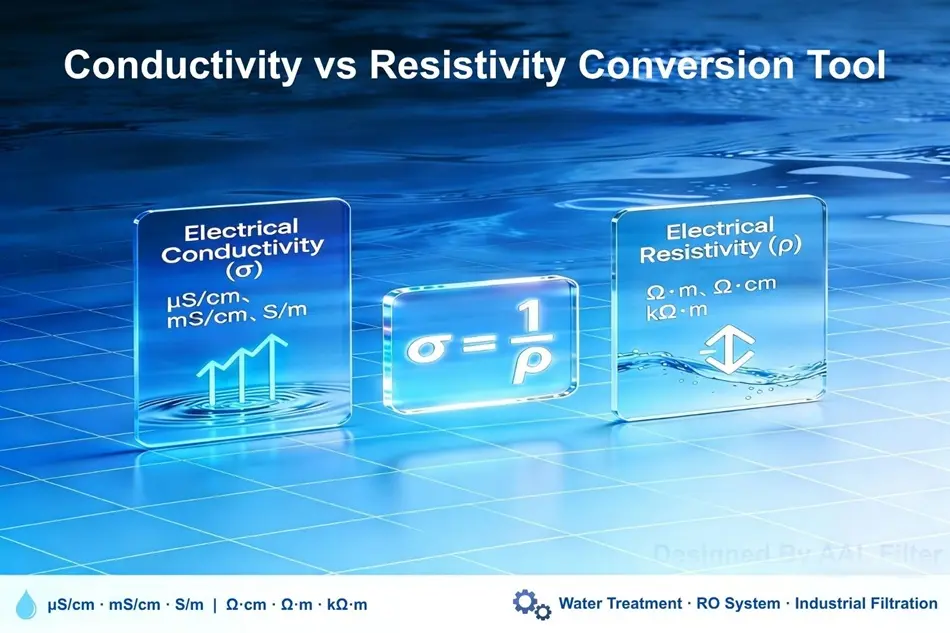
Electrical conductivity and electrical resistivity are two fundamental parameters widely used in water treatment, industrial process control, and high-purity water systems. They are essential for monitoring water quality in applications such as reverse osmosis (RO), boiler feedwater, and ultrapure water production systems.
This page provides a practical conductivity to resistivity conversion calculator, along with clear explanations, formulas, and engineering reference data.
1. What Is Electrical Conductivity?
Electrical conductivity (σ) measures how easily electric current can pass through water or any solution. It is directly related to the concentration of dissolved ions such as Na⁺, Cl⁻, Ca²⁺, and Mg²⁺.
Key understanding:
● Higher conductivity → higher ion concentration → lower water purity
● Lower conductivity → fewer ions → higher water purity
Common units:
● μS/cm (microsiemens per centimeter)
● mS/cm (millisiemens per centimeter)
● S/m (siemens per meter)
Among these, μS/cm is the most commonly used unit in industrial water treatment and pure water systems.
2. What Is Electrical Resistivity?
Electrical resistivity (ρ) is the inverse property of conductivity. It describes how strongly a material resists the flow of electric current.
Key understanding:
● High resistivity → very pure water
● Low resistivity → high ion concentration
Common units:
● Ω·m (ohm meter)
● Ω·cm (ohm centimeter)
● kΩ·m (kilo-ohm meter)
Resistivity is especially important in ultrapure water and semiconductor-grade water systems.
3. Relationship Between Conductivity and Resistivity
The relationship is strictly inverse:
σ = 1 / ρ , ρ = 1 / σ
This means:
● Higher conductivity → lower resistivity
● Higher resistivity → lower conductivity
4. Unit Conversion in Engineering Applications
In real industrial applications, different regions and industries use different units, including:
● μS/cm
● mS/cm
● S/m
● Ω·cm
● Ω·m
● kΩ·m
Therefore, a reliable conductivity vs resistivity conversion tool is essential for engineers working in water treatment systems.
5. Conductivity ↔ Resistivity Conversion Calculator
Electrical Resistivity ↔ Conductivity Converter
Conductivity (σ)
Resistivity (ρ)
This tool allows instant conversion between electrical conductivity and resistivity with automatic unit handling for engineering applications.
6. Typical Engineering Conversion Reference
Conductivity | Resistivity |
1 μS/cm | 10 kΩ·m |
10 μS/cm | 1 kΩ·m |
100 μS/cm | 100 Ω·m |
1000 μS/cm | 10 Ω·m |
Note: Actual values may vary depending on temperature (standard reference is 25°C).
7. Applications in Water Treatment Industry
Electrical conductivity and resistivity are widely used in:
Reverse Osmosis (RO) Systems
Monitoring permeate water quality and membrane performance.
Boiler Feedwater Systems
Preventing scaling and corrosion in high-pressure systems.
Industrial Water Treatment
Controlling ion concentration in process water.
Ultrapure Water (UPW) Systems
Ensuring extremely low ionic contamination levels.
Filtration System Monitoring
Evaluating upstream and downstream water quality differences.
8. Frequently Asked Questions (FAQ)
Q1: What is the relationship between conductivity and resistivity?
They are inverse properties. Conductivity increases when resistivity decreases, and vice versa.
Q2: Why is conductivity important in water treatment?
Because it indicates the level of dissolved ions in water, which directly reflects water purity.
Q3: What is the most common unit of conductivity?
μS/cm is the most widely used unit in industrial and laboratory water systems.
Q4: What is the difference between conductivity and TDS?
TDS is an estimated value based on conductivity, but they are not identical measurements.
Q5: Does temperature affect conductivity?
Yes. Conductivity increases with temperature, so values are usually standardized at 25°C.
9. Learn More (Authoritative Reference)
For a more detailed scientific explanation of electrical conductivity and resistivity, you may refer to the following authoritative source:
Electrical resistivity and conductivity (Wikipedia)
This reference provides a more theoretical and physics-based explanation of the relationship between conductivity, resistivity, and material properties.
10. Filtration Role in Water Quality Stability
In practical water treatment systems, stable electrical conductivity and resistivity values are not only determined by ion concentration, but are also influenced by the overall efficiency of the filtration process.
Effective pre-filtration and particle removal help maintain system stability by reducing suspended solids, organic matter, and fine contaminants that may affect downstream process performance.
Depending on the application and water quality requirements, different types of industrial filtration elements are commonly used in multi-stage water treatment systems, such as:
● String wound filter cartridges for general sediment removal and depth filtration
● Melt blown filter cartridges for fine particle retention in process water applications
● High-flow filter cartridges for large-scale industrial and high-capacity systems
These filtration technologies are widely applied in industrial water purification, reverse osmosis pretreatment, and process water conditioning systems, where consistent water quality is essential for stable conductivity and resistivity control.
Explore more filtration solutions used in industrial water treatment systems:
● String Wound Filter Cartridge
Conclusion
Electrical conductivity and resistivity are essential parameters in modern water treatment and industrial water quality control systems. Understanding their inverse relationship helps engineers accurately evaluate water purity and optimize system performance.
With the conversion tool and reference data provided on this page, you can quickly perform accurate unit conversions and apply them directly in engineering practice.