
How to Properly Interpret TDS Values and Filter Cartridge Selection
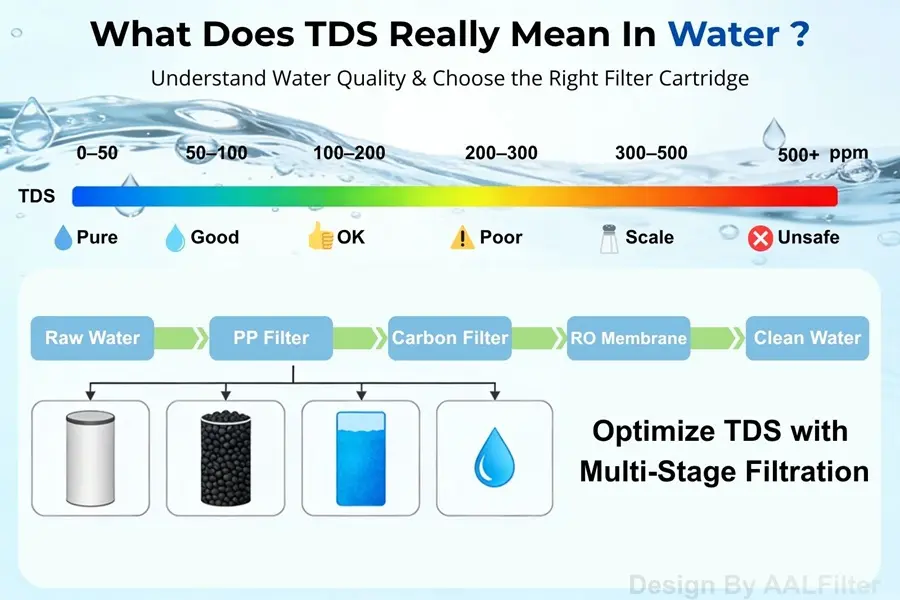
What is TDS?
TDS (Total Dissolved Solids) measures the total concentration of dissolved substances in water, usually expressed in ppm (mg/L). It includes:
● Inorganic salts (calcium, magnesium, sodium, potassium)
● Metal ions
● Small amounts of organic matter
Note: Higher TDS does not necessarily mean worse water quality. Values should be interpreted based on specific ranges.
TDS Range and Water Quality Interpretation
TDS Range (ppm) | Water Quality Description |
0–50 | High purity |
50–100 | Relatively high purity |
100–200 | Moderate purity |
200–300 | Poor purity |
300–400 | Scale formation likely |
400–500 | Poor taste |
>500 | Exceeds recommended contaminant limit |
Reference: The above TDS ranges and water quality interpretations are based on a professional guide for general reference. For more detailed explanations, please visit the Frizzlife TDS Measurement & Interpretation Guide.
How to Understand TDS Correctly
1. Lower TDS Does NOT Always Mean Better Water
Ultra-low TDS water (e.g., RO water) may lack essential minerals.
Minerals like calcium and magnesium are beneficial for health.
2. Moderate TDS is Ideal for Drinking Water
Guidelines:
● 50–150 ppm: Ideal (balanced minerals, good taste)
● 100–300 ppm: Acceptable range (common tap water)
3. Problems with High TDS Water
Above 300 ppm, TDS may cause:
● Scale buildup
● Poor taste
● Pipe fouling
● Reduced efficiency in industrial systems
Critical in boilers, cooling loops, or RO pre-treatment.
Relationship Between TDS and EC
TDS is closely linked to Electrical Conductivity (EC):
● EC measures water conductivity
● TDS ≈ EC × conversion factor (0.5–0.7)
EC is often used as a fast method to estimate TDS.
How to Reduce TDS?
Common treatment methods:
● Reverse Osmosis (RO)
● Nanofiltration (NF)
● Ion exchange
● Distillation
Optimal control often combines multi-stage filter cartridge systems + membrane technologies.
Choosing the Right Filter Cartridge
Single treatments are often insufficient for long-term TDS stability. Recommended filter setup includes:
● PP melt-blown cartridges: Remove suspended solids
● Activated carbon filters: Remove chlorine, organics, and odors
● Pleated membrane filters: Final-stage fine filtration
Proper filter cartridge combination stabilizes TDS, extends RO membrane life, and reduces operating costs.
For reliable industrial and drinking water filter cartridge solutions, visit our Filter Cartridge product page.
Common Misconceptions
Lower TDS always means better water
TDS reflects all contaminants
High TDS is always unsafe
Reality: TDS is a general indicator and cannot replace full water analysis.
Conclusion
TDS is a key water quality parameter, but interpretation depends on application:
Drinking water → taste & mineral balance
Industrial water → scaling & equipment protection
Purified water → stability & precision
Proper TDS control and suitable filter cartridges ensure optimal water treatment performance.