
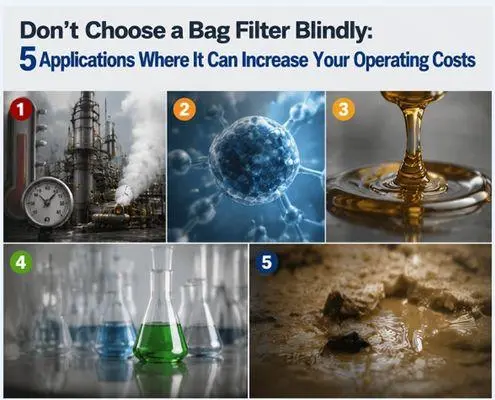
Don't Choose a Bag Filter Blindly: 5 Applications Where It Can Increase Your Operating Costs
Introduction: A Bag Filter Is Not Always the Most Cost-Effective Choice
In industrial liquid filtration, bag filters are widely used because they are affordable, easy to maintain, and suitable for many common applications.
They are commonly used in:
· Water treatment;
· Food and beverage processing;
· General chemical filtration;
· Industrial process water;
· Cooling water filtration.
For these applications, bag filters offer excellent value with:
· Low initial investment;
· Simple operation;
· Easy filter bag replacement;
· Good dirt-holding capacity.
However, a bag filter is not a universal filtration solution.
When the operating conditions exceed the capability of a filter bag system, choosing a bag filter can actually increase your total operating costs due to:
· Frequent filter bag replacement;
· High maintenance requirements;
· Increased downtime;
· Unstable filtration performance;
· Higher labor and production costs.
The right filtration solution is not always the cheapest equipment. It is the one that best matches your process conditions.
Learn more about choosing the right filter bag material for different industries, please check our previous article:
PP vs Polyester vs Nylon vs PTFE Filter Bags: Which Material Is Right for Your Industry?
In this article, we will discuss 5 industrial applications where bag filters may not be the best choice and introduce better alternatives.
1. High Temperature and High Pressure Applications
Why Bag Filters May Not Be Suitable
High-temperature and high-pressure filtration is common in industries such as:
· Petrochemical processing;
· Chemical production;
· Hot oil filtration;
· High-pressure process systems.
Although some filter bags can handle elevated temperatures, most bag filter systems have limitations in:
· Filter media temperature resistance;
· Mechanical strength;
· Sealing performance.
Under harsh conditions, problems may occur:
· Filter bag deformation;
· Material aging;
· Reduced strength;
· Seal leakage.
For continuous industrial operation, these risks can lead to unexpected downtime and increased maintenance costs.
Recommended Alternative: Metal Filters
For demanding applications, metal filters are usually a better solution.
Common options include:
· Sintered stainless steel filter cartridges;
· Stainless steel mesh filters.
Advantages:
· Excellent temperature resistance;
· High pressure capability;
· Strong mechanical strength;
· Reusable after cleaning.
Typical applications:
· High-temperature chemical filtration;
· Petrochemical processes;
· High-pressure liquid filtration.
2. Ultra-Fine Filtration Requirements (<1 Micron)
Why Bag Filters May Not Be Suitable
Bag filters are mainly designed for:
· Particle removal;
· Pre-filtration;
· General industrial liquid filtration.
However, industries such as:
· Semiconductor manufacturing;
· Pharmaceutical production;
· Electronics;
· High-purity chemical processing;
often require filtration accuracy below 1 micron, such as:
· 0.45 μm;
· 0.2 μm;
· 0.1 μm.
In these applications, bag filters may not provide the consistent filtration performance required.
Insufficient filtration can affect:
· Product quality;
· Process stability;
· Final product yield.
Recommended Alternative: Cartridge Filters
For precision filtration, cartridge filters are usually preferred.
Common filter types include:
· PP pleated cartridges;
Advantages:
· Stable filtration accuracy;
· Higher particle removal efficiency;
· Suitable for critical processes.
Typical applications:
· Electronics industry;
· Pharmaceutical filtration;
· Ultrapure water systems.
3. High Viscosity Liquid Filtration
Why Bag Filters May Not Be Suitable
High viscosity liquids include:
· Crude oil;
· Lubricating oil;
· Resin;
· Paint;
· Adhesives;
· Syrups.
These liquids flow slowly and create higher resistance during filtration.
When using bag filters, common problems include:
· Rapid clogging;
· Fast pressure increase;
· Reduced flow rate;
· Frequent filter bag replacement.
Although filter bags have a low replacement cost, frequent changes can significantly increase:
· Labor costs;
· Downtime;
· Operating expenses.
Recommended Alternative: Self-Cleaning Filters
For high viscosity applications, self-cleaning filters can provide better performance.
Common options:
· Scraper filters;
· Automatic backwash filters.
Advantages:
· Automatic contaminant removal;
· Reduced manual maintenance;
· Continuous operation capability.
Suitable for:
· High viscosity liquids;
· Large flow systems;
· Continuous production lines.
4. Highly Corrosive Chemical Applications
Why Bag Filters May Not Be Suitable
Corrosive liquids include:
· Strong acids;
· Strong alkaline solutions;
· Aggressive chemical solvents.
Some filter bags are available in corrosion-resistant materials, such as:
· PTFE;
· PVDF.
However, a filtration system includes more than just the filter bag.
Other components must also be chemically compatible:
· Filter housing;
· Support basket;
· Sealing components;
· Connections.
If any component fails, it may cause:
· Leakage;
· Contamination;
· Safety risks.
Recommended Alternative: Corrosion-Resistant Filtration Systems
Depending on the chemical properties, alternatives include:
PTFE Cartridge Filters
Suitable for:
· Strong chemical applications;
· High-purity filtration.
Ceramic Membrane Filters
Advantages:
· Excellent chemical resistance;
· Long service life;
· Stable performance under harsh conditions.
5. High Solid Loading Applications
Why Bag Filters May Not Be Suitable
Applications with high solid concentration include:
· Mining wastewater;
· Paper industry wastewater;
· Metal processing wastewater;
· Industrial sludge treatment.
These liquids often contain large amounts of:
· Suspended solids;
· Sand particles;
· Metal particles.
When using bag filters, the filter bags can become clogged quickly, causing:
· Rapid pressure increase;
· Frequent replacement;
· Increased maintenance workload.
In these situations, the low cost of filter bags may be outweighed by the high operating costs.
Recommended Alternative: Self-Cleaning Filters
For high solid loading applications, self-cleaning filters are often a better choice.
Options include:
· Scraper filters;
· Brush filters;
· Automatic backwash filters.
Advantages:
· Online cleaning;
· Reduced filter replacement;
· Longer continuous operation.
For extremely high solid concentrations, a combination of:
Cyclone Separator + Self-Cleaning Filter
can effectively reduce the load on the filtration system.
Bag Filter vs Alternative Filtration Solutions
Application | Limitation of Bag Filters | Recommended Solution |
High temperature | Material limitation | Metal filter |
High pressure | Limited mechanical strength | Metal filter |
<1 μm filtration | Insufficient precision | Cartridge filter |
High viscosity liquid | Fast clogging | Self-cleaning filter |
High solid loading | Frequent replacement | Self-cleaning filter |
Corrosive chemicals | Material compatibility risk | PTFE / Ceramic filtration |
How to Choose the Right Filtration System?
Before selecting a filtration system, consider these key factors:
1. Filtration Accuracy
· General particle removal → Bag filter
· Fine filtration → Cartridge filter
2. Operating Temperature and Pressure
· High temperature or high pressure → Metal filter
3. Solid Concentration
· High contamination load → Self-cleaning filter
4. Liquid Characteristics
Always evaluate:
· Viscosity;
· Chemical compatibility;
· Particle concentration;
· Required operating time.
Conclusion: Choose the Right Filter, Not Just the Cheapest One
Bag filters remain one of the most economical solutions for many industrial liquid filtration applications.
However, for challenging conditions, other filtration technologies may provide better long-term performance and lower total operating costs.
In simple terms:
· Cartridge filters → Precision filtration
· Self-cleaning filters → High contamination and continuous operation
· Metal filters → High temperature, high pressure, and harsh environments
The best filtration solution is not the one with the lowest purchase price — it is the one that delivers the lowest total cost throughout the entire operating life.