Sediment Filter vs Carbon Filter: Which One Do You Need
Sediment Filter vs Carbon Filter: Which One Do You Need — Choosing the Best Water Treatment Solution
In modern water treatment systems, Sediment filtration and Carbon filtration are two of the most common and essential methods. Each offers distinct advantages in terms of function, mechanism, and application scenarios. They can be used individually or in combination to achieve the best water quality. This article provides a detailed comparison to help you choose the ideal filtration solution based on your needs.
Fundamentals of Industrial Filtration
Industrial filtration refers to removing contaminants from liquids, gases, or air through physical or chemical means, ensuring efficient system operation, stable product quality, and compliance with environmental standards.
In water treatment, filtration plays a crucial role in:
● Keeping equipment and pipelines clean and extending their lifespan.
● Improving process water and final product quality.
● Ensuring potable or process water meets safety standards.
What is Sediment Filtration?
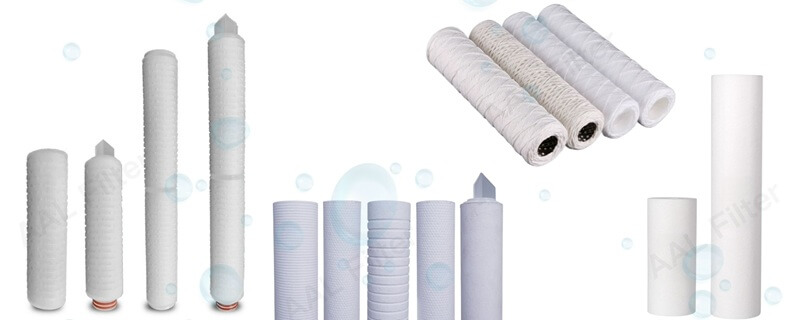
Sediment filtration is a physical filtration method primarily designed to remove large solid particles (such as sand, silt, rust, and debris) from water. It usually serves as the first filtration stage in water treatment systems, improving water clarity and protecting downstream systems such as Carbon filters, Reverse Osmosis (RO) membranes, Nanofiltration (NF), and Ultrafiltration (UF) systems from clogging or damage.
Materials and Features of Sediment Filters
Common materials used in Sediment filters include:
● Polypropylene (PP): Chemically stable, non-toxic, highly corrosion-resistant, suitable for most water conditions.
● Polyester: High temperature and pressure resistance, ideal for industrial applications.
● Nylon: Wear-resistant, suitable for high-precision filtration.
● Filter paper: Economical, often used in non-critical or disposable applications.
Key features:
🔹Efficient removal of suspended particles.
🔹Protection of downstream systems, extending the service life of fine filters and membranes.
🔹Simple maintenance and relatively low operating costs.
🔹Wide application: residential, industrial, agricultural, municipal, and more.
Types of Sediment Filters
1️⃣ String Wound Filter (Depth Filter)
Also known as a Depth filter, it is made by precisely winding yarn (usually polypropylene, cotton, or fiberglass) around a central core.
Features:
🔹Gradual density structure for multi-layer contaminant capture.
🔹High dirt-holding capacity, suitable for high contaminant loads.
🔹Ideal for industrial pre-filtration and large flow systems.
2️⃣ Melt Blown Filter (Depth Filter)
Manufactured using a polypropylene melt-blown process, forming layers of progressively finer fibers.
Features:
🔹Gradually decreasing pore size from outer to inner layers for gradient filtration.
🔹High dirt-holding capacity with low pressure drop.
🔹Widely used for drinking water, industrial water, and food & beverage pre-treatment.
3️⃣ Pleated Filter (Surface Filter)
Also known as a Surface filter, it uses folded media to increase the filtration surface area.
Features:
🔹Large surface area, high filtration efficiency, lower pressure drop.
🔹Easy to backwash or replace, long service life.
🔹Suitable for high-precision applications and longer replacement intervals.
4️⃣ Bag Filter
Uses a filter bag installed in a dedicated housing, suitable for high-flow scenarios.
Features:
🔹Simple installation and replacement, minimal maintenance downtime.
🔹Effective for coarse particle removal and pre-filtration in multi-stage setups.
🔹Common in industrial circulating water, chemical processing, coatings, and metalworking fluids.
What is Carbon Filtration?
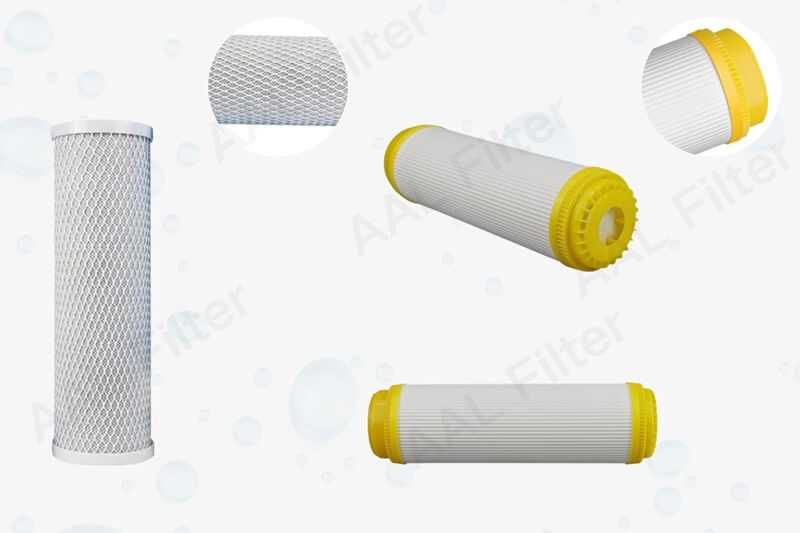
Carbon filtration utilizes carbon materials with high surface area and strong adsorption capacity to remove dissolved organic compounds, free chlorine, odors, heavy metals, volatile organic compounds (VOCs), and some micro-pollutants.
Carbon filters are often placed in the mid-to-late stages of water treatment systems to improve sensory quality (taste and odor) and enhance safety, especially in drinking water, food & beverage, pharmaceutical, and electronics ultra-pure water applications.
Materials and Features of Carbon Filters
The core material is Activated Carbon, which functions through physical adsorption, chemical adsorption, and catalytic reduction.
Types of activated carbon:
● Coal-based: Made from anthracite or coal powder, highly developed pore structure, ideal for industrial water and wastewater.
● Wood-based: High microporosity, suitable for removing larger organic molecules.
● Coconut shell-based: High microporosity and mechanical strength, widely used in premium drinking water and high-end water purification.
Key features:
🔹Extremely high surface area (1,000–2,000 m²/g) for strong adsorption.
🔹Effective in removing odors and improving taste.
🔹Broad-spectrum adsorption for various organic pollutants and some heavy metals.
🔹Highly adaptable, can be combined with Sediment filtration, RO, or UF systems.
🔹Flexible applications for residential, commercial, and industrial scenarios.
Types of Carbon Filters
1️⃣ Granular Activated Carbon (GAC) Filter
Filled with loose granular carbon inside the filter.
Features:
🔹High flow rates, suitable for large systems.
🔹Excellent for removing chlorine, odors, color, and organic compounds.
🔹Often combined with post-filters or microfiltration to ensure quality.
2️⃣ Carbon Block (CTO) Filter
Made by compressing carbon powder with a binder into a dense block.
Features:
🔹Smaller pore sizes, also capture fine suspended particles.
🔹More stable adsorption performance, clearer output water.
🔹Commonly used in premium water dispensers, coffee machines, and residential systems.
3️⃣ Powdered Activated Carbon (PAC) Filter
Uses powdered carbon, often blended into specific mixed media or used as a pre-treatment additive.
Features:
🔹Strong instantaneous adsorption for trace contaminants.
🔹Suitable for high-precision industrial water (e.g., electronics, pharmaceutical).
4️⃣ Catalytic Carbon Filter
Uses specially treated carbon (oxidized or surface-modified).
Features:
🔹Efficient at removing chloramines, hydrogen sulfide, and challenging compounds.
🔹Widely used in municipal water supply or specialized water improvement projects.
5️⃣ Impregnated Carbon Filter
Incorporates silver, copper, or other antimicrobial agents into the carbon.
Features:
🔹Provides antibacterial properties to inhibit bacterial growth.
🔹Suitable for storage tanks, beverage dispensers, and point-of-use systems to ensure hygiene.
Main Differences: Sediment Filtration vs. Carbon Filtration
Aspect | Sediment Filtration | Carbon Filtration |
Target Contaminants | Large particles (sand, silt, rust) | Dissolved organics, chlorine, odors, VOCs |
Filtration Mechanism | Physical interception | Chemical adsorption |
Application Stage | Pre-treatment | Post-treatment |
Filter Lifespan | Depends on particle load | Depends on organic contaminant concentration |
Main Purpose | Protect downstream equipment | Improve water quality and taste |
Applications
Sediment Filters
● Residential water: Prevent sand and silt from entering plumbing and appliances.
● Industrial water: Pre-treatment to protect RO membranes or precision instruments.
● Agricultural irrigation: Prevents nozzle clogging and ensures safe crop water.
● Municipal water: Removes suspended solids introduced during distribution.
Carbon Filters
● Drinking water: Remove chlorine and odors, improve taste.
● Food & beverage: Ensure pure water for processing, protect product quality.
● Aquariums and ponds: Remove harmful chemicals, maintain healthy ecosystems.
● Labs & medical: Provide ultra-pure water, ensure experimental accuracy.
Should You Use Both?
Absolutely! Using Sediment filtration first removes large particles, protecting the Carbon filter and extending its lifespan. The Carbon filter then polishes the water by removing dissolved contaminants and improving taste and odor.
This multi-stage setup has become standard in both industrial and residential systems, delivering higher water quality while reducing overall maintenance costs.
Conclusion and Recommendation
Both Sediment filtration and Carbon filtration have their unique advantages. Choosing the right solution depends on your source water quality, types of contaminants, and application requirements. For most users, combining both is the optimal approach to achieve safe, clean, and great-tasting water.
If you'd like a customized water filtration solution, AAL Filter offers a wide range of Sediment filters, Carbon filters, and combination systems. We support flexible configurations to help you tackle any water treatment challenge and create a highly efficient system tailored to your needs.
Frequently Asked Questions (FAQ)
Q1: How often should I replace a sediment filter?
🅰️It depends on water turbidity and usage. Generally, it's recommended to inspect every 3–6 months and replace if clogged to maintain flow and performance.
Q2: Can I use a carbon filter alone?
🅰️Yes, but if your water contains many suspended particles, a pre-filtration step using a sediment filter is advisable to avoid premature clogging.
Q3: Will activated carbon cause secondary contamination?
🅰️If not replaced on time, it can become saturated and harbor bacteria. Always replace as recommended to ensure safe, effective filtration.
Q4: Can sediment filters remove bacteria?
🅰️No, sediment filters target large particles only. For bacteria and viruses, use UF, NF, or RO systems.
Q5: Can carbon filters remove heavy metals?
🅰️They can adsorb some metals (e.g., lead, mercury) but not completely. Dedicated heavy metal filters or RO systems are better choices.
Q6: Which sediment filter type should I choose?
🅰️For large particles, bag filters are ideal. For finer particles, pleated or melt-blown filters work best. String wound filters are excellent for high-load or depth filtration needs.
Q7: How do I know when to change a carbon filter?
🅰️When water starts to smell or taste bad or chlorine levels rise, the filter is likely saturated and should be replaced.
Q8: Will carbon filtration change water pH?
🅰️Usually, no. Carbon primarily removes organics, chlorine, and odors without significantly affecting pH.
Q9: Will using both filters reduce flow rate?
🅰️ A well-designed system balances flow and filtration. Significant flow drops typically indicate clogged filters needing replacement.
Q10: Does AAL Filter provide customized multi-stage solutions?
🅰️Yes! We specialize in personalized Sediment filtration and Carbon filtration solutions, tailored to specific water qualities, flow requirements, and industry standards.
AAL Filter: Your Trusted Partner in Premium Industrial Filtration Solutions
Contact us For more product details or to request a sample, contact our technical sales team. AAL Filter is committed to delivering high-performance, reliable industrial filtration solutions globally.