How to Choose the Right Mesh Size for a Strainer – Complete Guide with Micron vs Mesh Conversion
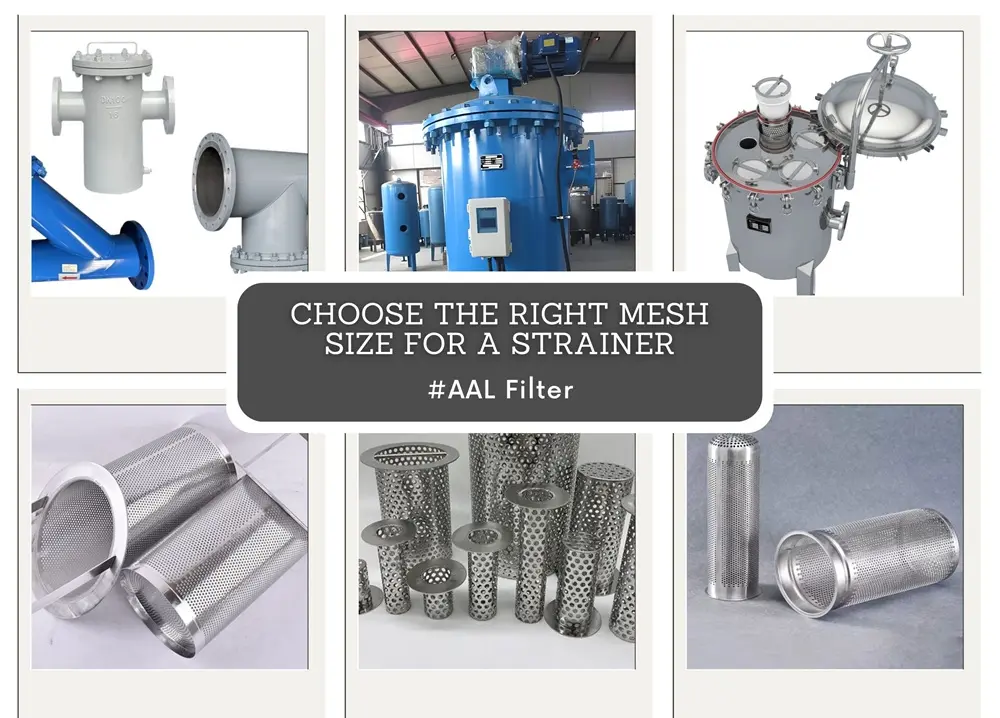
Choosing the right mesh size for strainers is essential for achieving reliable filtration, whether in industrial water treatment, chemical processing, or general particle separation. Understanding the relationship between microns, mesh numbers, and filtration efficiency helps prevent clogging, reduce pressure drop, and optimize system performance.
In this guide, AAL Filter, a trusted manufacturer of customized Y strainers, basket strainers, duplex strainers, and self-cleaning filter Housing, explains how to select the most suitable mesh size, with practical conversion charts and application insights.
1. What is Mesh Size?
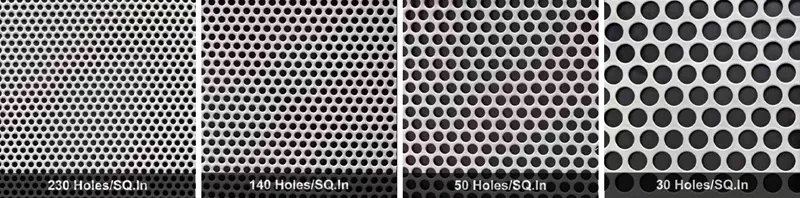
Mesh size indicates the number of openings per linear inch of mesh. For example, a 100 mesh screen has 100 openings per inch, which corresponds to an approximate opening size of 149 microns. The higher the mesh number, the finer the filtration.
● Micron (µm): A micron is one-millionth of a meter (1 µm = 0.001 mm).
● Mesh Number: Defined in ASTM E11, it refers to how many holes per inch the mesh contains.
There is no exact linear equivalence between mesh and microns, but conversion charts help approximate the filtration level.
2. How to Select the Right Mesh Size?
When choosing a strainer mesh:
● Measure particle size or refer to a particle size distribution chart.
✅Define the filtration requirement
● For example, removing sand (coarse particles) may need 40–60 mesh, while filtering silt or pollen requires 200–400 mesh.
✅Balance filtration efficiency and flow rate
● Fine mesh (high mesh number): Removes smaller particles but causes higher pressure drop and frequent cleaning.
● Coarse mesh (low mesh number): Allows higher flow rate and less clogging but filters fewer particles.
✅Consider operating conditions
● Temperature, pressure, and strainer material (e.g., stainless steel) affect the choice.
💡General rule: Choose a mesh slightly smaller than the particle size you want to remove.
3. Microns vs Mesh Equivalence
Although mesh and micron do not have an exact one-to-one conversion, here’s a useful reference chart:
Mesh Size Comparison Chart
Mesh Number | Inches | Microns | Millimetres |
3 | 0.265 | 6730 | 6.73 |
4 | 0.187 | 4760 | 4.76 |
5 | 0.157 | 4000 | 4 |
6 | 0.132 | 3360 | 3.36 |
7 | 0.111 | 2830 | 2.83 |
8 | 0.0937 | 2380 | 2.38 |
10 | 0.0787 | 2000 | 2 |
12 | 0.0661 | 1680 | 1.68 |
14 | 0.0555 | 1410 | 1.41 |
16 | 0.0469 | 1190 | 1.19 |
18 | 0.0394 | 1000 | 1 |
20 | 0.0331 | 841 | 0.841 |
25 | 0.028 | 707 | 0.707 |
30 | 0.0232 | 595 | 0.595 |
35 | 0.0197 | 500 | 0.5 |
40 | 0.0165 | 400 | 0.4 |
45 | 0.0138 | 354 | 0.354 |
50 | 0.0117 | 297 | 0.297 |
60 | 0.0098 | 250 | 0.25 |
70 | 0.0083 | 210 | 0.21 |
80 | 0.007 | 177 | 0.177 |
100 | 0.0059 | 149 | 0.149 |
120 | 0.0049 | 125 | 0.125 |
140 | 0.0041 | 105 | 0.105 |
170 | 0.0035 | 88 | 0.088 |
200 | 0.0029 | 74 | 0.074 |
230 | 0.0024 | 63 | 0.063 |
270 | 0.0021 | 53 | 0.053 |
325 | 0.0017 | 44 | 0.044 |
400 | 0.0015 | 37 | 0.037 |
Quick Guide:
● 28 mesh (700 µm): Coarse sand
● 60 mesh (250 µm): Fine sand
● 325 mesh (44 µm): Silt
● 400 mesh (37 µm): Pollen
● 12,000 mesh (12 µm): Red blood cells
● 48,000 mesh (2 µm): Cigarette smoke
4. Frequently Asked Questions (FAQ) about Mesh Size and Strainers
Q1: What is the difference between mesh size and micron rating?
Mesh size refers to the number of openings per inch in a strainer screen, while micron rating indicates the approximate size of particles the mesh can capture. They are related but not directly interchangeable.
Q2: How do I know which mesh size is suitable for my process?
Identify the particle size you need to remove, then select a mesh slightly smaller than that particle. Consider flow rate, operating pressure, and cleaning frequency as well.
Q3: Does a finer mesh always mean better filtration?
Not necessarily. A very fine mesh improves filtration precision but may cause high pressure drop and frequent clogging. Choosing the right balance is key.
Q4: Can AAL Filter provide customized mesh strainers?
Yes. AAL Filter manufactures Y strainers, basket strainers, duplex strainers, and automatic self-cleaning filters in different sizes and materials to meet specific process needs.
5. Conclusion
Selecting the right strainer mesh size is about finding a balance between filtration efficiency and operational stability. Fine mesh ensures precise filtration but increases pressure drop, while coarse mesh allows smoother flow but removes fewer particles.
If you are unsure about the best mesh size for your industrial process, consult with a filtration specialist.
👉 At AAL Filter, we provide customized strainer solutions, including Y Strainers, Basket Strainers, Duplex Strainers, and Automatic Self-Cleaning Filters, manufactured in all sizes and materials to meet your process needs.
Related Articles
Industrial Pipeline Filter Types