
How to Size High Flow Filter Cartridges: A Practical Guide for Industrial Filtration Systems
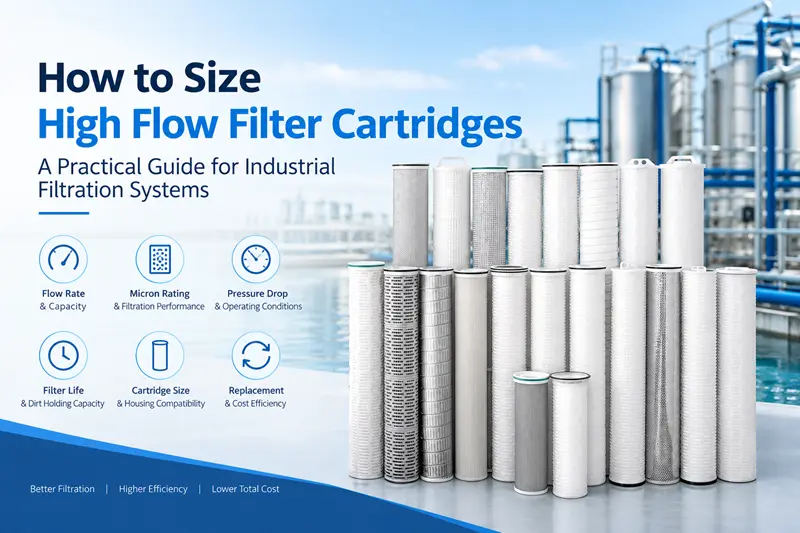
Selecting the right High Flow Filter Cartridges is not simply a matter of choosing the largest cartridge or the highest advertised flow rate.
For industrial water treatment, RO pre-filtration, seawater desalination, process water filtration, and other high-flow applications, proper cartridge sizing requires a combination of system flow rate, filtration rating, pressure drop, dirt loading, filter life, cartridge dimensions, and filter housing compatibility.
One of the most common questions engineers and purchasing teams ask is:
How many High Flow Filter Cartridges does my filtration system need?
A basic calculation starts with:
Required Number of Cartridges = Total System Flow Rate ÷ Design Flow Rate per Cartridge
However, this is only the starting point. The actual cartridge quantity should also consider operating conditions, water quality, pressure drop, filter life, and the design requirements of the filtration system.
This guide explains how to size High Flow Filter Cartridges step by step and what to check before selecting or replacing a cartridge.
What Information Do You Need to Size High Flow Filter Cartridges?
Before starting a sizing calculation, collect the basic information about the filtration system.
Parameter | Why It Matters |
System Flow Rate | Determines the required filtration capacity |
Peak Flow Rate | Helps account for flow fluctuations |
Liquid Type | Determines material and media compatibility |
Micron Rating | Affects filtration performance and pressure drop |
Cartridge Flow Capacity | Used to estimate cartridge quantity |
Initial Pressure Drop | Indicates hydraulic resistance |
Dirt Holding Capacity | Influences cartridge service life |
Operating Temperature | Can affect viscosity and material compatibility |
Existing Filter Housing | Determines physical compatibility |
Cartridge Dimensions | Required for replacement applications |
End Cap / Connection | Determines installation compatibility |
Filter Replacement Pressure | Helps establish maintenance requirements |
The more accurate the input data, the more reliable the High Flow Filter Cartridge sizing result will be.
Step 1: Determine the Total System Flow Rate
The first step is to determine how much liquid the filtration system needs to process.
Flow rate may be specified in:
· m³/h
· L/min
· GPM
For example: Required system flow = 120 m³/h
However, do not automatically use the maximum flow rate shown on a pump or equipment nameplate.
It is useful to distinguish between:
· Normal Operating Flow
· Peak Operating Flow
· Maximum Design Flow
For example:
Flow Condition | Flow Rate |
Normal Operating Flow | 80 m³/h |
Peak Operating Flow | 100 m³/h |
Maximum Design Flow | 120 m³/h |
The appropriate design flow should be determined according to the actual process requirements and operating conditions.
For a filtration system with significant flow fluctuations, designing only around the normal operating flow may result in insufficient filtration capacity during peak operation.
Step 2: Determine the Required Micron Rating
The next step is to determine the required filtration rating.
Common High Flow Filter Cartridge ratings may include:
· 1 μm
· 3 μm
· 5 μm
· 10 μm
· 20 μm
· 40 μm
· 70 μm
· 100 μm
The correct micron rating depends on the liquid being filtered and the requirements of the downstream process.
For example, an RO pre-filtration system may have different requirements from a cooling water system or general process water application.
Do Not Choose the Smallest Micron Rating Automatically
A smaller micron rating does not necessarily mean a better overall filtration solution.
Depending on the filter media and operating conditions, a finer filtration rating may result in:
· Higher initial pressure drop
· Faster filter loading
· Shorter service life
· More frequent cartridge replacement
The appropriate filtration rating should therefore balance:
Filtration Performance + Pressure Drop + Dirt Holding Capacity + Filter Life
Step 3: Determine the Design Flow Rate per Cartridge
Once the system flow and required filtration rating are known, determine the design flow rate per High Flow Filter Cartridge.
This is an important point:
Do not automatically use the manufacturer's maximum flow rate as the design flow rate.
A cartridge may have a published maximum flow capacity, but the recommended continuous operating flow may be lower depending on:
· Filtration rating
· Filter media
· Liquid viscosity
· Contaminant loading
· Pressure drop requirements
· Desired filter life
· Operating temperature
For example, assume:
System Flow Rate = 120 m³/h
and the selected cartridge has a suitable design flow rate of:
30 m³/h per cartridge
The theoretical cartridge quantity is:
120 ÷ 30 = 4 cartridges
Therefore:The theoretical requirement is 4 High Flow Filter Cartridges.
This calculation provides a starting point for system sizing, but the final cartridge quantity should still be checked against pressure drop, filter life, water quality, and housing configuration.
Step 4: Consider the Design Margin
Industrial filtration systems rarely operate under perfectly constant conditions.
Actual operating conditions may vary because of:
· Flow fluctuations
· Changes in feed water quality
· Increased contaminant loading
· Temperature changes
· Cartridge aging
· Process changes
For this reason, engineers may incorporate an appropriate design margin when determining the final number of cartridges.
However, there is no universal percentage that applies to every High Flow Filter Cartridge application.
The appropriate margin should be determined according to:
· Application requirements
· Cartridge performance data
· Liquid quality
· Expected flow variation
· Allowable pressure drop
· Required filter life
· System operating strategy
The objective is to ensure that the filtration system can meet its required performance without unnecessarily oversizing the equipment.
Step 5: Check Pressure Drop
Pressure drop is one of the most important factors in High Flow Filter Cartridge sizing.
A cartridge may have a high advertised flow capacity, but that does not necessarily mean it should operate continuously at that flow rate.
As flow increases, pressure drop across the filter generally increases.
Therefore, cartridge sizing should consider:
· Initial pressure drop
· Operating flow rate
· Maximum allowable pressure drop
· Liquid viscosity
· Temperature
· Filter loading
Ideally, engineers should review the manufacturer's pressure drop versus flow rate data for the specific cartridge.
For example:
Higher Flow Rate
↓
Higher Pressure Drop
↓
Greater Pumping Requirement / Reduced Available Pressure
This is why flow capacity should always be evaluated together with pressure drop.
Step 6: Evaluate Dirt Holding Capacity and Filter Life
Flow capacity is only one part of cartridge performance.
A cartridge that can process a high flow rate initially may not provide an economical solution if it loads rapidly.
Two cartridges can have similar flow capacities but significantly different service lives depending on:
· Filter media
· Filtration structure
· Contaminant concentration
· Particle size distribution
· Feed water quality
· Operating conditions
Therefore, High Flow Filter Cartridge sizing should consider:
Flow Capacity + Dirt Holding Capacity + Expected Filter Life
This is particularly important for industrial systems with high suspended solids or variable feed water quality.
Step 7: Check Cartridge Length and Dimensions
After determining the required filtration capacity, verify the physical dimensions of the cartridge.
Important dimensions include:
· Overall Length
· Outside Diameter
· Inside Diameter
· End Cap Configuration
· Connection Type
· O-Ring Position
· Sealing Structure
For a new filtration system, the cartridge dimensions should be selected together with the filter housing.
For a replacement application, the existing cartridge dimensions should be measured or confirmed from the original manufacturer's documentation.
Why Dimensions Alone Are Not Enough
Two cartridges may have similar overall dimensions but use different:
· End caps
· Connections
· O-rings
· Flow directions
· Locking mechanisms
· Sealing structures
Therefore, a cartridge should not be considered a direct replacement based on length and diameter alone.
Step 8: Check High Flow Filter Housing Compatibility
The filter housing is an important part of the sizing process.
A suitable High Flow Filter Cartridge must be compatible with the housing in terms of:
· Cartridge quantity
· Cartridge length
· Cartridge diameter
· End cap
· Connection
· Flow direction
· Sealing method
· Housing pressure rating
· Available installation space
For replacement projects, it is especially important to identify the existing housing configuration before selecting an alternative cartridge.
The final filtration system should be considered as a complete combination:
Filter Cartridge + Filter Housing + Flow Rate + Operating Conditions
rather than selecting the cartridge independently.
Step 9: Consider the Application
The same High Flow Filter Cartridge may not be suitable for every liquid filtration application.
The sizing process should consider the specific application.
RO Pre-Filtration
For RO pre-filtration, important considerations include:
· Raw water quality
· Suspended solids
· Turbidity
· SDI
· Required micron rating
· RO membrane protection requirements
· Cartridge service life
The objective is to provide suitable pretreatment before the RO membrane rather than simply selecting the finest available cartridge.
Seawater Desalination
Seawater filtration can involve relatively high flow rates and variable suspended solids.
Sizing should consider:
· Feed water characteristics
· Pretreatment configuration
· Flow rate
· Cartridge loading
· Pressure drop
· Required replacement interval
High Flow Filter Cartridges can be used as part of the pretreatment or polishing stages, depending on the overall system design.
Industrial Water Treatment
For industrial water treatment, cartridge sizing may depend on:
· Raw water source
· Process requirements
· Particle concentration
· Flow variation
· Required filtration rating
· Downstream equipment
A customized cartridge configuration may be appropriate when standard products do not match the existing system.
Worked Example: How Many High Flow Filter Cartridges Do You Need?
Let's consider a simplified industrial water filtration application.
Application Requirements
· System Flow Rate: 120 m³/h
· Liquid: Industrial Water
· Required Filtration: 5 μm
· Selected Cartridge Design Flow: 30 m³/h per cartridge
Step 1: Calculate the Theoretical Cartridge Quantity
Use:
Required Number of Cartridges = System Flow ÷ Design Flow per Cartridge
Therefore:
120 ÷ 30 = 4
The theoretical requirement is: 4 High Flow Filter Cartridges
Step 2: Check Operating Conditions
The engineer should then verify:
· Pressure drop at 120 m³/h
· Expected contaminant loading
· Cartridge service life
· Flow fluctuations
· Existing housing capacity
· Allowable operating pressure
Step 3: Determine the Final Configuration
The final cartridge quantity should be determined after reviewing these operating factors.
This illustrates an important principle:
Cartridge sizing is not just a mathematical flow calculation.
It is an engineering process that combines hydraulic capacity, filtration performance, cartridge life, and equipment compatibility.
Common High Flow Filter Cartridge Sizing Mistakes
Avoiding common sizing mistakes can help prevent unnecessary operating costs and maintenance problems.
Mistake 1: Using Maximum Flow as the Design Flow
A published maximum flow rate should not automatically be treated as the recommended continuous operating flow.
Always check the operating conditions and pressure drop at the required flow rate.
Mistake 2: Choosing Only by Micron Rating
Micron rating is important, but it is not the only selection criterion.
Flow capacity, pressure drop, dirt holding capacity, and filter life also need to be considered.
Mistake 3: Ignoring Pressure Drop
A cartridge may provide sufficient nominal flow capacity but still create excessive pressure drop at the actual operating flow.
Always evaluate pressure drop at the intended operating conditions.
Mistake 4: Ignoring Dirt Loading
Feed water with a high contaminant load can cause cartridges to load quickly.
Sizing should consider the expected filter life and replacement frequency.
Mistake 5: Matching Dimensions but Ignoring End Cap Design
A cartridge with the same length and diameter may not be a direct replacement if the end cap, connection, or sealing structure is different.
Mistake 6: Comparing Only Cartridge Price
The lowest cartridge unit price does not necessarily represent the lowest total filtration cost.
Consider:
Cartridge Cost + Replacement Labor + Downtime + Disposal + Inventory
Mistake 7: Forgetting Existing Housing Capacity
Before selecting a replacement cartridge, verify that the existing filter housing can accommodate the cartridge configuration and required flow.
High Flow Filter Cartridge Sizing Checklist
Before placing an order, confirm the following:
☐ System flow rate
☐ Peak flow rate
☐ Liquid type
☐ Required micron rating
☐ Cartridge design flow rate
☐ Initial pressure drop
☐ Dirt holding capacity
☐ Expected filter life
☐ Cartridge length
☐ Cartridge diameter
☐ End cap configuration
☐ O-ring / sealing specification
☐ Flow direction
☐ Existing filter housing
☐ Operating temperature
☐ Allowable pressure drop
Having this information available makes it much easier to select the appropriate High Flow Filter Cartridge configuration.
Need Help Sizing Your High Flow Filter Cartridges?
If you are unsure how many High Flow Filter Cartridges your system requires, a cartridge manufacturer can help evaluate the application based on the actual operating conditions.
For an existing filtration system, provide:
· Existing cartridge model
· Cartridge length and diameter
· Micron rating
· Required flow rate
· Existing filter housing model
· Liquid type
· Operating temperature
· Current cartridge service life
· Application requirements
AALFilter can evaluate these parameters and help develop a suitable High Flow Filter Cartridge configuration for industrial water treatment, RO pre-filtration, process filtration, and other high-flow liquid filtration applications.
Partner with AALFilter for Your High Flow Filtration Solution
From standard high flow cartridges to customized replacement solutions, AALFilter supports OEM and ODM requirements based on cartridge dimensions, filtration media, micron rating, end cap configuration, sealing requirements, and system flow conditions.
Provide your existing cartridge specifications and application requirements to discuss a suitable High Flow Filter Cartridge solution with AALFilter.