
Microfiltration vs Ultrafiltration vs Nanofiltration vs Reverse Osmosis: What's the Difference?
When people talk about wastewater treatment, biological treatment is often the first thing that comes to mind.
Engineers look at COD, BOD, ammonia nitrogen, suspended solids, and whether the secondary clarifier can consistently produce the required effluent quality.
But in recent years, membrane technology has become increasingly important in water and wastewater treatment.
Membranes are now widely used in industrial wastewater treatment, hospital wastewater treatment, landfill leachate treatment, water reuse, and seawater desalination.
This naturally raises several questions:
· What does a membrane actually do?
· Why can a membrane turn treated wastewater into high-quality reuse water?
· What is the difference between microfiltration, ultrafiltration, nanofiltration, and reverse osmosis?
· Does a smaller pore size always mean better filtration?
Although MF, UF, NF, and RO are all membrane technologies, they are designed for different separation requirements. Let's take a closer look.
What Is Membrane Filtration?
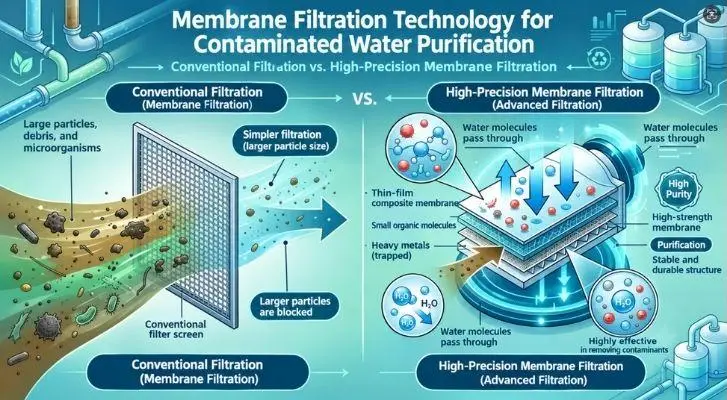
Membrane filtration can be simply understood as using a very fine "sieve" to separate contaminants from water.
Unlike conventional filters, which mainly remove relatively large particles, membrane systems can separate much smaller contaminants, including colloids, microorganisms, macromolecules, and dissolved salts, depending on the membrane technology.
Water may contain many different types of contaminants:
· Suspended solids
· Bacteria and microorganisms
· Colloids
· Organic compounds
· Dissolved salts and ions
Different membrane technologies target different types of contaminants. However, membrane selection is not simply about choosing the membrane with the smallest pore size. The right choice depends on the feed-water quality, target contaminants, required water quality, and operating conditions.
MF vs UF vs NF vs RO: What Is the Difference?
The four major pressure-driven membrane technologies can be broadly compared as follows:
Membrane Type | Pore Size | Driving Pressure | Retained Substances | Permeable Substances |
Microfiltration (MF) | 0.1um - 10um | 0.1 - 0.3mpa | Microorganisms | Colloids, viruses, organic matter, color, salts, water |
Ultrafiltration (UF)
(Common for MBR) | 0.001um- 0.1um | 0.3 - 1.0mpa | Colloids, viruses, macromolecules | Color, hardness, salts, water |
Nanofiltration (NF) | 1 - 10nm | 0.5 - 1.0mpa | Color, hardness | Salts, water |
Reverse Osmosis (RO) | < 1nm | 2.0 - 10mpa | Salts, metal ions, low-molecular-weight organics | Water |
In simple terms:
MF focuses on larger particles.
UF provides finer solid-liquid separation.
NF selectively removes certain dissolved contaminants.
RO provides deep desalination and dissolved-solids removal.
Microfiltration (MF): Removing Larger Particles
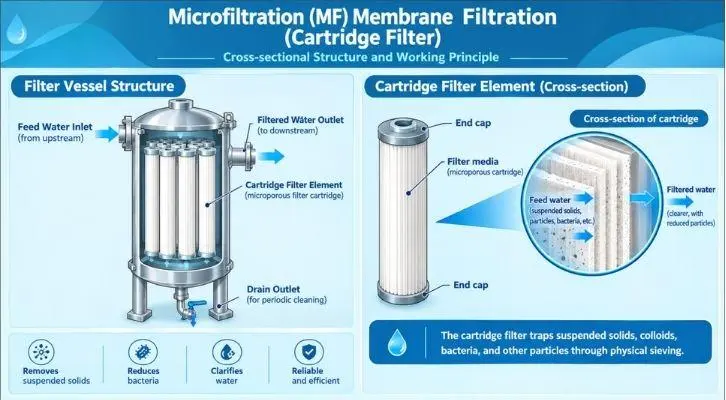
Microfiltration (MF) is one of the relatively coarse membrane processes. It is mainly used to remove suspended solids, turbidity, algae, larger particles, and some microorganisms.
For example, surface water may contain sediment, algae, and suspended particles. Removing these contaminants before downstream treatment can help protect more sensitive membrane systems.
Typical applications of MF include:
· Surface water treatment
· Industrial water treatment
· Wastewater treatment
· Process water clarification
· Pretreatment for downstream membrane systems
The main role of MF is therefore particle removal and pretreatment, rather than producing high-purity water.
Ultrafiltration (UF): A Key Membrane Technology for Wastewater Treatment
Ultrafiltration (UF) provides finer separation than MF and can retain colloids, bacteria, macromolecules, and fine suspended contaminants while allowing water and smaller dissolved substances to pass through.
This makes UF particularly useful in wastewater treatment, water reuse, and membrane bioreactor (MBR) systems.
In a conventional activated sludge system, biological treatment is followed by a secondary clarifier, where activated sludge is separated from treated water mainly through gravity sedimentation.
In an MBR system, UF membranes provide the solid-liquid separation instead.
In simple terms:
Conventional treatment:
Sludge is separated by settling.
MBR:
Sludge is retained by the membrane.
Because the membrane acts as a physical barrier for suspended solids and microorganisms, MBR systems can maintain higher mixed liquor concentrations while producing consistently low suspended solids in the permeate.
This can provide several advantages:
· Stable effluent quality
· Excellent solid-liquid separation
· Higher MLSS concentrations
· Smaller footprint
· Improved suitability for water reuse
For these reasons, UF membranes are widely used in MBR systems, industrial wastewater treatment, and water reuse applications.
Nanofiltration (NF): Selective Removal of Dissolved Contaminants
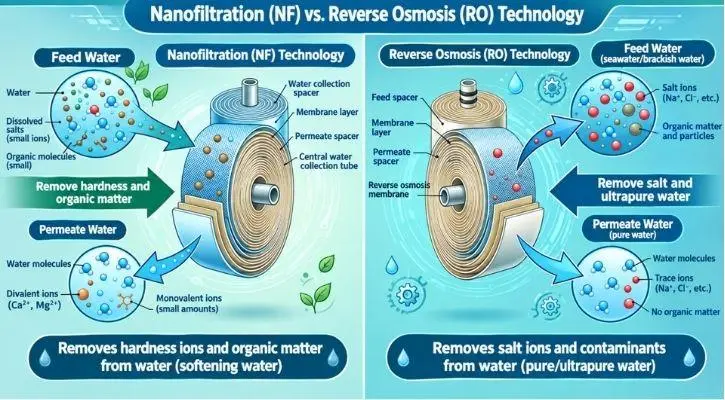
Nanofiltration (NF) sits between ultrafiltration and reverse osmosis in terms of separation capability, but it should not simply be considered a smaller-pore UF membrane.
NF is particularly useful for the selective removal of certain dissolved contaminants, including:
· Calcium and magnesium
· Water hardness
· Divalent ions
· Color
· Some dissolved organic compounds
· Certain dissolved salts
For example, if the main problem is water hardness, UF will generally not be effective because calcium and magnesium ions are too small to be retained. NF can provide a more suitable solution for this type of application.
Common applications include:
· Water softening
· Industrial wastewater reuse
· Process water treatment
· Partial desalination
· Removal of selected organic contaminants
This selective separation capability is one of the main differences between NF and RO.
Reverse Osmosis (RO): Deep Desalination
Reverse osmosis (RO) is one of the most widely used membrane technologies for desalination and high-purity water production.
Unlike MF and UF, which primarily target particles, colloids, and microorganisms, RO is used when significant removal of dissolved salts and other dissolved contaminants is required.
RO can remove or significantly reduce:
· Total dissolved solids (TDS)
· Sodium
· Chloride
· Dissolved salts
· Many inorganic contaminants
· Many dissolved organic contaminants
Why Does Reverse Osmosis Require High Pressure?
RO works differently from conventional filtration.
Under natural osmosis, water tends to move through a semi-permeable membrane toward the side with a higher concentration of dissolved substances. Reverse osmosis applies external pressure to overcome osmotic pressure and drive water in the opposite direction.
The process produces two streams:
Feed water → RO membrane → Permeate + Concentrate
The permeate is the treated water, while the concentrate contains a higher concentration of rejected salts and other contaminants.
Because RO requires relatively high pressure, its energy consumption and operating costs are generally higher than those of MF and UF. It is therefore typically used when deep desalination or high-quality water is required.
Typical applications include:
· Seawater desalination
· Brackish water treatment
· Industrial water reuse
· High-purity water production
· Process water treatment
Which Membrane Should You Choose?
The best membrane is not necessarily the one with the smallest pore size. The right choice depends on the treatment objective and the quality of the feed water.
If you mainly need to remove suspended solids:
MF or UF
If you need solid-liquid separation in an MBR:
UF
If you need to reduce hardness or selectively remove certain ions:
NF
If you need significant desalination:
RO
The final selection should also consider:
· Feed-water quality
· Target contaminants
· Required water quality
· Recovery rate
· Energy consumption
· Membrane fouling potential
· Cleaning and maintenance requirements
For example, using RO to solve a problem that can already be handled effectively by UF may add unnecessary energy consumption and operating costs.
The goal is not to use the most advanced membrane.
The goal is to use the right membrane for the right application.
MF, UF, NF, and RO Can Work Together
MF, UF, NF, and RO are not necessarily competing technologies. In many industrial water treatment systems, different membrane processes are combined to achieve the required water quality.
For example:
Industrial Wastewater Reuse
Biological Treatment → UF → RO → Reuse
Biological treatment reduces biodegradable organic pollutants, UF provides solid-liquid separation, and RO provides deeper removal of dissolved salts.
Seawater Desalination
Pretreatment → UF → RO → Desalinated Water
UF can help remove suspended solids and microorganisms before RO, reducing the contaminant load on the RO system.
The actual process configuration depends on the feed-water characteristics and final water-quality requirements.
Conclusion
Microfiltration, ultrafiltration, nanofiltration, and reverse osmosis may all be called membrane technologies, but they solve different water treatment problems.
MF → Larger particles and suspended solids
UF → Colloids, microorganisms, and solid-liquid separation
NF → Selective removal of hardness, ions, and certain dissolved contaminants
RO → Deep desalination and dissolved-solids removal
Choosing a membrane is not simply a matter of selecting the smallest pore size or highest filtration precision. The right technology depends on the contaminants in the feed water, the required water quality, system performance, and overall operating cost.
In modern industrial water treatment, membrane technology is not simply about removing pollutants. It is increasingly about turning treated wastewater into a reliable water resource for reuse.