
Pall / 3M / Parker High Flow Filter Cartridge Alternatives: A Practical Selection Guide
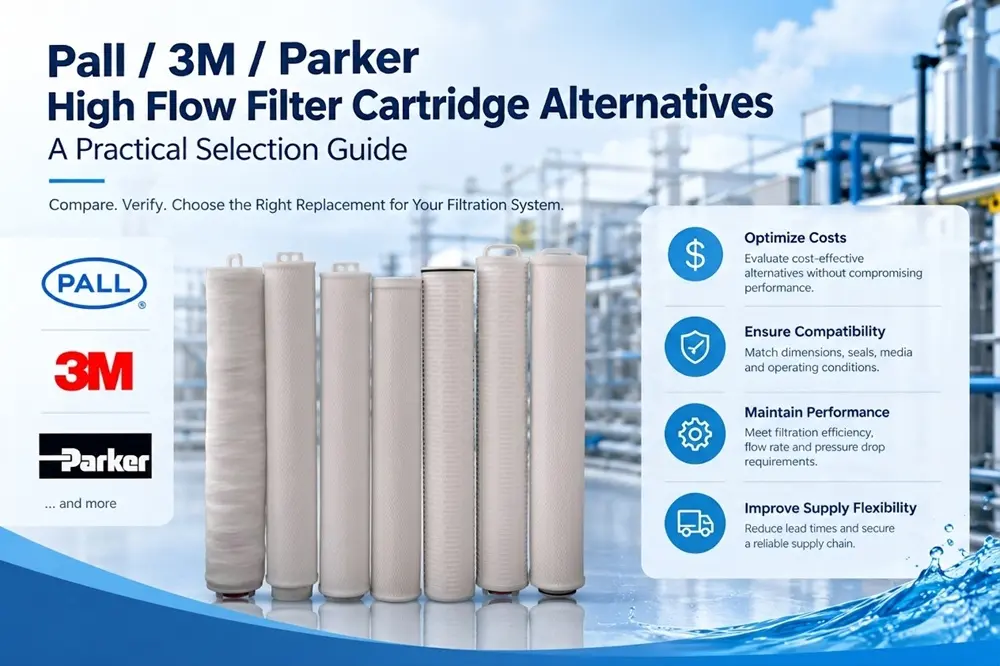
Industrial filtration systems often rely on high flow filter cartridges to handle large liquid volumes while maintaining reliable particulate removal. Pall, 3M, and Parker are well-known names in industrial filtration, and users of these systems may eventually need to evaluate alternative filter cartridges for procurement flexibility, maintenance planning, or cost management.
However, choosing a replacement is not simply a matter of matching the cartridge length or finding a product with a similar appearance. A suitable high flow filter cartridge alternative must meet the original system's dimensional, sealing, filtration, and operating requirements.
This guide explains how to evaluate Pall, 3M, and Parker high flow filter cartridge alternatives, which specifications to compare, and how to select a suitable replacement for industrial liquid filtration applications.
1. Why Consider Pall, 3M, and Parker High Flow Filter Cartridge Alternatives?
There are several reasons industrial users may evaluate alternative high flow filter cartridges.
Optimize Filter Cartridge Procurement Costs
High flow filter cartridges are consumable components that require periodic replacement. In systems with multiple cartridges, recurring replacement costs can become a significant part of the filtration budget.
Evaluating alternative suppliers may provide additional purchasing options and help users compare product pricing. However, a lower unit price does not automatically mean a lower total operating cost.
Filter service life, replacement frequency, maintenance labor, transportation, and potential downtime should also be considered when evaluating the overall cost of ownership.
Improve Supply Chain Flexibility
For industrial facilities that operate continuously, a stable supply of replacement cartridges is important for maintenance planning.
An alternative supplier may provide additional procurement flexibility when the original cartridge has a long lead time, when users want to establish a secondary supply source, or when spare-parts planning is a priority.
Any alternative should first undergo appropriate technical evaluation to confirm compatibility with the existing filtration system.
Find a Suitable Solution for Specific Operating Conditions
Different applications have different requirements for filtration efficiency, flow rate, pressure drop, chemical compatibility, and operating temperature.
Comparing products from different manufacturers allows users to evaluate available filtration media, cartridge configurations, and technical specifications against their actual process requirements.
The objective is not simply to replace one brand with another, but to identify a technically suitable solution for the intended application.
2. Key Specifications to Check When Replacing High Flow Filter Cartridges
The most important step in selecting a high flow filter cartridge alternative is verifying compatibility with the existing filtration system.
Before selecting a replacement for a Pall, 3M, or Parker cartridge, compare the following specifications.
Cartridge Dimensions and End Connections
Dimensional compatibility is the starting point for replacement selection.
Important parameters include:
· Cartridge length and outside diameter
· End-cap design and connection type
· O-ring quantity, dimensions, and position
· Bayonet, locking, or other locating structures
· Installation clearance and cartridge retention method
Two cartridges may have similar dimensions but different end connections or sealing arrangements. These differences can prevent proper installation or compromise sealing.
Before confirming a replacement, compare the original cartridge drawing or physical sample with the proposed alternative's technical drawing.
Filtration Rating and Efficiency
Filtration rating is another essential selection parameter.
Users should verify the required micron rating and determine whether the original specification refers to nominal or absolute filtration. Where available, compare filtration efficiency data obtained under comparable test conditions.
Two cartridges with the same stated micron rating do not necessarily provide identical filtration performance. Media structure, manufacturing processes, and test methods can influence particle retention, initial pressure drop, and dirt-holding capacity.
For applications such as reverse osmosis (RO) pretreatment and industrial process water filtration, replacement performance should be evaluated against the actual requirements of the downstream equipment and process.
Filter Media and Material Compatibility
High flow filter cartridges may use polypropylene (PP) filtration media with a supporting cage and suitable sealing materials.
Before selecting an alternative, confirm:
· Compatibility between the filter media and the process liquid
· Mechanical strength of the support structure
· Chemical compatibility of the sealing materials
· Allowable operating pressure and temperature
· Any application-specific requirements
For corrosive liquids, specialized process fluids, or elevated-temperature applications, visual similarity alone is not sufficient to establish compatibility.
Flow Rate, Pressure Drop, and Dirt-Holding Capacity
A replacement cartridge must meet the filtration system's actual operating requirements, not merely fit inside the housing.
Parameter | What to Verify |
Flow rate | Required operating flow and cartridge capacity under the intended conditions |
Initial pressure drop | Pressure drop at comparable flow, fluid, and test conditions |
Maximum differential pressure | Cartridge differential-pressure limits and replacement criteria |
Dirt-holding capacity | Available test data under defined testing conditions |
Service life | Expected performance based on water quality, contaminant loading, and operating conditions |
Operating pressure and temperature | Compatibility with the cartridge and sealing materials |
Flow rate and pressure drop are affected by factors such as fluid viscosity, temperature, filtration rating, contaminant loading, and effective filtration area.
For this reason, performance figures from different manufacturers should only be compared when the test conditions are sufficiently comparable.
3. Can Pall, 3M, and Parker High Flow Filter Cartridges Be Interchanged?
Not in every case.
Different manufacturers may offer cartridges with similar dimensions or connection styles, but this does not mean every model is directly interchangeable.
A replacement decision should be based on the specific original model, the housing configuration, and the required operating conditions.
Pall High Flow Filter Cartridge Alternatives
When evaluating an alternative to a Pall high flow filter cartridge, begin by identifying the complete original model number.
Check cartridge dimensions, end connections, sealing arrangements, filtration rating, media compatibility, and operating limits. The proposed alternative should then be assessed against these requirements.
3M High Flow Filter Cartridge Alternatives
For a 3M high flow filter cartridge replacement, confirm the original product series and model before comparing alternatives.
Review the connection structure, dimensions, filtration performance, and process compatibility. Do not assume that a cartridge is interchangeable solely because it has a similar appearance or nominal micron rating.
Parker High Flow Filter Cartridge Alternatives
When evaluating a Parker high flow filter cartridge alternative, verify the original cartridge's model number and technical requirements.
Particular attention should be paid to installation interfaces, sealing, flow direction where specified, differential-pressure limits, and compatibility with the existing housing.
These brand-specific evaluations are starting points, not confirmation that a particular alternative is compatible. Final selection requires model-level technical verification.
4. How to Select the Right High Flow Filter Cartridge Replacement
A structured selection process can help reduce the risk of choosing an unsuitable replacement.
Step 1: Identify the Original Cartridge Model
Record the original manufacturer's name, product series, model number, and available technical specifications.
If the model number is unavailable, check the cartridge label, purchasing records, equipment manual, or original supplier documentation.
A clear photograph of the cartridge and its end connections can also help with initial identification.
Step 2: Prepare a Technical Specification Checklist
Collect the key information needed for comparison:
· Cartridge length, outside diameter, and end connection
· O-ring specifications and sealing positions
· Required filtration rating and efficiency
· Filter media and sealing materials
· Operating flow rate, pressure, temperature, and differential-pressure limits
· Process liquid and major contaminants
· Existing filter housing model
Mark any unknown specifications for confirmation rather than assuming they match the original cartridge.
Step 3: Request Technical Documentation
Ask the alternative manufacturer for relevant product drawings, technical data sheets, material information, and available performance test data.
Compare these documents with the original cartridge specifications and the requirements of the existing system.
Step 4: Evaluate System Compatibility
After reviewing the technical documentation, confirm that the proposed cartridge is suitable for the existing housing and operating conditions.
For critical processes or continuously operated systems, consider a controlled trial or other appropriate validation before full-scale replacement.
Monitor relevant operating indicators, which may include flow rate, differential pressure, downstream liquid quality, and cartridge service life.
Avoid replacing all original cartridges in a critical system solely on the basis of dimensional similarity.
Step 5: Compare Total Cost of Ownership
Once technical suitability has been established, compare the overall costs of the available options.
Consider:
· Purchase price per cartridge
· Expected service life and replacement frequency
· Maintenance labor
· Shipping costs and delivery lead time
· Spare-parts inventory requirements
· Potential costs associated with downtime or unsuitable filtration performance
The best alternative is not necessarily the one with the lowest initial price. It is the option that meets the process requirements while providing an appropriate balance of performance, reliability, supply availability, and cost.
5. Why Evaluate AALFilter for High Flow Filter Cartridge Alternatives?
AALFilter supplies industrial filtration products, including high flow filter cartridges for liquid filtration applications.
For customers evaluating alternatives to Pall, 3M, or Parker cartridges, AALFilter can assess a proposed replacement based on the original model information and the customer's operating requirements.
The evaluation may cover:
· Model identification: Review the original cartridge model and available technical documentation.
· Dimensional compatibility: Compare cartridge dimensions, end connections, and sealing arrangements.
· Filtration requirements: Review the required filtration rating and available performance information.
· Operating conditions: Assess flow rate, pressure, temperature, differential pressure, and fluid compatibility.
· Customized design: Evaluate the feasibility of customized designs according to customer flow requirements and specified dimensions or connection configurations.
The availability and suitability of a replacement depend on the original model and its technical requirements. Compatibility and performance should be confirmed before the replacement is approved for use.
If you are sourcing a replacement for an existing high flow filter cartridge, providing the original model number, technical drawing, or clear product photographs can help accelerate the initial evaluation.
6. Frequently Asked Questions About High Flow Filter Cartridge Alternatives
Q1: Can AALFilter high flow filter cartridges replace Pall cartridges?
A replacement may be possible, depending on the specific Pall model and the compatibility of the proposed alternative. Cartridge dimensions, end connections, filtration requirements, materials, and operating conditions should be checked before confirming a replacement.
Q2: Are alternatives available for 3M and Parker high flow filter cartridges?
Specific 3M and Parker models can be evaluated for potential replacement options. The availability of a suitable alternative depends on the original model and the technical requirements of the filtration system.
Q3: Does a replacement cartridge need to be identical to the original?
Not necessarily. A replacement may use a different manufacturing process or internal construction, provided that it meets the system's essential dimensional, sealing, filtration, material, and operating requirements. Any relevant differences should be assessed before use.
Q4: Will an alternative high flow filter cartridge reduce operating costs?
Not automatically. Overall cost depends on purchase price, service life, replacement frequency, maintenance labor, supply availability, and actual operating performance. Compare total cost of ownership rather than purchase price alone.
Q5: What information is needed to identify a replacement cartridge?
Provide the original cartridge model number, dimensions, end-connection details, filtration rating, process liquid, and operating conditions whenever available. A technical drawing or clear photographs of the cartridge and its connections can also help with the initial assessment.
Find a Suitable Alternative for Your High Flow Filtration System
Evaluating alternatives to Pall, 3M, and Parker high flow filter cartridges requires more than a simple dimensional comparison. The replacement should be assessed for installation compatibility, filtration performance, material suitability, operating limits, and overall procurement cost.
By following a structured selection process, industrial users can evaluate alternative suppliers while managing the risks associated with replacing critical filtration components.
AALFilter can help assess potential high flow filter cartridge alternatives based on your original model and application requirements.
Partner with AALFilter to evaluate a suitable high flow filter cartridge replacement for your filtration system. Share your original model number, technical drawing, or product photographs to begin the technical review.