
Top 3 Pretreatment Filter Cartridges for Desalination: Melt Blown, String Wound & High Flow
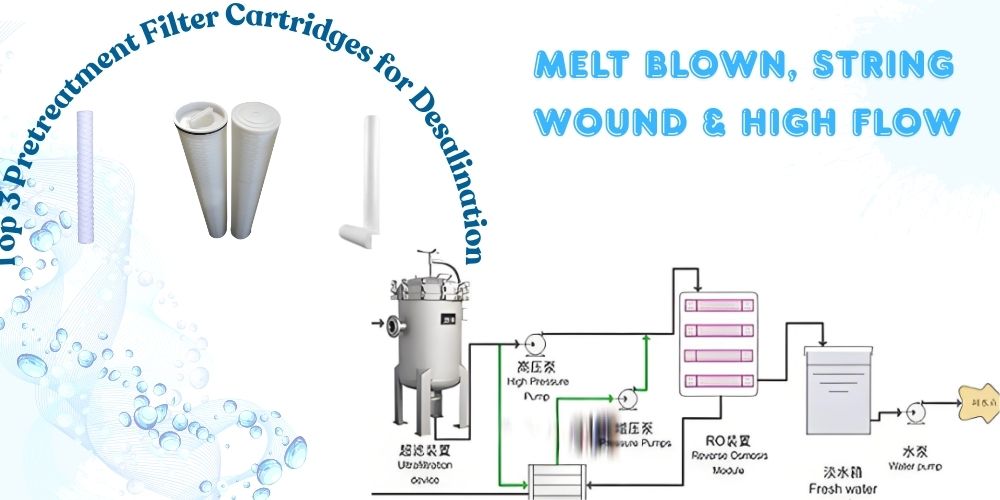
Top 3 Pretreatment Filter Cartridges for Desalination
Introduction
Desalination has become an essential solution for meeting the growing demand for fresh water, especially in coastal and arid regions. Among all technologies, seawater desalination using reverse osmosis (RO) membranes is the most widely adopted. However, the success and efficiency of these systems largely depend on the pretreatment stage.
Pretreatment ensures that contaminants such as suspended solids, silt, sand, and organic matter are removed before water reaches the delicate RO membranes. Without proper pretreatment, membranes can foul, scale, or clog prematurely, resulting in higher costs and downtime.
In this article, we will review the three most commonly used pretreatment filter cartridges in desalination systems: melt blown, string wound, and high flow cartridges. We’ll explore their features, advantages, and best applications to help you choose the right solution for your RO pretreatment process.
Why Pretreatment Matters in Desalination
The Role of Pretreatment in RO Systems
Pretreatment acts as the first line of defense in seawater desalination plants. Since seawater contains a variety of contaminants, pretreatment helps:
Protect RO membranes from fouling and scaling
Reduce the silt density index (SDI) to acceptable levels (typically <5)
Lower chemical cleaning frequency and operating costs
Ensure stable, long-term system performance
Common Pretreatment Technologies
In modern desalination facilities, pretreatment often involves a combination of:
Multimedia filters or sand filters (removing larger particles)
Cartridge filters (melt blown, string wound, or high flow)
Chemical dosing for scaling or biofouling control
Among these, filter cartridges play a critical role in final-stage filtration before water enters the RO system.
Melt Blown Filter Cartridges in Desalination
Structure and Features
Melt blown filter cartridges are manufactured from polypropylene fibers using a melt-blown process. Their gradient pore structure allows them to capture both surface and deeper contaminants.
Key Advantages
Cost-effective: Ideal for large-scale projects where cartridges require frequent replacement
Efficient filtration: Removes fine particles such as sand, rust, and suspended solids
Chemical resistance: Excellent compatibility with seawater conditions
Applications in Seawater Desalination
Used after multimedia filtration as the final barrier before RO membranes
Helps reduce SDI and protect RO membranes from clogging
Recommended in small to medium-sized desalination plants
Common Specifications
Lengths: 40 inches (commonly recommended for desalination plants)
Micron ratings: 1–10 μm are most common for RO pretreatment
String Wound Filter Cartridges in Desalination
Structure and Features
String wound filters are made by winding yarn (commonly polypropylene) around a central core. The winding pattern creates a multi-layer depth filtration structure, ideal for capturing high levels of suspended solids.
Key Advantages
High dirt-holding capacity: Performs well with high turbidity feedwater
Material versatility: While PP is most commonly used, cotton or glass fiber can be chosen for special applications
Durability: Suitable for seawater with variable water quality
Applications in Seawater Desalination
Pretreatment for high-turbidity seawater or oily feedwater
Commonly used in seawater RO pretreatment where particle loads are high
Acts as an intermediate filter before finer melt blown or high flow cartridges
Common Specifications
Lengths: 40–70 inches (standard in desalination plants)
Micron ratings: 1–50 μm
Melt Blown vs. String Wound Filter Cartridges: Which One to Choose?
High Flow Filter Cartridges in Desalination
Structure and Features
High flow cartridges are designed with a large outer diameter (typically 6 inches) and pleated filter media, allowing for much higher flow rates per cartridge compared to standard melt blown or string wound filters.
Key Advantages
High capacity: One high flow cartridge can replace several standard filters
Lower maintenance: Fewer changeouts, reducing downtime and labor costs
Space-saving: Requires smaller housings, ideal for large desalination facilities
Applications in Seawater Desalination
Large-scale seawater RO plants with high flow requirements
Final filtration step before RO membranes to ensure low SDI
Cost-effective solution for plants looking to reduce footprint and operating costs
Common Specifications
Lengths: 40–80 inches
Micron ratings: 1–20 μm
How to Choose the Right High Flow Filter Cartridge?
Comparison of Melt Blown, String Wound, and High Flow Cartridges
Filter Type | Main Advantage | Best Application | Cost | Replacement Frequency |
Melt Blown | Low cost, fine filtration | Initial RO protection, low turbidity water | ★ | Frequent |
String Wound | High dirt holding, robust | Turbid or oily seawater pretreatment | ★★ | Medium |
High Flow | High capacity, fewer cartridges | Large-scale desalination plants | ★★★ | Less frequent |
How to Choose the Right Cartridge for Your Desalination System
When selecting the right filter cartridge for RO pretreatment, consider:
Feedwater quality: Turbidity, SDI, oil content
Plant size: Small/medium plants may rely on melt blown or string wound, while large plants often adopt high flow cartridges
Operational costs: Balance between filter cost, replacement frequency, and system downtime
Combination approach: In many seawater desalination projects, filters are used in sequence (e.g., string wound + melt blown + high flow) to optimize protection and performance.
Conclusion
Efficient RO pretreatment is the cornerstone of reliable and cost-effective seawater desalination. Among the many options available, melt blown, string wound, and high flow filter cartridges remain the most widely used due to their proven performance and adaptability.
Choosing the right filter depends on water quality, plant capacity, and operational preferences. By investing in the correct pretreatment solution, desalination plants can significantly reduce membrane fouling, extend system lifespan, and lower overall costs.
filter cartridges for desalination pretreatment and get tailored recommendations for your project.