
The Ultimate Guide to Membrane CIP: Why Cleaning is Nothing Without Filtration
1. Introduction: The Million-Dollar Cleaning Trap
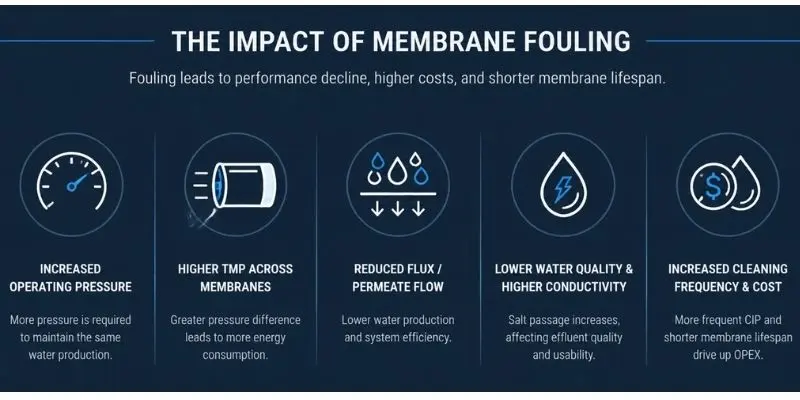
In industrial water treatment—whether it is Seawater Desalination (SWRO), Wastewater Reuse, or Zero Liquid Discharge (ZLD)—Ultrafiltration (UF) and Reverse Osmosis (RO) membranes are your most expensive assets. When performance declines due to fouling or scaling, a Clean-in-Place (CIP) cycle is the standard remedy to restore flux.
However, many plants face a frustrating paradox: membranes are cleaned strictly by the book, yet their lifespan is cut short. UF fibers break, and RO membranes suffer an irreversible drop in salt rejection right after cleaning.
The root cause? Using "dirty water" to wash your million-dollar membranes. Without proper filtration in your CIP loop, the cleaning fluid becomes an abrasive slurry. Instead of cleaning your membranes, you are inadvertently facilitating their physical destruction.
2. What Exactly is Membrane CIP?
Clean-in-Place (CIP) is the method of cleaning membrane surfaces and internal piping without dismantling the equipment. It relies on circulating chemical solutions to dissolve and flush away foulants.
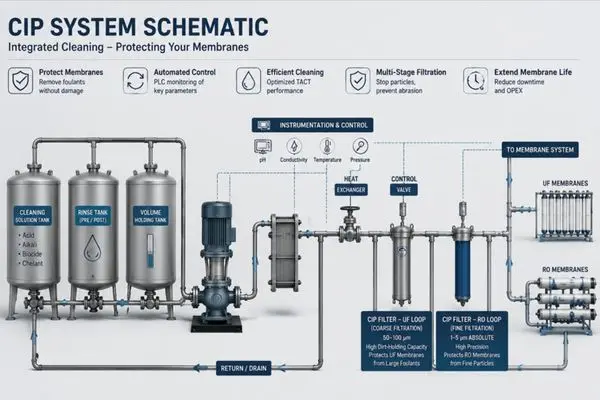
According to ISPE guidelines, a professional CIP system is a highly integrated skid featuring:
Storage Tanks: For chemical dosing, pre-rinsing, and volume holding.
Circulation Pumps: To deliver the high velocities needed to displace foulants.
Heat Exchangers: To maintain optimal reaction temperatures.
Instruments & Controls: PLC-connected sensors for conductivity, pH, pressure, and temperature.
In standard UF+RO systems, the piping and vessels are split into two independent CIP loops because hollow-fiber UF and spiral-wound RO have completely different fluid dynamics.
Within these circuits, the inline CIP filter housing acts as the final safety gate. If this barrier is omitted, your automated skid will pump accumulated hazards straight back into your core membrane stack.
3. The TACT Principle: When Cleaning Forces Turn Destructive
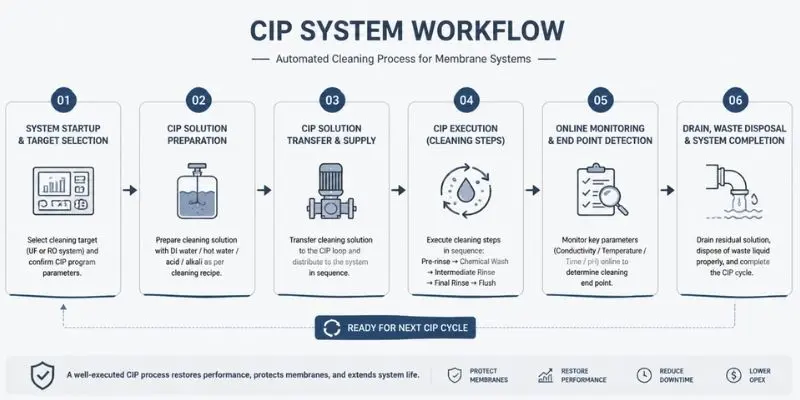
A successful CIP cycle relies on the TACT principle (Temperature, Action, Chemical, and Time) working in harmony. However, without filtration, the crucial Mechanical Action (Fluid Velocity) becomes a major liability:
Temperature (T): Accelerates chemical reactions but also speeds up the kinetic impact of unfiltered particles.
Action (A): High-velocity cross-flow is designed to scour foulants away. The Risk: If the fluid carries rigid debris, high velocity turns it into "sandpaper," scratching the membrane.
Chemical (C): Dissolves foulants, but undissolved powder chemical crystals can physically clog membrane spacers.
Time (T): Longer circulation with contaminated fluid leads to prolonged physical wear and tear.
During CIP, the pump operates at much higher flow rates than normal operation. As chemicals peel off large chunks of bio-sludge from UF membranes or sharp calcium scale from RO sheets, these solids enter the loop. Without a filter, these hard crystals act as micro-projectiles, physically shredding the delicate membrane elements.
4. The Solution: A "Multi-Stage Defense" CIP Loop
To eliminate mechanical damage across various applications, plants must abandon the "one-size-fits-all" approach and implement a segmented defense strategy:
Front-End Defense (For UF Membranes): Focuses on high dirt-holding capacity and automation. UF cleaning deals with large, stripped sheets of organics and bio-sludge. The filter here acts as a large-particle trap (typically 50μm–100μm) to prevent fibers from plugging.
Back-End Guard (For RO Membranes): Focuses on high precision and extreme chemical resistance. Expensive RO elements deal with micron-sized mineral crystals. The safety filter here must feature an absolute rating (1μm–5μm) and withstand aggressive pH 1–12 environments.
By pairing the right coarse and fine filtration technologies, the Critical Control Parameters (CCCPs) of the cleaning fluid are kept completely safe.
5. Conclusion & Next Steps
Investing in high-quality CIP filtration is not an extra expense; it is a high-value insurance policy for your membrane assets. Cleaning without filtration is simply washing your equipment with dirty water.
Because UF and RO require vastly different equipment and selection criteria, we have broken down the specifics in our upcoming technical deep-dives:
[Read Part 2: The UF Guide] – Why Your UF Membrane CIP is Failing: Preventing Hollow Fiber Blockage and Breakage. Learn how automatic self-cleaning filters and high-capacity bag filters protect hollow fibers at a minimal operating cost.
[Read Part 3: The RO Guide] – The Hidden Blind Spot in RO CIP: How Tiny Particles Cause Irreversible Membrane Damage. See how chemical-resistant FRP housings and high-flow pleated cartridges safeguard your most delicate assets.