
The Hidden Blind Spot in RO CIP: How Tiny Particles Cause Irreversible Membrane Damage
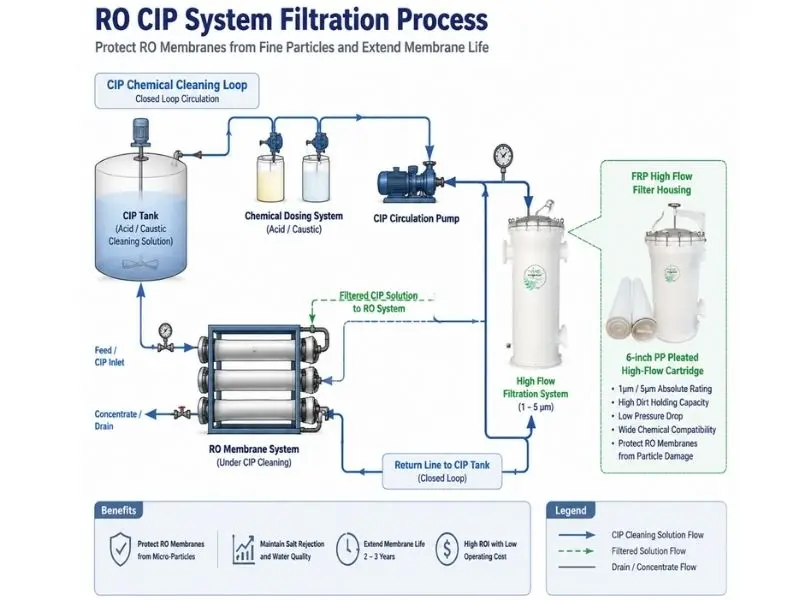
1. Introduction: The High-Stakes Cleaning Game
If you manage a Reverse Osmosis (RO) system—whether it’s for brackish water, sea water desalination (SWRO), or high-recovery industrial zero-liquid discharge (ZLD)—you already know that RO elements are the most expensive, delicate assets in your water room.
When mineral scaling or bio-fouling inevitably builds up, a Clean-in-Place (CIP) cycle is your only choice to bring production back. You spend hours adjusting the pH, dosing the right chemicals, and heating up the tanks.
But here is where many plants get blindsided: they hook up their RO skids to a standard chemical cleaning loop, and right after the acid or caustic wash, the salt rejection drops and never recovers.
Most plant operators immediately blame the chemical suppliers or assume the membrane functionality just naturally degraded. But the real culprit is a mechanical one: microscopic abrasive particles circulating in the CIP loop. In this final part of our CIP series, we will look at how sub-micron debris in an unfiltered cleaning stream can permanently scratch and ruin your RO membrane functional layers.
New to this series? Catch up on our previous deep-dives here:
[Part 1: The General CIP Guide – Why Recirculating Unfiltered Fluid Fails]
[Part 2: The Ultrafiltration Guide – Preventing Hollow Fiber Blockage and Breakage]
2. The Physical Reality: How Micro-Particles Wound Your RO Membrane
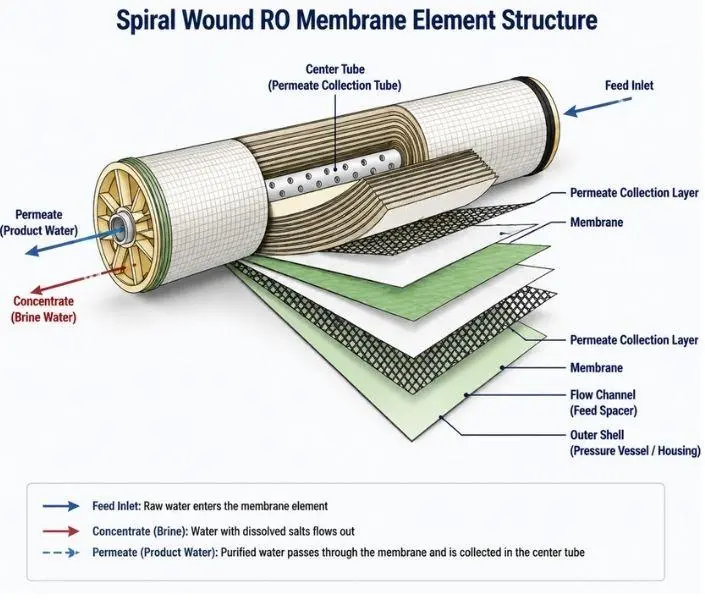
Unlike hollow-fiber UF membranes, RO elements use a spiral-wound layout featuring flat sheets of polyamide thin-film composite (TFC). The active layer doing the actual separation is incredibly thin—often just a fraction of a micron.
When you run a CIP cycle without high-precision fine filtration, this delicate layer is exposed to severe mechanical damage through two hidden mechanisms:
The Sandpaper Effect (Micro-Scratching)
During an acid CIP, you are dissolving hard mineral scales like calcium carbonate, calcium sulfate, or silica. These scales don't just melt instantly into thin air; they break off into the fluid stream as micro-crystalline shards and sharp mineral fragments.
Because CIP pumps operate at high flow rates to create turbulent scouring velocity, these tiny, razor-sharp crystals are forced through the narrow feed spacers of the RO element.
Without a safety filter, they act exactly like liquid sandpaper, carving microscopic gouges straight through the polyamide rejection layer. Once that layer is scratched, salt slips right through, and your water quality is permanently compromised.
Spacer Plugging and Flow Channeling
If you are washing off organic fouling or coagulant residuals with a caustic CIP, large clumps of sticky matter enter the fluid loop. If you don't catch them, these solids trap themselves right inside the tight mesh of the RO feed spacers. This creates "dead zones" within the element.
When the high-velocity CIP fluid hits these blockages, it is forced to channel around them, creating localized high-pressure zones that can mechanically delaminate the membrane sheets or tear the glue lines.
3. The Workaround: Securing the Final Line of Defense
For an RO CIP system, you cannot use coarse screen filters or simple bag filters. The tolerance for particles in a high-pressure RO channel is virtually zero. Your safety defense needs two things: absolute micro-precision and extreme chemical resistance to survive pH levels ranging from 1 to 12.
Here is the industry-standard hardware setup to lock down your RO CIP skid:
The Filter Housing: FRP (Fiberglass Reinforced Plastic) is King
Why It Matters: Many standard CIP skids use 304 or 316L stainless steel housings. While stainless steel works fine for UF, it is a risky choice for RO CIP. The aggressive combination of hot, low-pH organic acids and high-concentration salt streams can cause localized pitting and stress corrosion cracking in stainless steel over time.
The Solution: Use heavy-duty FRP High Flow Filter Housings. FRP is completely inert to chemical attacks. It doesn't rust, it doesn't pit, and it easily handles the extreme pH 1–12 range and temperatures used in aggressive RO cleanings. It gives you a housing that lasts the lifetime of the plant.
The Core Consumable: 6-Inch PP Pleated High-Flow Cartridges
The Specification: Inside that FRP housing, you need an absolute-rated, 1μm to 5μm Polypropylene (PP) Pleated High-Flow Cartridge (typically 40-inch or 60-inch length).
Why it works: These 6-inch large-diameter pleated cartridges are designed for massive surface areas and low clean pressure drops. They trap undissolved chemical powders, scale shards, and incoming silt before they ever touch the RO feed spacers.
Because they are made of 100% pure PP thermally bonded together, they offer wide chemical compatibility without shedding fibers into your high-purity loop.
4. The Real ROI: Protecting a High-Value Asset
Let's look at the actual numbers. Replacing a full bank of 8-inch seawater or brackish water RO elements can easily cost tens of thousands of dollars in a mid-sized facility, and millions in a large municipal SWRO or industrial ZLD plant.
In contrast, a rugged FRP high-flow housing paired with a few high-quality PP pleated cartridges represents a tiny fraction of that cost—typically less than 2% of the membrane replacement value.
By spending a small, predictable amount on defensive consumables, you completely eliminate the risk of micro-scratching, preserve your salt rejection rates, and easily stretch the lifespan of your RO elements by an extra 2 to 3 years. From a plant management perspective, it’s one of the easiest RO decisions you’ll make.
5. Let's Optimize Your CIP Skid
We manufacture industrial-grade, highly reliable filtration hardware engineered to survive the toughest chemical environments. If you are building a new RO CIP skid or trying to fix a drop in salt rejection at an existing facility, we supply the exact components you need:
Corrosion-proof FRP High Flow Filter Housings (configured for single or multi-round setups).
High-efficiency 1μm / 5μm Polypropylene (PP) Pleated High-Flow Cartridges (6-inch diameter, compatible with global standard skids).
Heavy-duty 316L Stainless Steel multi-cartridge housings for non-corrosive chemical lines.