
Why Your UF Membrane CIP is Failing: Preventing Hollow Fiber Blockage and Breakage
1. Introduction: The Problem with Re-Circulating "Dirty Water"
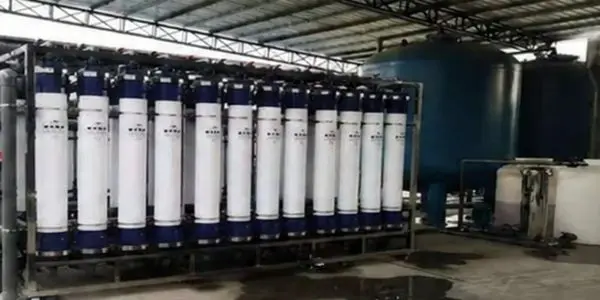
In any industrial water plant running a UF+RO setup—whether it is an SWRO desalination plant or a wastewater reuse system—the Ultrafiltration (UF) stage takes the biggest beating. Over time, things like organics and suspended solids build up, the Transmembrane Pressure (TMP) goes up, and you have to run a Clean-in-Place (CIP) cycle with acid, caustic, or bleach to get your flux back.
But here is a common headache many plant managers face: you run the chemical cleaning exactly by the book, but the membranes clog up again even faster, and sometimes the filtrate turbidity actually spikes right after the wash.
The issue usually isn't your chemical concentration or soaking time. The real issue is much simpler: you are using a closed loop to wash the membranes, but you aren't filtering the cleaning fluid itself. If you don't trap the solids during the wash, your CIP system ends up pumping a concentrated mixture of abrasive debris right back into the module.
Missed our breakdown of global CIP design flaws? Read [Part 1: The Ultimate Guide to Membrane CIP: Why Cleaning is Nothing Without Filtration].
2. The Practical Issue: How Unfiltered CIP Ruins Hollow Fibers
Industrial UF modules use hollow-fiber designs, meaning you have thousands of tiny, fragile fibers packed closely inside a housing. When you pump high-velocity CIP chemicals through them without a filter, two things usually go wrong:
Issue 1: Blinding the Fiber Headers Chemicals like sodium hypochlorite or caustic do a great job of peeling thick layers of bio-sludge and organics off the fibers. But when these large chunks of solid trash enter the fluid stream, they have nowhere to go. Without an inline filter to catch them, they get pumped back into the module and get wedged permanently into the dense fiber headers and dead zones. This creates a physical blockage that no chemical recipe can dissolve. This is exactly why some membranes end up tighter after a wash.
Issue 2: Sandpaper Effect and Fiber Breakage Feed water almost always contains fine sand, silt, or hard mineral scales. To get good cleaning results, CIP pumps have to run at much higher flow rates than normal production to generate high fluid shear. If your fluid is dirty, those hard particles act like tiny blades at high speeds. They repeatedly scrape and hit the fibers, causing widespread fiber breakage. Once a fiber snaps, the module is done—your turbidity shoots up, and you have to scrap the whole element early.
3. The Workaround: Setting Up the Right Filters for Your UF CIP Loop
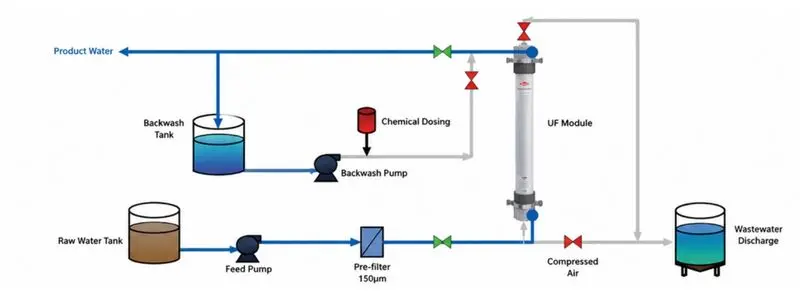
To stop destroying your membranes during a wash, your CIP filtration needs to do three things: handle high flow rates, hold a lot of dirt, and survive aggressive chemicals. Depending on your plant size and your budget, here are the two best ways to set this up:
Option A: The Budget-Friendly Setup – Stainless Steel Bag Filters
Best For: Small-to-medium systems, wastewater retrofits, or any project where you want solid physical protection without spending a fortune.
How it Works: You install a standard Size #2 Stainless Steel Bag Filter Housing right on the CIP return line. You can choose 304 Stainless Steel to keep costs down, or 316L if you are dealing with aggressive chemicals. Inside, you pop in an industrial Polypropylene (PP) filter bag rated at 50μm to 100μm.
Why it works: Bag filters have a massive open area. When the chemicals strip large sheets of organic sludge from the membranes, the PP bag catches all of it at once. This keeps the trash out of your CIP tank and away from your fibers. Plus, PP bags have wide chemical resistance and cost very little to replace.
Option B: The Hands-Off Setup – Automatic Self-Cleaning Filters
Best For: Large-scale desalination systems, zero-liquid discharge (ZLD) plants, or any modern facility where you don't want operators manually changing bags during a CIP cycle.
How it Works: You integrate an Automatic Self-Cleaning Screen Filter directly into the CIP skid piping, using a mesh size between 50μm and 80μm.
Why it works: A heavy UF cleaning cycle releases a massive amount of solids. A self-cleaning filter handles the workload without manual labor. When the screen gets loaded and the pressure drops, the valve opens and flushes the sludge out automatically, without interrupting your cleaning cycle.
4. The Bottom Line on ROI
An industrial-grade UF module is expensive, and replacing a whole stack can ruin your maintenance budget. Adding a durable 304/316L bag filter or an automatic self-cleaning system usually costs less than 3% to 5% of what you spent on the membranes.
Spending a small, predictable amount on PP filter bags or screen flushes to protect against permanent clogging and broken fibers is just smart business. Keeping your CIP fluid clean isn't a luxury—it is how you protect your investment.
Next Chapter Preview: Protecting your UF pre-treatment is just step one. For the high-pressure Reverse Osmosis (RO) membranes downstream, microscopic scratches during a CIP cycle are even harder to spot and much more destructive. Read our final part: [Part 3: The RO Guide – How Tiny Particles Cause Irreversible Membrane Damage].
5. Let’s Talk About Your Project
We manufacture heavy-duty, chemical-resistant filtration components for industrial water plants and global EPC projects. Our standard product lineup includes:
Industrial Size #1 and Size #2 Bag Filter Housings in both 304 and 316L Stainless Steel.
Heavy-duty, chemical-resistant industrial Polypropylene (PP) filter bags.
Turnkey, automated Self-Cleaning Screen Filtration Skids.
If your UF system is struggling with high TMPs after cleaning, or if you are tired of dealing with broken fibers, Contact us today.
Ralated blog: More details about case studies about UF Membrane.