
5 Reasons to Choose Membrane Filtration for Your Water Treatment
5 Reasons to Choose Membrane Filtration for Your Water Treatment
As industries worldwide face increasing pressure to improve water quality, meet stricter environmental regulations, and enhance product purity, membrane filtration is rapidly becoming the preferred solution for liquid separation and purification. According to market research, the global membrane filtration market is expected to exceed $20 billion USD by 2030, driven by growing demand in sectors like food and beverage, pharmaceuticals, wastewater treatment, and desalination.
Membrane filtration stands out for its efficiency, scalability, and ability to achieve ultra-high purity without the need for chemical additives. Whether the goal is to produce clean drinking water, recycle industrial wastewater, or separate valuable components in bioprocessing, membrane technologies provide a highly effective and sustainable solution.
What Is Membrane Filtration?
Membrane filtration is a pressure-driven separation process that uses semi-permeable membranes to retain particles based on size, molecular weight, or charge, while allowing clean water or specific molecules to pass through. It is widely used in industrial, municipal, and commercial applications where precision and purity are critical.
The filtered fluid that passes through the membrane is called the permeate, while the retained material is known as the retentate or concentrate.
Advantages of Membrane Filtration
✅ High Filtration Precision
Membrane filtration can remove particles as small as 0.0001 µm, including bacteria, viruses, organic molecules, and dissolved salts.
✅ Environmentally Friendly
Membrane filtration systems often require no chemical additives, supporting sustainable practices and reducing environmental discharge.
✅ Lower Operational Costs Over Time
Although initial installation costs may be higher than traditional methods, membranes are energy-efficient, require minimal maintenance, and reduce overall water and chemical usage.
✅ Scalable and Modular
Systems can be customized for small production lines or expanded to accommodate industrial-scale operations, offering flexibility for growth.
✅ Supports Water Reuse
Used permeate water can be recycled into production, cutting freshwater demand and helping industries meet zero liquid discharge (ZLD) or green certification goals.
Types of Membrane Filtration
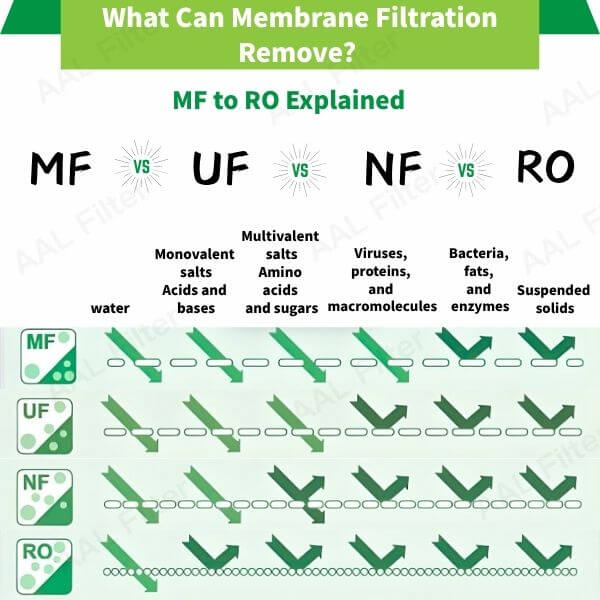
Membrane filtration systems are categorized by pore size and the type of contaminants they remove. The four main types include:
### 1. Microfiltration (MF)
Pore Size: 0.1 – 10 µm
Removes: Suspended solids, algae, some bacteria
Applications: Beverage clarification, pre-filtration for RO systems, wastewater pre-treatment
Included:
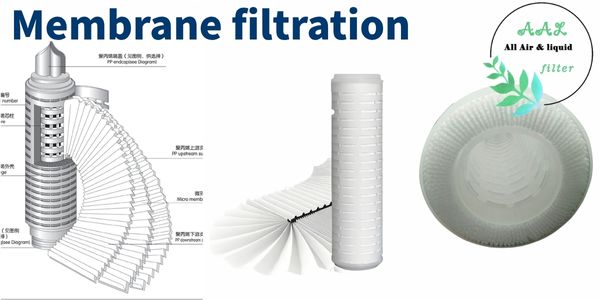
Pleated Membrane Filter Cartridges
Materials: PES, PTFE, Nylon, PVDF
Features: Absolute-rated, high surface area, excellent flow rates
Uses: Electronics manufacturing, pharmaceutical pre-filtration, fine chemical separation
2. Ultrafiltration (UF)
Pore Size: 0.01 – 0.1 µm
Removes: Proteins, most viruses, suspended particles
Applications: Dairy processing, biotechnology, municipal drinking water treatment
3. Nanofiltration (NF)
Pore Size: < 0.001 µm
Removes: Multivalent ions, organic compounds
Applications: Water softening, sugar concentration, pharmaceutical purification
4. Reverse Osmosis (RO)
Pore Size: ~0.0001 µm
Removes: Monovalent and multivalent salts, viruses, bacteria, most dissolved solids
Applications: Desalination, ultrapure water production, high-end industrial processes
Applications of Membrane Filtration Across Industries
🏭Industrial Wastewater Treatment
Membrane systems remove oils, chemicals, and suspended solids, allowing treated water to be discharged safely or reused in production.
🧪Pharmaceutical & Biotech
Used to separate and purify active pharmaceutical ingredients, enzymes, and proteins under sterile, controlled conditions.
🧴Food & Beverage
Used for milk protein separation, beer and wine clarification, and juice concentration without compromising taste or aroma.
🚰Municipal Drinking Water
Cities and rural areas use RO, UF, and NF membranes to remove contaminants, heavy metals, and pathogens for safe, reliable drinking water.
🌊Seawater Desalination
RO membrane systems help transform saline or brackish water into potable water for agriculture, cities, and industries.
Membrane Filtration vs. Depth Filtration: How to Choose?
While membrane filtration is best for fine purification and molecular-level separation, depth filtration remains essential for bulk particle removal, pre-filtration, and high-solid load applications.
What is Depth Filtration?
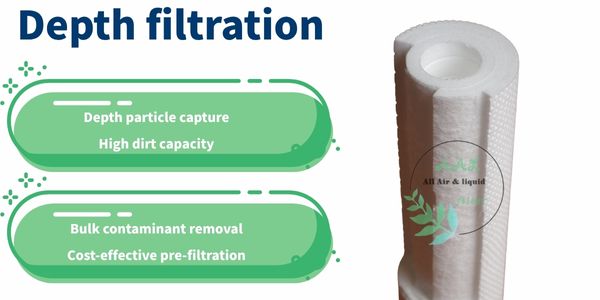
Depth filters capture particles through the entire thickness of the filter media instead of just the surface. This allows for longer service life, higher dirt-holding capacity, and lower cost per filtration cycle, especially in high-load systems.
Our Depth Filtration Products
✅ Melt-Blown Filter Cartridges
Materials: Polypropylene or nylon
Variants: Grooved surface, "Big Fat" 4.5” OD
Applications: Industrial process water, RO pre-filtration, high-viscosity fluid filtration
✅ String Wound Filter Cartridges
Materials: Polypropylene, cotton, glass fiber
Advantages: High temperature resistance, excellent chemical compatibility
Applications: Petrochemical fluids, food & beverage, desalination plants
Tip: Many systems combine both technologies—depth filters as pre-filtration to protect sensitive membranes and extend their lifespan, followed by membrane filters for precision polishing.
Final Thoughts
Membrane filtration is a core technology driving the future of sustainable, high-performance liquid treatment. As industries demand cleaner, safer, and more efficient processes, membrane systems deliver unmatched value across sectors.
By strategically integrating membrane and depth filtration technologies, you can achieve optimal system performance, meet regulatory requirements, and reduce long-term operational costs.
Frequently Asked Questions (FAQ) About Membrane Filtration
Q1: What is the difference between microfiltration and ultrafiltration?
A1: Microfiltration (MF) removes larger particles such as bacteria and suspended solids, typically with pore sizes of 0.1 to 1.0 microns. Ultrafiltration (UF), with smaller pore sizes (0.01 to 0.1 microns), can remove viruses, proteins, and colloids in addition to bacteria.
Q2: Which industries commonly use membrane filtration systems?
A2: Membrane filtration is widely used in biopharmaceuticals, electronics manufacturing, food & beverage, municipal water treatment, wastewater reuse, and chemical processing, among others.
Q3: What are the advantages of using pleated membrane filter cartridges over standard depth filters?
A3: Pleated membrane filters offer high filtration precision, a larger surface area, and absolute-rated performance, making them ideal for applications requiring high purity. In contrast, depth filters like melt-blown or string wound cartridges are better for bulk contaminant removal and pre-filtration.
Q4: Can membrane filtration replace all other types of filtration?
A4: No. Membrane filtration is effective for fine and selective separation, but it often requires pre-filtration using depth filters to reduce membrane fouling and extend lifespan. A combined filtration strategy is typically recommended.
Q5: How do I choose the right membrane material (e.g., PES, PTFE, Nylon)?
A5:
PES (polyethersulfone): Excellent flow and low protein binding – suitable for biopharma and food.
PTFE: Chemically resistant and hydrophobic – ideal for aggressive solvents or gas filtration.
Nylon: Strong mechanical strength and hydrophilic – good for electronics and water-based solutions.
PVDF: High purity, chemical resistance – suitable for microelectronics and ultrapure water.
Q6: What maintenance is required for membrane filtration systems?
A6:
Regular maintenance includes:
Monitoring pressure drop across membranes
Periodic chemical cleaning (CIP) to prevent fouling
Scheduled cartridge replacement based on service life or turbidity breakthrough
Proper pre-filtration can significantly extend membrane life.
Q7: What is the difference between absolute-rated and nominal-rated filters?
A7:
Absolute-rated filters (like pleated membrane cartridges) retain 100% of particles above a specified size under defined conditions.
Nominal-rated filters (like melt-blown or string wound) retain a percentage (typically 85-95%) of particles of a stated size.