
Thermal Power Plant RO Pretreatment Optimization Case Study
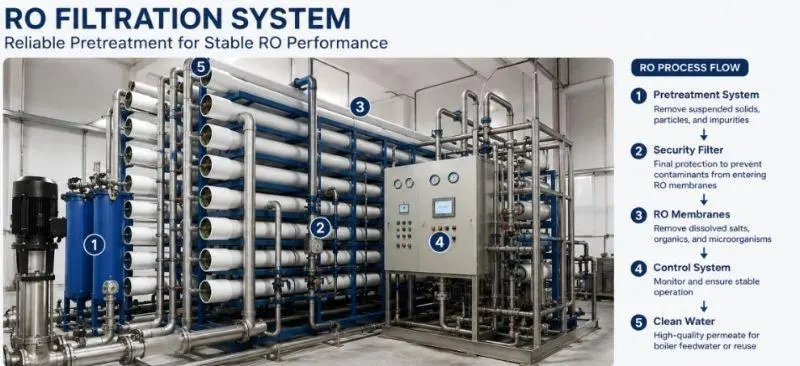
Introduction: Reliable RO Pretreatment Is Essential for Stable Power Plant Water Treatment
In modern thermal power plants, water treatment systems play a critical role in boiler feedwater production, cooling water treatment, and industrial water reuse. With increasing requirements for water conservation and wastewater recycling, reverse osmosis (RO) systems have become an essential part of power plant water treatment processes.
However, RO membranes are highly sensitive to suspended solids, colloidal particles, and other contaminants. Poor pretreatment performance can lead to:
· RO membrane fouling
· Increased differential pressure
· Reduced permeate flow
· More frequent chemical cleaning
· Shortened membrane service life
As the final filtration barrier before RO membranes, cartridge security filters play a key role in removing residual contaminants and protecting the RO system.
This case study introduces how a thermal power plant optimized its RO pretreatment system by combining:
· SS316L stainless steel multi-cartridge filter housings
· High-capacity string wound filter cartridges
· 3-layer PP melt blown filter cartridges
Through customized filtration configurations for different water conditions, the plant achieved longer filter service life, lower maintenance costs, and improved RO system stability.
Project Background: RO Water Treatment Systems in a Thermal Power Plant
The thermal power plant in this case operates multiple RO water treatment systems, mainly for boiler feedwater production and cooling water reuse.
The existing configuration includes:
· 4 sets of first-stage boiler feedwater RO systems
· 3 sets of cooling tower circulation water reuse RO systems
A total of 7 RO systems are in operation.
As a continuously operating industrial facility, stable RO performance is critical for reliable power generation. Therefore, the upstream cartridge filtration system must provide:
· Stable filtration performance
· High operational reliability
· Long service life
System Applications
First-Stage Boiler Feedwater RO System
The boiler feedwater system is designed to produce high-quality water for boiler operation and requires strict control of feedwater quality.
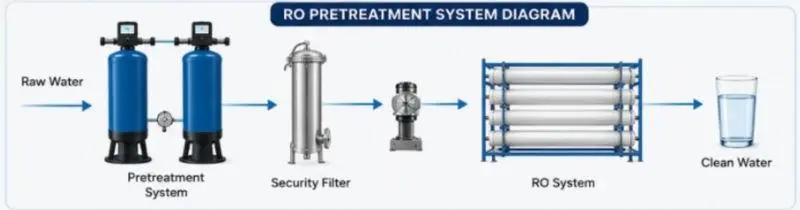
Typical process flow:
Raw Water
↓
Pretreatment System
↓
Cartridge Security Filter
↓
1st Stage RO
↓
2nd Stage RO
↓
Boiler Feedwater
The cartridge filter before the first-stage RO system is responsible for removing residual:
· Suspended solids
· Colloidal particles
· Fine contaminants
This helps prevent contaminants from entering the RO membranes and reduces membrane fouling risks.
Key requirements for this application include:
· Stable filtration accuracy
· Low fiber shedding risk
· Long operating cycle
Cooling Water Reuse RO System
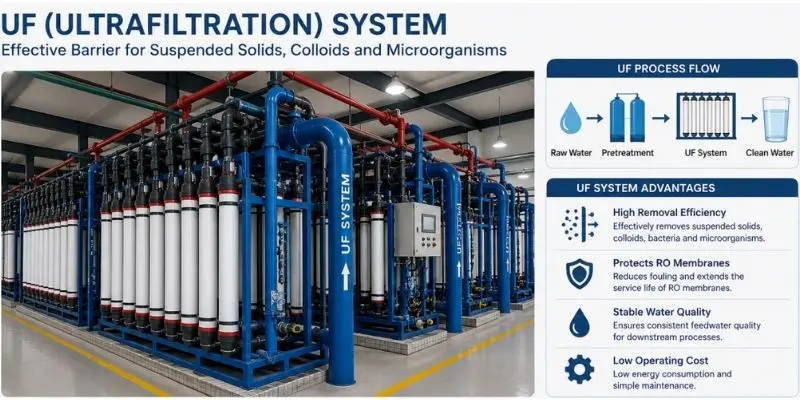
The cooling water reuse RO system is designed to improve water efficiency by treating and recycling cooling tower blowdown water.
Typical process flow:
Cooling Tower Blowdown Water
↓
Pretreatment System
↓
Cartridge Security Filter
↓
RO Reuse System
↓
Recycled Water
Compared with boiler feedwater systems, cooling water reuse applications usually have more challenging operating conditions:
· Higher suspended solids loading
· Greater water quality fluctuations
· Higher contaminant variation
· Faster filter clogging tendency
Therefore, this application requires:
· Higher dirt-holding capacity
· Longer filter life
· Better fouling resistance
Challenges Before Filtration Optimization
Challenge 1: Short Filter Life in Cooling Water Reuse RO Systems
Before optimization, the cooling water reuse RO systems experienced frequent cartridge replacement.
Due to the complex water source, the feedwater contained higher levels of:
· Suspended solids
· Colloidal particles
· Pipe corrosion products
· Water treatment residues
These contaminants caused rapid cartridge blockage.
Main issues included:
· Filter replacement every 3-5 days
· Rapid pressure increase
· High maintenance frequency
· Increased operating costs
The system required a filtration solution with higher dirt-holding capacity and longer service life.
Challenge 2: Higher Filtration Stability Requirements for Boiler Feedwater RO
Although boiler feedwater systems have lower contamination loads, they require more stable filtration performance.
The main risks included:
Particle breakthrough
When filter cartridges are operated for extended periods, unstable structures may reduce filtration efficiency and allow contaminants to reach RO membranes.
Fiber shedding
Some filter materials may release fibers during operation, which can affect downstream RO performance.
Increasing pressure drop
Filter blockage can result in:
· Reduced flow rate
· Higher energy consumption
· Shorter replacement cycles
Therefore, a more reliable precision filtration solution was required.
Challenge 3: Filter Housing Sealing and Bypass Risk
In industrial RO systems, filtration performance depends not only on the filter cartridge but also on the filter housing design.
Poor housing performance may cause:
· Insufficient sealing
· Incorrect cartridge installation
· Improper internal structure
Leading to filter bypass and unfiltered water entering the RO system.
Therefore, a reliable filter housing is equally important for RO pretreatment.
Solution: Customized RO Pretreatment Based on Different Operating Conditions
To address different RO system requirements, the project adopted a customized filtration solution combining:
Reliable filter housings + Proper filter cartridge selection
The optimized configuration was:
Application | Filter Housing | Filter Cartridge |
Cooling water reuse RO | SS316L Multi-Cartridge Filter Housing | High-capacity String Wound Filter Cartridge |
Boiler feedwater RO | SS316L Multi-Cartridge Filter Housing | 3-Layer PP Melt Blown Filter Cartridge |
This approach ensured optimized filtration performance under different water conditions.
SS316L Stainless Steel Multi-Cartridge Filter Housing: A Reliable RO Pretreatment Platform
As the core hardware of the filtration system, stainless steel multi-cartridge filter housings provide a stable platform for RO pretreatment.
High Flow Capacity
The multi-cartridge design allows multiple cartridges to be installed simultaneously, increasing filtration area and meeting the flow requirements of large-scale RO systems.
Key advantages:
· High processing capacity
· Low pressure drop
· Stable operation
· Easy maintenance
Reliable Sealing Design to Minimize Bypass Risk
Industrial RO systems require highly reliable filtration performance.
The optimized multi-cartridge filter housing uses:
· Accurate cartridge positioning
· Optimized internal structure
· Reliable sealing design
to ensure all process water passes through the filter media and reduce bypass risks.
SS316L Material for Industrial Applications
SS316L stainless steel provides excellent corrosion resistance and is suitable for:
· Power plant water treatment
· Industrial RO systems
· High-performance liquid filtration applications
Cooling Water Reuse RO Solution: Improving Dirt Holding Capacity with String Wound Filter Cartridges
For cooling water reuse RO systems with high contaminant loading, high-capacity string wound filter cartridges were selected.
String wound cartridges use a depth filtration structure, allowing contaminants to be trapped throughout the filter media rather than only on the surface.
Main advantages include:
· High dirt-holding capacity
· Strong contaminant loading capability
· Suitable for fluctuating water quality
· Extended service life
The solution helps:
· Remove higher concentrations of suspended solids
· Reduce RO membrane fouling risks
· Decrease cartridge replacement frequency
Product link:
Industrial String Wound Filter Cartridge
Boiler Feedwater RO Solution: Precision Protection with 3-Layer PP Melt Blown Filter Cartridges
For first-stage boiler feedwater RO systems, more stable filtration performance was required.
Therefore, 3-layer gradient PP melt blown filter cartridges were selected.
The multi-layer structure provides progressive filtration:
Outer Layer
Captures larger particles
↓
Middle Layer
Removes medium-sized contaminants
↓
Inner Layer
Provides fine filtration
Key advantages:
· Stable micron retention
· Improved dirt-holding capacity
· Reduced particle breakthrough risk
· Lower fiber shedding risk
Suitable applications include:
· RO pretreatment
· Boiler feedwater filtration
· Industrial pure water systems
Product link:
3-Layer PP Melt Blown Filter Cartridge
Related Technical Guide: String Wound vs PP Melt Blown Filter Cartridge
Performance Results: Improving RO Stability and Reducing Operating Costs
After filtration optimization, the RO pretreatment systems achieved significant improvements.
Parameter | Before Optimization | After Optimization |
Cooling water reuse RO cartridge life | 3-5 days | 25-30 days |
Boiler feedwater RO cartridge life | 7-10 days | 35-45 days |
RO feedwater SDI | Unstable | More stable |
Cartridge replacement frequency | High | Significantly reduced |
Maintenance workload | High | Reduced |
The optimization delivered several benefits:
· Reduced cartridge consumption
· Lower maintenance requirements
· Improved RO operation continuity
· Extended RO membrane service life
Conclusion: Proper Filtration Configuration Is the Key to Long-Term RO Reliability
Optimizing RO pretreatment systems in thermal power plants is not simply about selecting a finer filter cartridge. The best solution depends on matching the filtration technology with actual operating conditions.
In this case, the combination of:
SS316L Stainless Steel Multi-Cartridge Filter Housing
+
String Wound Filter Cartridge
+
3-Layer PP Melt Blown Filter Cartridge
provided:
· Long-term operation under high contaminant loading conditions
· Reliable protection for high-quality RO systems
· Reduced maintenance costs
· Improved overall system efficiency
If you are looking for filtration solutions for thermal power plants, industrial RO systems, or water treatment projects, our engineering team can provide customized recommendations based on:
· Water quality conditions
· Flow requirements
· Filtration accuracy
· Equipment configuration
to help optimize your filtration system.