Water Conductivity Chart: EC Ranges for Different Water Types (μS/cm Guide)
Electrical Conductivity (EC) measures the concentration of dissolved ions in water. It is widely used in water treatment, industrial processes, environmental monitoring, and drinking water quality assessment.
Higher EC indicates more dissolved salts and contaminants, while lower EC reflects higher water purity.
This guide helps you understand EC ranges for various water types and introduces practical solutions to optimize water quality with filter cartridges.
1. Conductivity Ranges by Water Type
Water Type | Conductivity (μS/cm) | Key Interpretation |
Distilled Water | ~0.05–1 | Extremely pure, near-zero dissolved ions |
Boiler Feed Water | ~1–10 | Highly treated water to prevent scaling |
Drinking Water | ~100–1000 | Contains essential minerals |
Surface Water | ~100–10000 | Varies due to environment and pollution |
Wastewater | ~1000–10000 | High dissolved contaminants |
Seawater | ~10000–50000 | High salinity (NaCl dominant) |
Industrial High-Concentration Water | >50000 | Strong acids, alkalis, or brine |
The above conductivity ranges are for reference only; actual water quality may vary depending on source, temperature, and environmental factors. For more authoritative data, visit Apure Instrument – Water Conductivity Range to better understand conductivity characteristics across different water types.
2. EC and Water Quality
2.1 EC vs TDS Conversion
TDS (Total Dissolved Solids) can be estimated from EC:
TDS (ppm) = K x EC (μS/cm)
K = Conversion factor (typically 0.5 – 0.7)
The factor varies by water type.
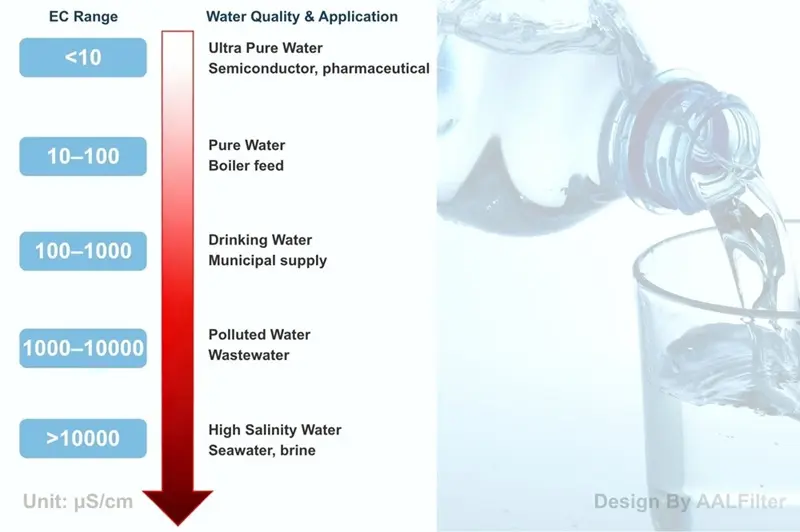
2.2 Conductivity Classification
EC Range | Water Quality | Application |
<10 μS/cm | Ultra Pure Water | Semiconductor, pharmaceutical |
10–100 μS/cm | Pure Water | Boiler feed |
100–1000 μS/cm | Drinking Water | Municipal supply |
1000–10000 μS/cm | Polluted Water | Wastewater |
>10000 μS/cm | High Salinity Water | Seawater, brine |
2.3 Probe Constant (K Value)
● K ≈ 0.1 → Low conductivity (pure water)
● K ≈ 1 → General water
● K ≈ 10 → High conductivity (wastewater, seawater)
3. Industrial Applications of Conductivity
Water Treatment Systems (RO / UF / EDI)
● Evaluate desalination performance
● Detect membrane fouling or leakage
Boilers & Cooling Systems
● Prevent scaling
● Control corrosion
Wastewater Treatment
● Assess contamination levels
● Support discharge compliance
4. Water Quality Optimization & Filter Cartridge Solutions
Understanding water EC is only the first step. Choosing the right filter cartridge is key to maintaining stable water quality.
AALFilter offers high-performance filter cartridges, including pleated membrane filters, bag filters, and basket strainers, designed to remove suspended solids, particles, and impurities efficiently. Whether for industrial water treatment, boiler feed, or seawater pre-treatment, our filters provide reliable support for long-term system operation.
Learn more about our filter solutions on our Filter Cartridges page.
5. FAQ
Q1: Is lower conductivity always better?
No. Drinking water needs essential minerals; ultra-pure water is not suitable for long-term consumption.
Q2: Why does the same TDS give different EC?
Different ions conduct electricity differently (e.g., Na⁺ vs Ca²⁺).
Q3: Can EC alone determine water safety?
No. EC should be combined with microbial and chemical testing.
6. Conclusion
Conductivity is a practical and widely used water quality parameter:
● Quickly assess purity
● Monitor contamination
● Guide water treatment
● Combined with high-performance filters, ensure system reliability
In industrial water treatment and environmental applications, EC monitoring plus suitable filter cartridges is key to safe and stable water management.