
How High Flow Filter Cartridges Reduce System Footprint & Operating Costs
1. Introduction: The Challenge of High-Flow Industrial Filtration
In many industrial filtration systems, increasing flow demand is no longer optional—it is a necessity. Industries such as water treatment, desalination, power generation, chemical processing, and manufacturing all require higher throughput while maintaining stable filtration performance.
However, traditional standard-size filter cartridges often struggle to meet these requirements efficiently. As system flow increases, engineers are forced to add more cartridges, larger housings, and more complex piping. This leads to larger system footprints, higher installation costs, and rising operating expenses.
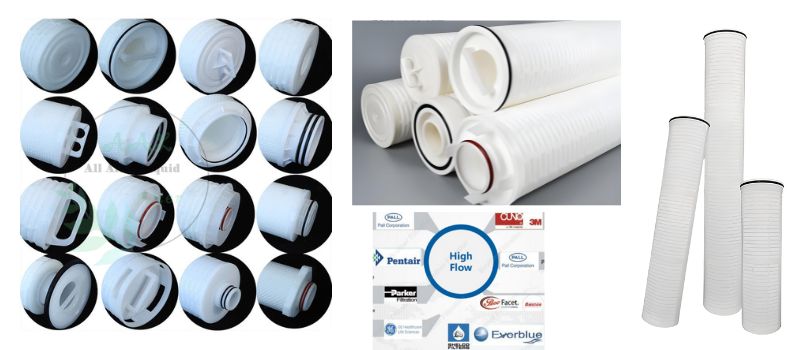
High flow filter cartridges were developed specifically to address these challenges. By delivering significantly higher flow capacity per cartridge, they allow filtration systems to become more compact, efficient, and cost-effective over their entire lifecycle.
2. What Is System Footprint in Filtration Systems?
In industrial filtration, system footprint refers to the total physical space occupied by the filtration system and its supporting components. This includes:
Filter housings and cartridge arrangement
Piping, valves, and instrumentation
Structural supports and access clearance
Space required for maintenance and cartridge replacement
System footprint is a critical design factor, especially in:
Water treatment plants with limited installation space
Desalination facilities using skid-mounted systems
Retrofit projects where existing layouts cannot be changed
Offshore or containerized filtration systems
Reducing footprint does not only save space—it often simplifies system design and lowers both capital and operating costs.
3. High Flow Filter Cartridges vs Standard Cartridges: Flow Capacity Comparison
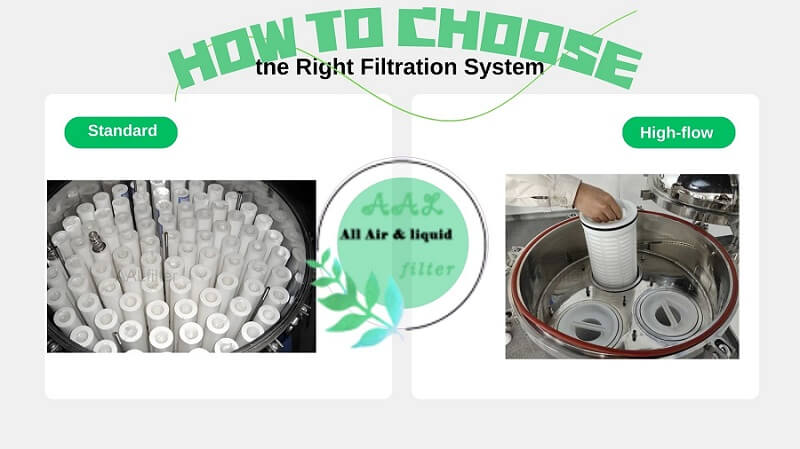
Traditional industrial filtration systems typically rely on standard 2.5-inch diameter filter cartridges. While these cartridges are widely used, their individual flow capacity is limited. As system flow requirements increase, filtration systems must use a large number of cartridges installed in multi-round housings, which increases system footprint, piping complexity, and maintenance effort.
A 60-inch high flow filter cartridge is specifically designed to handle significantly higher flow rates by using a large diameter, optimized pleated structure, and high-permeability filter media. In practical industrial applications, one 60-inch high flow filter cartridge can typically replace approximately 15 to 20 standard 2.5-inch cartridges, depending on operating conditions and micron rating.
The table below provides a clear, quantitative comparison between a 60-inch high flow filter cartridge and standard 2.5-inch cartridges.
Flow Capacity Comparison Table (60” High Flow vs 2.5” Standard Cartridges)
Parameter | Standard Cartridge (2.5", 40") | High Flow Filter Cartridge (60") |
Typical Length | 40" | 60" |
Cartridge Diameter | 2.5" | Large diameter (high flow design) |
Flow Rate per Cartridge | ~1–2 m³/h | ~25–30 m³/h |
Number of Cartridges for Same Flow | 15–20 cartridges | 1 cartridge |
Typical Housing Type | Multi-round housing | Single high flow housing |
System Footprint | Large | Significantly reduced |
Cartridge Replacement Time | Long (many cartridges) | Short (single cartridge) |
Pressure Drop at Design Flow | Higher | Lower and more stable |
Note: Actual flow rates depend on micron rating, filter media, fluid viscosity, and operating conditions.
As the comparison clearly shows, replacing a traditional multi-cartridge system with a high flow filtration solution can dramatically reduce the number of cartridges and housings required. This quantitative advantage is a key reason why high flow filter cartridges are widely adopted in high-capacity industrial filtration systems.
4. How High Flow Filters Reduce System Footprint
4.1 Fewer Filter Cartridges Required
Because each high flow filter cartridge handles a significantly higher flow rate, fewer cartridges are needed to achieve the same system throughput. This leads to:
Reduced number of cartridge positions
Smaller housing diameters
Less internal hardware and support structures
For high-capacity systems, the difference can be substantial—dozens of standard cartridges can often be replaced by a much smaller number of high flow cartridges.
4.2 Smaller and Fewer Filter Housings
With fewer cartridges required, filtration systems can use:
Fewer housings overall
More compact housing designs
Simplified multi-cartridge arrangements
In many applications, a high flow single-housing solution can replace multiple traditional multi-round housings. This reduces:
Installation space
Structural steel requirements
Skid size and weight
These advantages are particularly valuable for modular systems and skid-mounted filtration units.
4.3 Simplified Piping and System Design
Reducing the number of housings also simplifies piping design:
Fewer inlet and outlet connections
Shorter piping runs
Reduced pressure loss across the system
Simpler piping layouts not only reduce material and installation costs but also lower the risk of leakage and long-term maintenance issues.
5. How High Flow Filter Cartridges Reduce Operating Costs (OPEX)
5.1 Lower Labor and Maintenance Costs
Maintenance is one of the most significant ongoing expenses in filtration systems. High flow filter cartridges help reduce these costs by:
Requiring fewer cartridges to replace
Reducing replacement time per maintenance cycle
Minimizing system downtime
Instead of replacing dozens of standard cartridges, operators can service a smaller number of high flow cartridges more quickly and safely.
5.2 Reduced Energy Consumption
High flow filter cartridges are engineered to operate efficiently at high flow rates with relatively low pressure drop. This results in:
Lower pump energy consumption
More stable operating pressure
Reduced stress on pumps and system components
Over time, even small reductions in pressure drop can translate into significant energy savings, especially in continuous-operation systems.
5.3 Lower Consumables and Inventory Costs
Using fewer cartridges also simplifies inventory management:
Reduced storage space for spare cartridges
Lower inventory value tied up in consumables
Simplified purchasing and logistics
Additionally, the higher dirt-holding capacity of high flow cartridges often extends service life, further reducing replacement frequency.
6. Total Cost of Ownership (TCO): A Long-Term Cost Perspective
While high flow filter cartridges may have a higher unit price than standard cartridges, focusing only on initial purchase cost can be misleading.
When evaluating total cost of ownership (TCO), factors such as:
Maintenance labor
Energy consumption
Downtime costs
Replacement frequency
often reveal that high flow filtration systems deliver lower overall costs over time.
In many industrial applications, the additional upfront investment is offset by operational savings within a relatively short payback period.
7. Typical Applications Where Footprint & Cost Reduction Matter Most
High flow filter cartridges are widely used in applications where space, efficiency, and cost control are critical:
Seawater desalination pretreatment
Industrial water treatment systems
Oil & gas process filtration
Chemical and petrochemical processing
In these industries, compact system design and reliable long-term operation are essential to maintaining productivity and profitability.
8. Key Considerations When Designing a High Flow Filtration System
To fully realize the benefits of high flow filter cartridges, proper system design is essential. Key considerations include:
Required system flow rate and operating pressure
Filter media selection (polypropylene, glass fiber, etc.)
Micron rating and filtration efficiency
Cartridge length options such as 40", 60", or 70"
Housing compatibility and sealing design
Working with an experienced filtration supplier ensures that the system is optimized for both performance and cost efficiency.
9. Conclusion: Designing More Efficient Filtration Systems with High Flow Filters
High flow filter cartridges offer a practical solution to the growing demands of modern industrial filtration. By reducing the number of cartridges and housings required, they significantly decrease system footprint while simplifying installation and maintenance.
At the same time, lower labor requirements, reduced energy consumption, and longer service life contribute to lower operating costs and improved total cost of ownership.
For industries seeking to design more compact, efficient, and cost-effective filtration systems, high flow filter cartridges are an increasingly preferred choice.
10. Call to Action
Learn more about our High Flow Filter Cartridges → about how to choose good ones.
Contact us for customized filtration system design and quotations.