
Microfiltration Solutions with Industrial Filter Cartridges and Bags
Microfiltration
Introduction: Why Microfiltration Matters in Modern Industry
Microfiltration is a separation process that uses a porous membrane or filter media with pore sizes typically ranging from 0.1 to 10 micrometers. It is widely recognized as a reliable method to remove suspended solids, bacteria, yeast, and colloids from liquids. Unlike ultrafiltration or reverse osmosis, microfiltration focuses on retaining larger particles while allowing water and dissolved substances to pass through.
In modern industries, however, microfiltration is not limited to membranes alone. Filter cartridges and filter bags play an equally important role in protecting downstream equipment, reducing operational costs, and ensuring product quality. By combining different types of filters—such as melt blown filter cartridges, string wound filter cartridges, pleated filter cartridges, activated carbon filters, and filter bags—companies can design efficient and cost-effective microfiltration systems tailored to their processes.
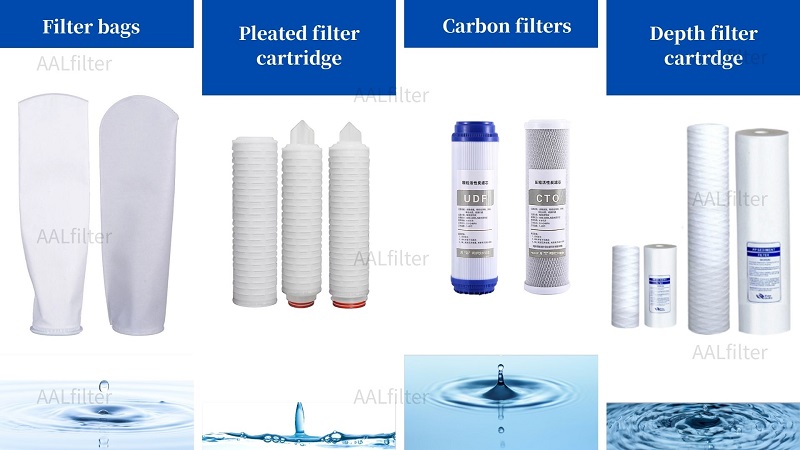
Understanding Microfiltration Beyond Membranes
When people think of microfiltration, they often associate it solely with membranes. In reality, industrial microfiltration is usually a multi-stage process, where different filters work together to achieve optimal results.
Melt Blown Filter Cartridges: Designed to capture larger suspended solids and reduce turbidity, often used as the first stage of pre-filtration.
String Wound Filter Cartridges: Ideal for high-sediment or chemically aggressive fluids, providing depth filtration and protecting finer membranes.
Pleated Filter Cartridges: Offer high surface area and precise retention, suitable for applications requiring stable micro-level clarity.
Activated Carbon Filters: Remove chlorine, organic contaminants, odors, and unwanted tastes, especially in food & beverage applications.
Filter Bags: Efficient for high-flow and high-sediment applications, widely used in industrial wastewater treatment and bulk liquid filtration.
Microfiltration vs Membranes: While membranes are often highlighted as the “core” of microfiltration, in reality, filter cartridges and bags act as essential partners. Pre-filtration reduces membrane fouling, lowers pressure drop, and prolongs the membrane lifespan, ensuring more reliable and cost-effective operation.
For a deeper dive into how Membrane filtration technologies work and membrane selection tips, check out our related article: 5 Reasons to Choose Membrane Filtration.
How Microfiltration Works in Industrial Processes
The principle of microfiltration is straightforward: liquid is forced through a porous medium, where particles larger than the pore size are retained. The driving force is usually low to moderate pressure (0.01–0.2 MPa).
In real-world applications, however, the process is rarely dependent on one filter type. Instead, a filtration train is used:
Pre-Filtration Stage – filter bags or melt blown cartridges remove large suspended solids.
Depth Filtration Stage – string wound cartridges capture fine particles and colloids.
Fine Filtration Stage – pleated cartridges or microfiltration membranes provide clarity and microbial reduction.
Polishing Stage – activated carbon filters eliminate residual organic compounds and improve taste and odor.
This layered approach extends the lifespan of expensive microfiltration membranes while delivering consistently high-quality effluent or product streams.
Key Industries and Applications of Microfiltration
1. Water Treatment & Desalination
In drinking water treatment and seawater desalination, microfiltration is crucial to ensure safe, high-quality water. Melt blown filter cartridges and filter bags are commonly applied as pre-filters to remove suspended solids before the water reaches sensitive membranes. String wound cartridges provide extra protection when raw water has a high load of particulates, while pleated filters ensure final clarity.
Benefit: Reduces fouling, lowers operational costs, and guarantees stable water quality.
2. Food & Beverage Processing
Microfiltration is widely used to clarify beverages, remove bacteria from juices, and ensure consistent taste in beer, wine, and dairy. In these industries, pleated filter cartridges are valued for their high surface area and precise particle retention, while activated carbon filters remove unwanted tastes, odors, and organic compounds. For high-volume processes, filter bags provide economical pre-filtration.
Benefit: Ensures product safety, extends shelf life, and meets stringent food safety standards.
3. Pharmaceutical & Biotechnology
Pharmaceutical manufacturing and biotech rely heavily on microfiltration to produce sterile and pure products. During fermentation and drug production, pleated filter cartridges are used to remove microorganisms and cell debris. Melt blown cartridges are often employed in pre-filtration, reducing particulate loads before critical sterile filtration steps.
Benefit: Guarantees product purity, supports compliance with regulatory standards, and protects patient safety.
4. Petrochemical & Chemical Industry
Chemical processes require reliable filtration to protect catalysts, ensure product purity, and safeguard downstream equipment. String wound filter cartridges, known for their chemical resistance and ability to handle high-temperature fluids, are widely applied. For bulk liquid streams, filter bags are used to capture impurities cost-effectively.
Benefit: Reduces downtime, improves process efficiency, and prevents contamination in sensitive chemical reactions.
5. Industrial Wastewater Treatment
Microfiltration is also a critical component of industrial wastewater treatment, where suspended solids, oils, and colloids must be removed before discharge or reuse. Filter bags and melt blown cartridges are effective for handling high-solid loads. In polishing stages, pleated cartridges can bring effluent clarity to meet environmental discharge regulations.
Benefit: Achieves compliance, reduces environmental impact, and enables water recycling.
Benefits of Using Filter Cartridges and Bags in Microfiltration
Incorporating filter cartridges and bags into microfiltration systems provides several key advantages:
Extended Membrane Life – Pre-filtration reduces fouling and minimizes replacement frequency.
Cost Savings – Using economical cartridges and bags lowers overall operational costs compared to relying solely on membranes.
Flexibility – Different filter types suit a variety of industries, from water treatment to pharmaceuticals.
High Efficiency – Depth filtration combined with membrane microfiltration ensures superior particle and microbial removal.
Sustainability – Less chemical cleaning and fewer membrane replacements contribute to environmentally friendly operations.
Choosing the Right Microfiltration Product
Selecting the right filter depends on fluid type, particle load, chemical compatibility, and flow rate requirements. For example:
High turbidity raw water → filter bags + melt blown cartridges.
Food & beverage production → pleated cartridges + activated carbon filters.
Pharmaceutical processes → multi-stage melt blown + pleated cartridges.
Chemical & petrochemical → string wound cartridges for aggressive fluids.
Working with an experienced filter manufacturer ensures you receive a customized solution optimized for your application.
Conclusion
Microfiltration is a versatile and powerful technology that ensures product quality, process efficiency, and environmental compliance across industries. While membranes are central to the process, filter cartridges and filter bags are the true backbone of industrial microfiltration systems—protecting membranes, reducing costs, and delivering reliable performance.
By choosing the right combination of melt blown filter cartridges, string wound cartridges, pleated cartridges, activated carbon filters, and filter bags, companies can unlock the full potential of microfiltration in water treatment, food & beverage, pharmaceuticals, petrochemicals, and wastewater management.
Looking for tailored microfiltration solutions? Contact us today to find the right filter products for your industry.
Adding Depth: What’s the Difference Between Microfiltration, Ultrafiltration, and Nanofiltration?
To briefly explain how microfiltration compares to other pressure-driven membrane technologies:
Microfiltration (MF): Pore size 0.1–10 μm; removes suspended solids, bacteria, yeast; cannot remove dissolved salts or small organic molecules.
Ultrafiltration (UF): Pore size 0.01–0.1 μm; retains viruses, proteins, and larger organic molecules.
Nanofiltration (NF): Pore size 0.001–0.01 μm; partially retains monovalent ions and most organic molecules.