
TDS to EC Conversion Calculator | Conductivity to TDS Tool
Understanding the relationship between Total Dissolved Solids (TDS) and Electrical Conductivity (EC) is essential in water treatment, RO systems, aquaculture, and industrial filtration. This TDS to conductivity calculator helps you quickly convert values using a flexible conversion factor.
What is TDS and EC?
● TDS (Total Dissolved Solids) refers to the total concentration of dissolved substances in water, including inorganic salts, organic matter, and trace minerals. For a more detailed explanation of how to interpret TDS values in different water conditions, you can refer to this how to interpret TDS values guide
● EC (Electrical Conductivity) measures the water’s ability to conduct electricity, which depends on the concentration of ions.
In simple terms:Higher TDS = Higher Conductivity
TDS to EC Conversion Formula
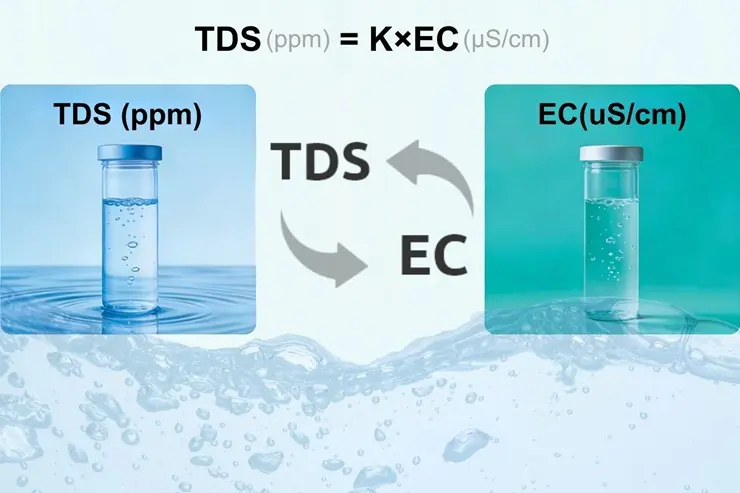
TDS (ppm) = K x EC (μS/cm)
K = Conversion factor (typically 0.5 – 0.7)
Common values:
0.5 → NaCl-based water
0.64 → Natural water
0.7 → High mineral content water
TDS to EC Calculator (Conductivity to TDS Conversion Tool)
Flexible Conversion between TDS and EC
TDS(ppm) = K × EC(μS/cm)
Please fill in:
Note: Conversion factor K varies by region, typically 0.5-0.8 (default 0.64)
1 EC = 0.1 CF = 1 μS/cm
Reference Tools : For reference, you can also explore this external TDS to conductivity calculator for additional comparison.
How to Use the TDS Calculator
1.Enter your EC value (μS/cm)
2.Select or input a conversion factor (K)
3.Get instant TDS value (ppm)
This tds to conductivity calculator is ideal for:
● Reverse osmosis (RO) systems
● Drinking water monitoring
● Industrial water treatment
● Agriculture & irrigation systems
Conductivity to TDS Conversion (EC to TDS)
You can also convert electrical conductivity (EC) to TDS using a conversion factor:
TDS = EC × K
Instead of manual calculation, simply use the TDS to EC calculator above for fast and accurate results.
Units Explained
1 EC = 1 μS/cm
1 EC = 0.1 CF (Conductivity Factor)
Some meters display:
EC (Electrical Conductivity)
CF (Conductivity Factor)
Be sure to check your device settings.
Why TDS and EC Conversion Matters
Accurate tds to ec conversion is critical for:
● Protecting RO membranes
● Monitoring water quality
● Preventing scaling and fouling
● Ensuring compliance in industrial processes
Understanding conductivity ranges is essential when performing conductivity and TDS conversion, as different water types have different EC values. For a detailed conductivity reference chart, see this water conductivity chart
FAQ – TDS & Conductivity Conversion
1. Is TDS always equal to EC?
No. TDS is estimated from EC using a conversion factor, not directly measured.
2. What is the best conversion factor?
It depends on water composition:
0.5 for pure salt solutions
0.6–0.7 for natural water
3. Can I rely on a TDS calculator?
Yes, but accuracy depends on choosing the correct factor K.
Conclusion
A reliable TDS to conductivity calculator simplifies water analysis and improves operational efficiency. Whether you are working in RO systems, industrial filtration, or agriculture, understanding conductivity conversion to TDS ensures better control of water quality.