
How to Install High Flow Filter Cartridges in FRP Filter Housing: A Complete Installation Guide
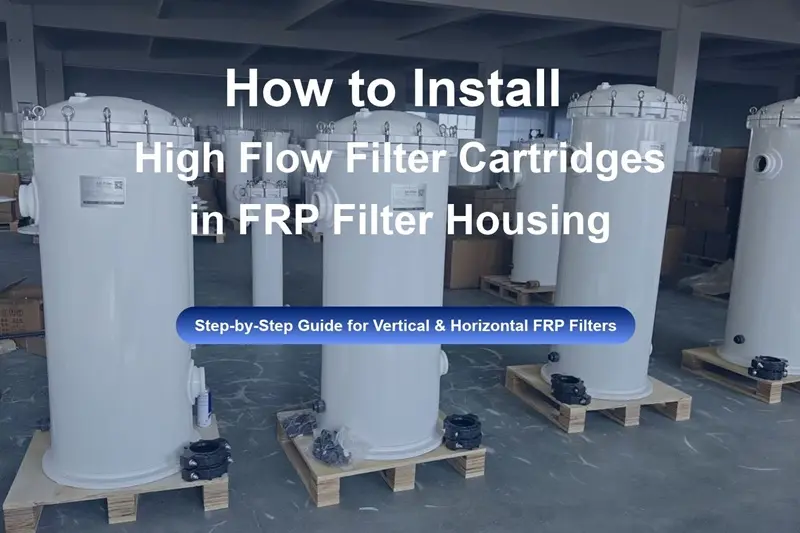
FRP (Fiber Reinforced Plastic) filter housings are widely used in industrial water treatment and liquid filtration systems. Compared with conventional stainless steel filter housings, FRP filter housings offer excellent corrosion resistance, acid and alkali resistance, and good structural strength. They are particularly suitable for seawater desalination, brackish water treatment, high-salinity water filtration, and other applications involving corrosive liquids.
In industrial high-flow filtration systems, FRP high flow filter housings are commonly used with high flow filter cartridges. These large-diameter cartridges provide a high filtration area and help meet the requirements of industrial systems for high flow rates, filtration efficiency, and reliable operation.
However, the installation and replacement procedures vary depending on the housing design. Based on their installation orientation, FRP high flow filter housings can generally be classified into two types: vertical and horizontal. They are also available in single-cartridge and multi-cartridge configurations.
Incorrect cartridge installation may result in poor sealing, liquid bypass, cartridge damage, or reduced filtration efficiency. Therefore, understanding the housing structure and following the correct installation procedures are essential for maintaining the performance and reliability of an FRP high flow filtration system.
This guide explains the common types of FRP high flow filter housings, step-by-step installation procedures for vertical and horizontal configurations, cartridge replacement methods, and important maintenance precautions.
What Are the Types of FRP High Flow Filter Housing?
FRP high flow filter housings can be classified according to their installation orientation and internal cartridge configuration. Different designs accommodate different requirements for filtration capacity, installation space, and maintenance access.
1. Vertical FRP High Flow Filter Housing
A vertical FRP high flow filter housing features a vertically oriented structure, with filter cartridges typically installed in an upright position inside the vessel.
Depending on the housing design, it can accommodate either a single high flow filter cartridge or multiple cartridges.
Key features:
· Vertical installation with a relatively compact footprint.
· Available in single-cartridge and multi-cartridge configurations.
· Top-access design facilitates cartridge installation and routine maintenance.
· Can be used as a standalone filtration unit or in parallel configurations.
For industrial water treatment projects requiring higher flow rates, the filtration capacity can be increased by using more cartridges or connecting multiple filter housings in parallel, subject to the system design.
2. Horizontal FRP High Flow Filter Housing
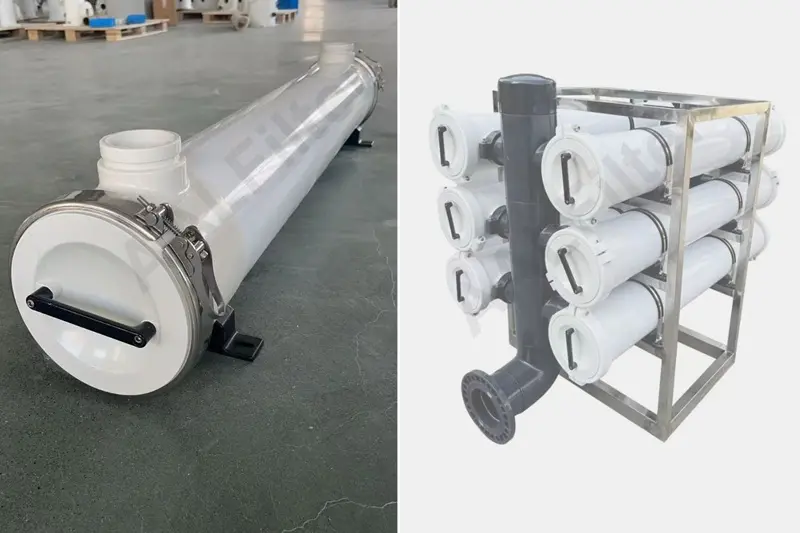
A horizontal FRP high flow filter housing features a horizontally oriented vessel, with the filter cartridge installed along the length of the housing.
This configuration is commonly designed for a single high flow filter cartridge, although other arrangements may be available depending on the specific product design and project requirements.
Key features:
· Horizontal installation for specific equipment layouts and piping arrangements.
· Cartridge installation and removal are generally performed through an end-access opening.
· End-cover sealing is essential for reliable operation.
· Multiple horizontal housings can be arranged in parallel according to the system layout.
· Stacked arrangements may help optimize floor space where installation conditions permit.
Unlike vertical FRP filter housings, horizontal designs require sufficient clearance at the access end to remove and replace the cartridge.
3. Single-Cartridge and Multi-Cartridge FRP Filter Housing
In addition to installation orientation, FRP filter housings can be classified by the number of cartridges they accommodate.
Single-Cartridge FRP Filter Housing
A single-cartridge FRP filter housing accommodates one high flow filter cartridge. It is suitable for systems where the required filtration capacity can be achieved with a single cartridge.
Multi-Cartridge FRP Filter Housing
A multi-cartridge FRP filter housing accommodates multiple high flow filter cartridges. By increasing the total effective filtration area, it can support higher system flow requirements.
The appropriate configuration should be selected according to the required flow rate, filtration rating, contaminant loading, and available installation space.
It is important to note that the actual filtration capacity also depends on cartridge specifications, incoming liquid quality, and allowable differential pressure. Cartridge quantity alone does not determine the system flow rate.
When selecting an FRP high flow filter housing, it is important to consider not only the cartridge configuration but also the required flow rate, housing material, operating pressure, corrosion resistance, and installation space. For a more detailed explanation of these factors, read our guide to high flow filter housing selection.
How to Install a Vertical FRP High Flow Filter Housing?
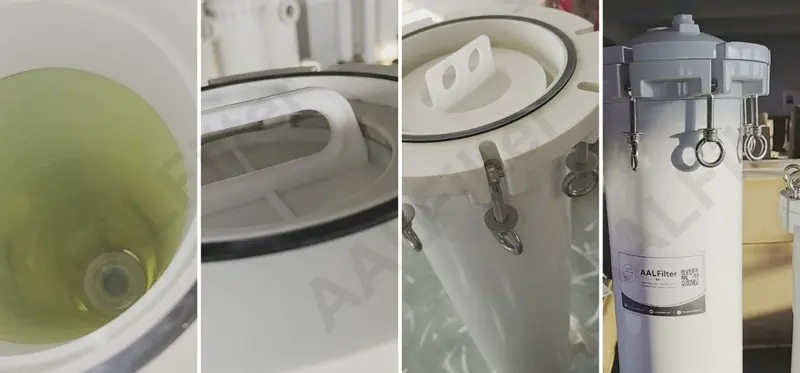
Vertical FRP high flow filter housings generally feature a top-access design, allowing cartridges to be installed and removed vertically.
The following steps describe the general installation and cartridge replacement procedure.
Step 1: Inspect the FRP Filter Housing Before Installation
Before installing the FRP filter housing, inspect the vessel, specifications, and supplied accessories.
Check the following items:
· Confirm that the housing model, dimensions, and design specifications meet the project requirements.
· Inspect the FRP surface for cracks, visible damage, or abnormal deformation.
· Check the top flange, cover, and sealing components.
· Identify the inlet, outlet, vent, drain, and pressure gauge connections.
· Inspect the internal cartridge supports, positioning components, and sealing structures.
After confirming that the housing is in good condition, install the pressure gauge, vent valve, drain valve, and other accessories according to the manufacturer's instructions.
Step 2: Position and Connect the Vertical FRP Filter Housing
Position the vertical FRP filter housing on a suitable foundation or support structure. Make sure the equipment is stable and properly supported.
For a single-housing system, connect the inlet and outlet piping according to the system drawings.
For a parallel filtration system, position all housings according to the piping layout before connecting the inlet and outlet manifolds.
During installation, pay attention to the following:
· Make sure the inlet and outlet directions match the system design.
· Provide independent and adequate support for the connecting pipes to prevent excessive loads on the FRP housing connections.
· Install flanges, clamps, or other connections according to the product design.
· Allow sufficient clearance above the housing for opening the cover and vertically removing the cartridges.
· Avoid applying excessive external force or torque to the FRP vessel during installation.
Step 3: Clean the Inside of the FRP Filter Housing
Before installing new filter cartridges, clean the inside of the housing.
For a new installation, flush the internal surface with clean water or a cleaning solution compatible with the FRP material and process requirements. This helps remove dust and debris that may have accumulated during transportation and installation.
When replacing used cartridges, first isolate the system, release the internal pressure, and drain the housing. Open the top cover and remove the old cartridges.
Clean any accumulated sediment and contaminants from the housing. Then inspect the cartridge connections, positioning supports, and sealing grooves for damage.
After cleaning, drain any remaining liquid through the drain outlet and close the drain valve according to the operating procedure.
Step 4: Install the New High Flow Filter Cartridge
This is one of the most important steps when installing a vertical FRP high flow filter housing.
First, confirm that the replacement cartridge is compatible with the filtration system. Check its length, outside diameter, filtration rating, end connection, and sealing structure.
Follow these steps:
· Open the packaging and inspect the cartridge, end caps, and O-rings for visible damage.
· If required by the cartridge manufacturer, apply a suitable lubricant that is compatible with the sealing material and process liquid.
· Hold the cartridge by its handle or designated installation area.
· Carefully lower the cartridge vertically into the FRP filter housing.
· Make sure the cartridge end connection aligns correctly with the corresponding positioning and sealing interface inside the housing.
· Check that the cartridge is fully seated and that the sealing components are correctly positioned.
· If the housing uses retaining brackets or compression devices, install them according to the product design.
For multi-cartridge FRP filter housings, install the cartridges one by one and check the position and sealing condition of each cartridge.
Important: High flow filter cartridges from different manufacturers and product series may use different end connections and sealing designs. Always follow the actual cartridge specifications and manufacturer's installation instructions. Do not force a cartridge into the housing or use incompatible retaining components.
Step 5: Close the Top Cover of the FRP Filter Housing
After installing all cartridges, inspect the top cover gasket and the housing sealing surface.
Make sure the gasket is not damaged, displaced, or contaminated before reinstalling the cover.
Tighten the fixing bolts or swing bolts evenly, following the tightening sequence and requirements specified by the manufacturer.
Ensure that the top cover is properly positioned and the sealing structure is correctly assembled.
Step 6: Fill and Vent the Vertical FRP Filter Housing
After cartridge installation, gradually introduce liquid into the housing according to the equipment startup procedure.
The general procedure is as follows:
· Confirm that the drain valve is closed.
· Open the designated vent valve.
· Slowly open the upstream inlet valve to allow liquid to enter the housing gradually.
· Allow trapped air to escape. Once the housing is properly filled and air has been adequately removed, close the vent valve according to the operating procedure.
· Inspect the top cover, inlet and outlet connections, and valve interfaces for leakage.
During filling and venting, avoid rapid pressurization and pressure surges.
Step 7: Start the Vertical FRP Filtration System
After filling and venting, gradually return the filtration system to normal operation.
Slowly open the downstream outlet valve and adjust the upstream inlet valve according to the system startup procedure until the required operating conditions are reached.
After startup, check the following:
· Inlet and outlet pressures.
· Initial differential pressure across the filter cartridges.
· Actual system flow rate.
· Leakage around the housing and pipe connections.
· Overall filtration system stability.
Record the initial differential pressure as a reference for future maintenance and cartridge replacement.
How to Install a Horizontal FRP High Flow Filter Housing?
The installation procedure for a horizontal FRP high flow filter housing differs from that of a vertical design.
The cartridge is generally installed horizontally and accessed through an end-cover opening. Therefore, particular attention should be paid to the cartridge insertion direction, end sealing, and internal retaining components.
Step 1: Inspect the Horizontal FRP Filter Housing
First, inspect the horizontal FRP filter housing and its accessories.
Check the following:
· Inspect the FRP vessel for cracks, damage, or deformation.
· Confirm that the housing dimensions and design specifications meet the application requirements.
· Check both end covers, sealing rings, and connection structures.
· Inspect the internal cartridge supports, positioning rings, and retaining components.
· Confirm the locations of the inlet, outlet, vent, and drain connections.
After confirming that the equipment is in good condition, install the valves and pressure measurement accessories according to the product instructions.
Step 2: Position and Connect the Horizontal FRP Housing
Install the horizontal FRP filter housing on the designated equipment supports or foundation according to the system drawings.
For systems with multiple horizontal filter housings operating in parallel, arrange the equipment and connect the piping according to the engineering design.
Some installations use vertically stacked parallel arrangements to reduce the required floor space.
During installation, make sure that:
· The housing is securely supported.
· The inlet and outlet directions are correct.
· Piping connections do not impose excessive mechanical loads on the FRP connections.
· Sufficient clearance is available for removing the end cover and extracting the cartridge horizontally.
· All connections are properly sealed.
Step 3: Depressurize and Open the Housing
For a new installation, confirm that the housing is clean and in a safe condition before installing the cartridge.
When replacing an existing cartridge, first stop the filtration system. Close the upstream inlet valve and downstream outlet valve, and isolate any other piping that could supply pressure to the housing.
Then slowly operate the designated vent or depressurization device according to the equipment procedure. Drain the remaining liquid through the drain outlet.
Only remove the end covers after confirming that the internal pressure has been completely released and the housing has been drained.
Important: Never remove an end cover while the filter housing is pressurized.
Step 4: Clean the Inside of the Horizontal FRP Housing
After opening the end cover, remove the internal retaining brackets, positioning rings, and other components that need to be taken out according to the housing design.
For a new installation, clean the inside of the housing using a compatible cleaning method.
When replacing an existing cartridge, remove the used cartridge first. Then clean any remaining sediment and contaminants from the housing.
Pay particular attention to:
· Cartridge end positioning structures.
· Internal support components.
· O-rings and sealing grooves.
· Housing end-cover sealing surfaces.
After cleaning, make sure no debris remains inside the housing that could interfere with cartridge installation or sealing.
Step 5: Install the High Flow Filter Cartridge Horizontally
After confirming that the replacement cartridge has the correct model and connection design, carefully insert it horizontally into the FRP filter housing.
Follow these steps:
· Inspect the cartridge body, end caps, and sealing rings.
· If required by the manufacturer, apply a compatible lubricant to the sealing components.
· Insert the cartridge horizontally in the specified direction.
· Make sure the cartridge end connection correctly engages with the corresponding positioning and sealing structure inside the housing.
· Confirm that the cartridge is fully seated.
· Install the retaining brackets, positioning rings, and other fixing components according to the housing design.
· Check that the cartridge is securely positioned and cannot move out of alignment.
For FRP filter housings with different end-retaining designs, always follow the installation instructions for the specific model.
Step 6: Reinstall the End Covers
After installing the cartridge, inspect the sealing gaskets and O-rings on the end covers.
Make sure the sealing components are not damaged, deformed, or displaced before reinstalling the covers.
Secure the end covers according to the tightening sequence and requirements specified by the manufacturer. Ensure that the sealing structures are correctly positioned.
Step 7: Fill, Vent, and Start the Horizontal FRP Filtration System
After reinstalling the end covers, gradually introduce liquid into the housing according to the equipment startup procedure.
The general procedure is as follows:
· Confirm that the drain valve is closed.
· Open the designated vent or depressurization device as required by the startup procedure.
· Slowly open the upstream inlet valve to allow liquid to enter the housing.
· Allow trapped air to escape. Once the housing is completely filled and adequately vented, close the vent device according to the manufacturer's instructions.
· Slowly open the downstream outlet valve.
· Gradually adjust the system flow rate until normal operating conditions are restored.
· Inspect both end covers, inlet and outlet connections, and other interfaces for leakage.
After startup, record the initial differential pressure and operating flow rate. Confirm that all operating parameters comply with the technical requirements of the filter cartridge and housing.
Important Precautions When Installing and Replacing High Flow Filter Cartridges in FRP Housing
FRP filter housings differ from stainless steel filter housings in material properties and structural design. The following precautions are important during cartridge installation and routine maintenance.
The basic safety principles for replacing high flow filter cartridges are similar across different types of filter housings. However, the cartridge access structure and removal procedures may vary depending on the housing design. If you are also working with stainless steel filtration systems, see our guide on replacing high flow filter cartridges in a stainless steel filter housing for detailed replacement procedures.
1. Always Depressurize the FRP Filter Housing Before Opening
Whether using a vertical or horizontal FRP filter housing, always stop the system, isolate the inlet and outlet piping, release the internal pressure, and drain the housing before replacing cartridges.
Only open the top cover or end covers after confirming that the internal pressure has been completely released.
Do not assume that closing the inlet and outlet valves alone makes the equipment safe. Never dismantle the housing while it is pressurized.
2. Confirm the Correct Inlet and Outlet Connections
The inlet and outlet connections of the FRP filter housing must match the equipment design.
Carefully check the flow direction markings on the housing and connect the piping according to the system drawings.
Incorrect piping connections may result in an unsuitable flow direction for the cartridge, reduced filtration performance, or damage to the cartridge and internal components.
3. Ensure Proper Cartridge Sealing
Proper cartridge sealing is essential for reliable filtration performance.
During installation, check the following:
· O-rings are in good condition.
· Sealing rings are correctly positioned.
· Internal sealing surfaces are clean.
· Sealing components are not twisted, pinched, or displaced.
· Sealing materials are compatible with the process liquid and operating temperature.
Improper sealing may allow unfiltered liquid to bypass the filter media and enter the downstream system, reducing filtration efficiency.
4. Avoid Excessive Mechanical Stress on the FRP Housing
FRP filter housings provide good corrosion resistance, but their installation and operation must still comply with the specified mechanical load requirements.
Avoid forcing pipe connections into position, overtightening connections, or applying excessive external loads to the housing.
The filter housing should also have adequate structural support to prevent pipe weight and vibration from being transferred directly to the FRP vessel.
5. Check Operating Pressure and Temperature
Different FRP filter housing models have different design pressures, maximum operating temperatures, and allowable differential pressures.
Before operation, check the housing nameplate and technical documentation to ensure that the system operates within the specified limits.
For seawater, high-salinity water, and chemical filtration applications, also verify the compatibility of the process liquid with the FRP housing, sealing materials, and cartridge media.
6. Check for Leakage After Installation
After installing the cartridges and restarting the system, carefully inspect the following areas:
· Top cover or end-cover connections.
· Liquid inlet and outlet connections.
· Vent and drain valves.
· Pressure gauges and accessory connections.
· All flange, clamp, and sealing connections.
If leakage or abnormal pressure changes occur, stop the system. Isolate and depressurize the housing before investigating the cause.
How to Maintain FRP High Flow Filter Housing and Filter Cartridges?
Proper maintenance helps extend the service life of the filtration system, reduce unnecessary cartridge replacements, and control operating costs.
1. Monitor Differential Pressure Regularly
Regularly record the inlet and outlet pressures and monitor the differential pressure across the filter cartridges.
As contaminants accumulate in the filter media, the differential pressure generally increases.
When the differential pressure reaches the replacement limit recommended by the manufacturer, replace the cartridges promptly.
2. Check Filter Cartridge Condition
Inspect the cartridges regularly for abnormal clogging, damaged filter media, cracked end caps, or sealing failure.
If filtration performance becomes abnormal, check both the cartridges and the internal housing components.
3. Select Compatible Filter Cartridges
When selecting replacement cartridges, confirm that their length, outside diameter, end connection, flow direction, and sealing method are compatible with the FRP filter housing.
Do not assume that cartridges from different brands are interchangeable based on appearance alone.
4. Inspect the FRP Housing and Sealing Components
Regularly inspect the FRP vessel surface, end covers, connection areas, and sealing components.
If cracks, visible deformation, abnormal wear, or aging seals are found, arrange a professional inspection and take appropriate corrective action.
5. Keep Maintenance Records
It is recommended to maintain an operating and maintenance log for each filtration system.
Important records include:
· FRP filter housing model and specifications.
· Installed cartridge model and filtration rating.
· Initial operating differential pressure.
· Differential pressure at cartridge replacement.
· Actual operating flow rate.
· Process liquid and water quality changes.
· Cartridge replacement dates.
These records help evaluate cartridge service life and improve future filtration system maintenance planning.
How to Choose the Right High Flow Filter Cartridge for FRP Filter Housing?
Selecting the right high flow filter cartridge for an FRP filter housing involves more than checking cartridge dimensions. The end connection, flow direction, sealing structure, and actual operating conditions must also be considered.
The following technical parameters should be checked before selecting a replacement cartridge:
Selection Parameter | Description |
Cartridge Length | Cartridge length and available installation space |
Outside Diameter | Cartridge outside diameter |
Filtration Rating | Required micron rating, such as 1, 5, 10, or 20 μm |
Flow Direction | Inside-to-outside or outside-to-inside flow |
End Connection | End-cap and connection design |
Filter Media | PP, PES, or other suitable filter media |
Seal Material | EPDM, silicone, FKM, or other compatible sealing materials |
Operating Pressure | System operating pressure and allowable differential pressure |
Operating Temperature | Actual operating temperature |
Liquid Compatibility | Compatibility of the filter media and seals with the process liquid |
For seawater desalination and brackish water treatment systems using FRP filter housings, particular attention should be paid to cartridge material compatibility, filtration rating, flow capacity, and operating differential pressure.
If you need to replace an existing Pall, Parker, or other branded high flow filter cartridge, providing the original cartridge model, product photos, or technical drawings can help verify dimensional and connection compatibility.
AALFilter FRP High Flow Filter Housing and Cartridge Solutions
AALFilter provides FRP high flow filter housing and high flow filter cartridge solutions for industrial liquid filtration applications.
FRP filter housings are particularly suitable for applications requiring corrosion-resistant filtration equipment, including seawater desalination, brackish water treatment, and other industrial water treatment processes.
AALFilter offers different FRP filter housing configurations to accommodate various installation and filtration requirements, including:
Vertical FRP High Flow Filter Housing: Available in single-cartridge and multi-cartridge configurations.
Horizontal FRP High Flow Filter Housing: Designed for horizontal cartridge installation and suitable for specific industrial filtration system layouts.
FRP Bag Filter Housing: Available in different configurations for industrial liquid filtration.
FRP High Flow Cartridge Filter Housing: Designed for high-flow filter cartridge applications.
For high flow filtration applications, AALFilter also provides compatible high flow filter cartridges, including Pall Ultipleat replacement high flow filter cartridges designed for industrial liquid filtration systems. These replacement cartridges offer an alternative solution for users looking for compatible high flow filtration products.
For applications requiring an alternative to Parker high flow filter cartridges, AALFilter also offers Parker high flow filter cartridge replacements with compatible configurations for selected filtration systems. Cartridge dimensions, end connections, flow direction, and sealing requirements should be verified before replacement.
When selecting an FRP high flow filtration solution, customers should consider the required flow rate, filtration rating, cartridge configuration, operating pressure, temperature, and liquid compatibility.
Partner with AALFilter for Reliable FRP High Flow Filtration Solutions.
Whether you need a vertical FRP filter housing, a horizontal FRP high flow filtration system, or compatible high flow filter cartridges, AALFilter can help you evaluate a suitable filtration solution based on your application requirements.
Contact us or email [email protected] to discuss your filtration requirements.
Frequently Asked Questions (FAQ)
1. What are the advantages of FRP high flow filter housing?
FRP high flow filter housings offer good corrosion resistance, acid and alkali resistance, and a lightweight structural design. They are particularly suitable for seawater desalination, brackish water treatment, and industrial liquid filtration applications where corrosion resistance is important.
2. What is the difference between vertical and horizontal FRP filter housing?
Vertical FRP filter housings generally feature top-access cartridge installation, while horizontal FRP filter housings typically use end-access cartridge installation. The appropriate configuration depends on installation space, cartridge arrangement, and maintenance requirements.
3. How many high flow filter cartridges can be installed in an FRP filter housing?
The number of cartridges depends on the housing design. FRP high flow filter housings are available in single-cartridge and multi-cartridge configurations. The required quantity should be determined according to the system flow rate, filtration requirements, and available installation space.
4. How often should high flow filter cartridges in FRP housing be replaced?
There is no fixed replacement interval. It depends on incoming liquid quality, contaminant concentration, filtration rating, and operating conditions. Differential pressure should be monitored regularly, and cartridges should be replaced according to the manufacturer's recommended limits.
5. Can Pall or Parker high flow filter cartridges be used in FRP filter housings?
FRP filter housings can be designed for compatible high flow filter cartridges, including certain Pall- and Parker-style configurations. However, cartridge dimensions, end connections, sealing structures, and flow directions must be verified before installation.
6. What should be checked before starting an FRP high flow filtration system?
Before startup, check cartridge installation, sealing components, housing closure, inlet and outlet connections, drain and vent valves, and pressure measurement instruments. Fill and vent the housing according to the manufacturer's startup procedure, then gradually restore normal operating conditions and inspect for leakage.