
How to Replace High Flow Filter Cartridges in a Stainless Steel Filter Housing
High flow filtration systems are widely used in industrial water treatment, reverse osmosis (RO) pre-filtration, power generation, and other liquid filtration applications. A typical system consists of high flow filter cartridges installed inside a stainless steel filter housing.
During continuous operation, suspended solids, sediment, and other contaminants gradually accumulate on the filter media. As the filter cartridges become clogged, the differential pressure across the cartridges increases and the filtration flow rate may decrease. Replacing the cartridges at the appropriate time is essential to maintaining filtration efficiency, protecting downstream equipment, and ensuring stable system operation.
This guide explains how to replace high flow filter cartridges in a stainless steel filter housing, including replacement indicators, step-by-step installation procedures, and key maintenance considerations.
Understand Your Stainless Steel High Flow Filter Housing
Before replacing filter cartridges, it is important to understand the structure and configuration of your stainless steel filter housing. Different housing designs may require different cartridge removal and installation procedures.
Vertical and Horizontal High Flow Filter Housings
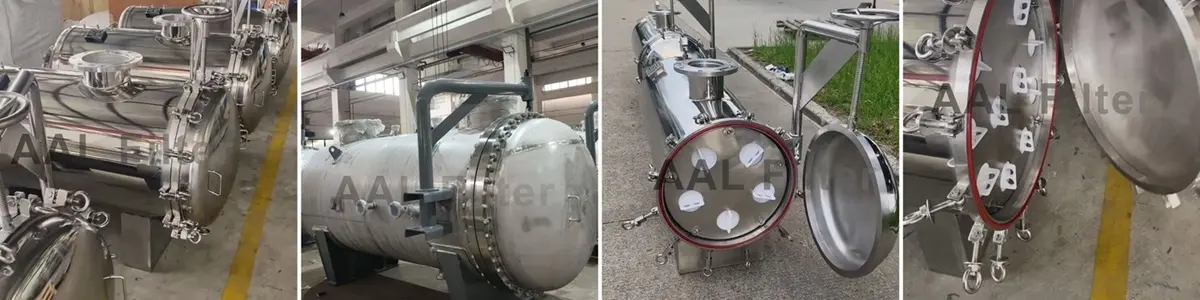
High flow filter housings are generally available in vertical and horizontal configurations.
· Vertical High Flow Filter Housing: The filter cartridges are installed vertically inside the housing. The top cover is typically opened to access and replace the cartridges.
· Horizontal High Flow Filter Housing: The filter cartridges are arranged horizontally inside the housing. Depending on the design, cartridge replacement may require opening a side cover or end closure.
The installation arrangement, cover design, and internal support structure should be checked before maintenance begins.
Inside-to-Outside and Outside-to-Inside Flow Designs
High flow filter cartridges are available in different flow configurations. Two common designs are:
· Inside-to-Outside Flow: Liquid enters the inside of the filter cartridge and flows outward through the filter media. Contaminants are retained on the inner surface of the cartridge.
· Outside-to-Inside Flow: Liquid enters from the outside of the filter cartridge and flows inward through the filter media. Contaminants are retained on the outer surface.
The correct flow direction is determined by the cartridge and housing design. Always confirm the flow configuration before installing replacement cartridges. Installing a cartridge with an incompatible flow direction or end connection may affect sealing and filtration performance.
When Should High Flow Filter Cartridges Be Replaced?
Replacing filter cartridges at the right time helps maintain stable system performance and prevents excessive pressure loss. The following operating conditions can indicate that cartridge replacement is necessary.
1. Increased Differential Pressure
Differential pressure is one of the most important indicators of filter cartridge condition.
As contaminants accumulate on the filter media, resistance to liquid flow increases, causing the differential pressure between the inlet and outlet sides of the filter to rise.
When the differential pressure reaches the cartridge manufacturer's recommended replacement limit, the filter cartridges should be inspected and replaced as necessary.
2. Reduced Filtration Flow Rate
A significant reduction in system flow rate may indicate that the filter cartridges are clogged. However, low flow can also result from pump performance, partially closed valves, blocked pipelines, or other system conditions.
Check the entire filtration system before determining whether cartridge replacement is required.
3. Changes in Downstream Water Quality
If particles or suspended solids appear in the filtered liquid, inspect the filter cartridges and sealing components. Possible causes include damaged filter media, incorrect cartridge installation, or sealing failure.
4. Scheduled Maintenance
Even when the system appears to be operating normally, regular inspections should be performed according to the operating conditions and maintenance recommendations.
The replacement interval depends on the liquid quality, contaminant concentration, filtration rating, operating flow rate, and system conditions. A fixed replacement schedule should not replace differential-pressure monitoring and actual performance checks.
How to Replace High Flow Filter Cartridges: Step-by-Step Guide
The following procedure provides a general reference for replacing high flow filter cartridges in a stainless steel filter housing. Always follow the equipment manufacturer's instructions and site-specific safety procedures.
Step 1: Shut Down the Filtration System
Before opening the filter housing, stop the filtration system and isolate it from the liquid supply.
· Stop the relevant pump or filtration equipment.
· Close the inlet and outlet valves.
· Isolate any connected bypass or auxiliary lines where necessary.
· Apply lockout/tagout (LOTO) procedures to prevent accidental startup.
Make sure the system cannot be unintentionally pressurized during maintenance.
Step 2: Release Pressure and Drain the Housing
Never open a stainless steel filter housing while it is under pressure.
Open the designated vent and drain valves according to the manufacturer's procedure. Allow the liquid inside the housing to drain safely.
Before loosening the cover, verify that the housing is fully depressurized and that no trapped pressure remains. Do not rely solely on a pressure gauge if its accuracy or operating condition is uncertain.
If the filtered liquid is corrosive, hot, or otherwise hazardous, use appropriate personal protective equipment (PPE) and follow the site's liquid handling and disposal procedures.
Step 3: Open the Filter Housing Cover
Once zero pressure has been confirmed and the housing has been safely drained, open the housing cover.
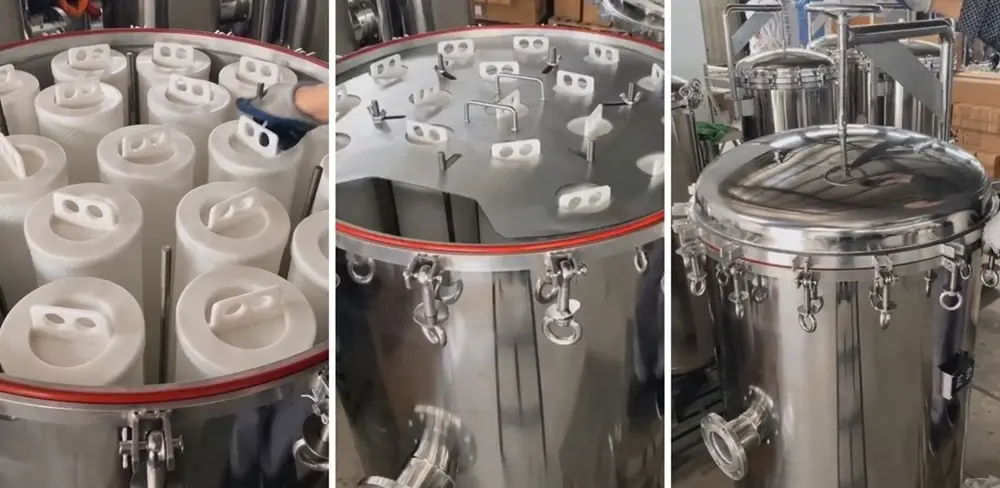
Depending on the housing design, the cover may be secured with bolts, a clamp, or another closure mechanism.
For large or heavy covers, use suitable lifting equipment and follow the manufacturer's handling instructions. Avoid damaging the sealing surface or cover gasket during removal.
Step 4: Remove the Used High Flow Filter Cartridges
Carefully remove the used filter cartridges from the internal support structure.
Check the cartridge connection type and locking mechanism before removal. Some high flow cartridges use different end configurations, such as single-open-end connections, bayonet connections, or other specialized fittings.
Avoid applying excessive force, which may damage the cartridge support components or internal housing structure.
Dispose of used cartridges in accordance with the applicable environmental and site safety requirements.
Step 5: Clean and Inspect the Filter Housing
Before installing new cartridges, clean the inside of the stainless steel filter housing.
Pay particular attention to:
· The internal support plate and cartridge locating components.
· Cartridge connection points and sealing surfaces.
· The housing bottom and areas where sediment may accumulate.
· The cover gasket and O-ring sealing grooves.
Remove accumulated dirt and sediment using a cleaning method compatible with the housing material and process liquid.
Inspect the housing for corrosion, deformation, damaged threads, worn sealing surfaces, and other signs of deterioration. Replace damaged sealing components before returning the equipment to service.
Step 6: Install the New High Flow Filter Cartridges
Select replacement cartridges that are compatible with the original cartridge specifications and the housing configuration.
Before installation, check the following:
· Cartridge length and outside diameter.
· Filtration rating and filter media material.
· Flow direction and cartridge structure.
· End connection and locking mechanism.
· O-ring material and sealing configuration.
· Operating temperature, pressure, and liquid compatibility.
Carefully insert each cartridge into its designated position. Make sure the end connections are properly aligned and fully engaged with the corresponding housing fittings.
Check that all cartridges are securely installed and correctly seated. Incorrect installation may cause bypass leakage, reduce filtration efficiency, or damage the cartridge connections.
Step 7: Reinstall the Filter Housing Cover
After all replacement cartridges have been installed, inspect the cover gasket or O-ring and replace it if necessary.
Reinstall the housing cover and tighten the closure components according to the manufacturer's recommended procedure and torque requirements, where specified.
Ensure that the cover is correctly positioned and that the sealing surfaces are clean and free from foreign material.
Step 8: Refill, Vent, and Restart the System
After closing the housing, prepare the system for operation.
· Close the drain valve.
· Open the designated vent valve.
· Slowly introduce liquid into the filter housing according to the equipment manufacturer's startup procedure.
· Allow trapped air to escape through the vent.
· Close the vent once the housing has been properly filled and vented.
· Gradually restore normal operating conditions.
Check the housing cover, connections, and drain points for leakage. Monitor the inlet pressure, outlet pressure, differential pressure, and flow rate after startup to confirm that the filtration system is operating normally.
Important Considerations When Replacing High Flow Filter Cartridges
Correct installation is essential for maintaining filtration performance and preventing leakage or equipment damage. Keep the following points in mind during cartridge replacement.
1. Confirm Cartridge Compatibility
High flow filter cartridges are available in different lengths, diameters, end connections, flow directions, and internal structures.
A cartridge that looks similar to the original may not be compatible with the existing housing. Confirm the complete cartridge specifications before ordering replacements.
For brand-replacement applications, verify the original manufacturer's model number and connection configuration. Compatibility should be confirmed by model and dimensions rather than appearance alone.
2. Check O-Rings and Sealing Components
O-rings and gaskets play an important role in preventing unfiltered liquid from bypassing the filter media.
Before installation, inspect the sealing components for cracks, deformation, hardening, or wear. Confirm that the replacement seal material is compatible with the process liquid and operating temperature.
3. Follow the Correct Flow Direction
Always install the cartridge according to its specified flow direction. An incorrectly installed cartridge may result in poor sealing, abnormal pressure behavior, or damage to the filter structure.
4. Monitor Differential Pressure After Startup
After replacing the cartridges, record the initial differential pressure under normal operating conditions.
This provides a useful baseline for future maintenance. A rapid increase in differential pressure may indicate high contaminant loading, an unsuitable filter rating, or abnormal operating conditions.
5. Never Open the Housing Under Pressure
This is one of the most important safety requirements. Always isolate the system, release trapped pressure, drain the housing, and verify zero pressure before opening the cover.
Follow the manufacturer's maintenance procedure and the site's safety requirements throughout the replacement process.
How to Extend the Service Life of High Flow Filter Cartridges
Proper system operation and routine maintenance can help improve cartridge service life and reduce replacement frequency.
Monitor Differential Pressure Regularly
Track the differential pressure across the filter during operation. Timely replacement helps prevent excessive pressure loss and unnecessary stress on the filtration system.
Select the Appropriate Filtration Rating
Choose a filtration rating that meets the downstream equipment protection requirements without creating unnecessary resistance to liquid flow. An excessively fine filter may clog more quickly when the incoming liquid contains a high concentration of suspended solids.
Choose Compatible Filter Media
The filter media should be compatible with the process liquid, operating temperature, and chemical conditions. Polypropylene (PP) is commonly used for industrial water filtration, while other materials may be required for different liquid applications.
Maintain Stable Operating Conditions
Avoid unnecessary flow fluctuations and operating conditions beyond the recommended limits of the filter cartridges and housing.
Keep Maintenance Records
Record cartridge replacement dates, differential pressure, operating flow rate, and any unusual system conditions. These records help identify recurring filtration problems and establish a more effective maintenance schedule.
How to Select the Right Replacement High Flow Filter Cartridges
When purchasing replacement high flow filter cartridges, matching the original specifications is essential for proper installation and reliable operation.
The following information can help determine cartridge compatibility:
Specification | What to Confirm |
Cartridge Length | Overall cartridge length and dimensional tolerance |
Outside Diameter | Cartridge outer diameter |
Flow Direction | Inside-to-outside or outside-to-inside |
End Connection | Single open end, 226, bayonet, or other connection type |
Filtration Rating | Required micron rating |
Filter Media | PP, PES, or other compatible media |
Seal Material | EPDM, silicone, Viton, or other compatible materials |
Operating Conditions | Liquid type, flow rate, pressure, and temperature |
For replacement projects involving Pall, 3M, Parker, or other high flow filter brands, the original model number, cartridge dimensions, end connection, and flow configuration should be checked carefully before selecting an alternative.
For more information about cartridge sizing and compatibility, see our High Flow Filter Housing Selection Guide and How to Size High Flow Filter Cartridges: A Practical Guide for Industrial Filtration Systems.
You can also explore our guide to Pall / 3M / Parker High Flow Filter Cartridge Alternatives: A Practical Selection Guide for additional information on replacement options.
AALFilter High Flow Filter Cartridge and Stainless Steel Housing Solutions
AALFilter provides high flow filter cartridges and stainless steel filter housing solutions for industrial liquid filtration applications.
Our high flow filter cartridge range includes replacement options for various mainstream filtration brands, including Pall, 3M, and Parker. Different cartridge configurations are available to meet specific filtration requirements, including different lengths, filtration ratings, flow directions, and end connections.
To help identify a suitable replacement cartridge, please provide the following information:
· Original cartridge brand and model number.
· Cartridge length and outside diameter.
· End connection and flow direction.
· Required filtration rating.
· Process liquid and operating temperature.
· Operating flow rate and pressure.
Based on these details, AALFilter can help evaluate cartridge compatibility and recommend a suitable high flow filtration solution for your existing stainless steel filter housing.
Partner with AALFilter for Reliable High Flow Filter Cartridge Solutions.
Contact us to discuss your industrial filtration requirements.
Frequently Asked Questions (FAQ)
1. How often should high flow filter cartridges be replaced?
There is no universal replacement interval. It depends on the incoming liquid quality, contaminant concentration, filtration rating, flow rate, and operating conditions. Monitor differential pressure and follow the cartridge manufacturer's replacement recommendations.
2. How do I know when a high flow filter cartridge is clogged?
An increase in differential pressure is a key indication of cartridge loading. Reduced flow rate may also indicate clogging, but other system components should be checked before confirming the cause.
3. Can I install a different brand of high flow filter cartridge in my existing stainless steel filter housing?
In many cases, an alternative cartridge may be suitable, but compatibility must be verified. Check the cartridge dimensions, end connection, flow direction, sealing arrangement, filtration rating, and operating conditions before installation.
4. What should I check before installing a replacement high flow filter cartridge?
Confirm the cartridge length, outside diameter, micron rating, filter media, end connection, flow direction, and O-ring material. Also inspect the housing's internal support components and sealing surfaces.
5. Can I open a stainless steel filter housing without draining the liquid?
No. The housing must be isolated, depressurized, and safely drained according to the manufacturer's procedure before the cover is opened. Never attempt to open a pressurized filter housing.
6. Why should the differential pressure be checked after replacing filter cartridges?
The initial differential pressure provides a baseline for monitoring future cartridge performance. It helps operators identify changes in filtration resistance and determine when maintenance may be required.