
UPVC Cartridge Filter Housing Filter Cartridge Replacement Guide
UPVC Cartridge Filter Housings are widely used in water treatment, chemical processing, electroplating, electronics, food & beverage, and other industrial filtration applications due to their excellent corrosion resistance, lightweight construction, and cost-effectiveness.
To maintain optimal filtration performance and protect downstream equipment, filter cartridges should be inspected and replaced regularly. This guide explains the correct procedure for replacing filter cartridges in a UPVC cartridge filter housing, helping improve filtration efficiency, reduce downtime, and extend equipment service life.
Why Is Regular Filter Cartridge Replacement Important?
During operation, filter cartridges continuously capture suspended solids, particles, sediments, and other contaminants. Over time, this leads to:
· Increased differential pressure across the filter housing
· Reduced system flow rate
· Lower filtration efficiency
· Higher pump operating load
· Potential impact on downstream equipment performance
Filter cartridges should be replaced when they become clogged or when the pressure differential reaches the recommended limit. In most applications, replacement is recommended when the pressure drop reaches 0.10–0.15 MPa (1.0–1.5 bar).
Preparation Before Replacing the Filter Cartridge
Required Tools
· Wrench or housing opening tool
· Clean cloth
· New replacement filter cartridges
· Protective gloves
· Safety goggles (if required)
Safety Precautions
Before opening the filter housing, ensure that:
· The pump is shut down
· The inlet valve is closed
· The outlet valve is closed
· Internal pressure is completely released
· The filter housing is fully drained
Warning: Never open a pressurized filter housing. Failure to release pressure may result in equipment damage or personal injury.
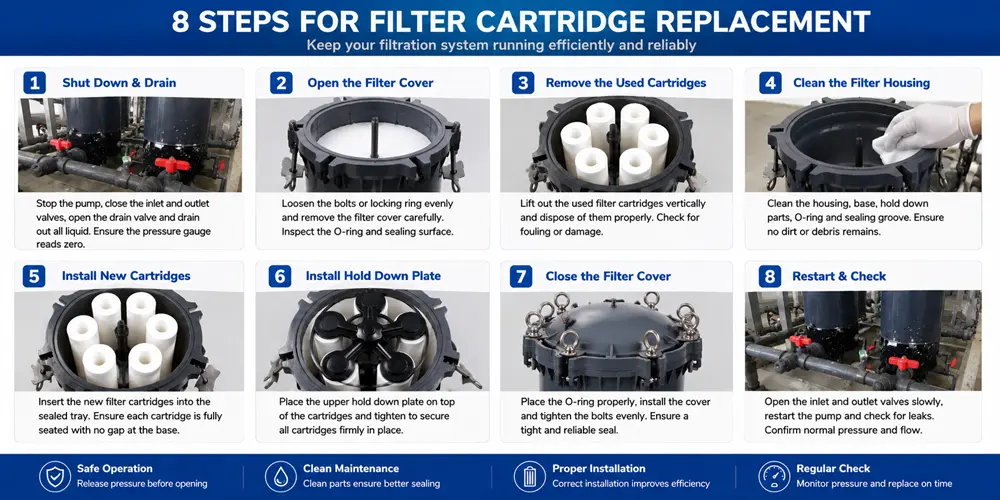
UPVC Cartridge Filter Housing Filter Cartridge Replacement Procedure
Step 1: Shut Down the System and Drain the Housing
1. Stop the feed pump.
2. Close the inlet valve.
3. Close the outlet valve.
4. Open the drain valve.
5. Completely drain the liquid from the filter housing.
6. Confirm that the pressure gauge reads zero.
Step 2: Open the Filter Housing Cover
1. Loosen the cover bolts or locking ring.
2. Carefully remove the housing cover.
3. Inspect the O-ring and sealing surfaces.
Check for:
· Damaged O-rings
· Cracks or deformation
· Dirt or residue in the sealing groove
Step 3: Remove the Used Filter Cartridge
1. Grip the filter cartridge firmly.
2. Pull it straight upward from the cartridge seat.
3. Dispose of the used cartridge according to local regulations.
While removing the cartridge, inspect it for:
· Heavy fouling
· Mechanical damage
· Unusual contamination
This information can help identify potential process issues.
Step 4: Clean the Filter Housing
Before installing a new cartridge, thoroughly clean:
· Internal housing surfaces
· Cartridge support base
· Hold-down plate
· O-ring
· Sealing groove
Ensure there is:
· No debris
· No scale buildup
· No chemical residue
Replace any worn or damaged sealing components if necessary.
Step 5: Install the New Filter Cartridge
1. Verify that the replacement cartridge matches the required specifications.
2. Align the cartridge with the cartridge seat.
3. Insert the cartridge vertically into the housing.
4. Ensure the cartridge is fully seated.
5. Confirm there is no gap between the cartridge and the base.
For multi-cartridge filter housings:
· Install all cartridges correctly.
· Ensure each cartridge is seated securely.
· Avoid tilting or misalignment.
Step 6: Install and Tighten the Hold-Down Plate
1. Position the hold-down plate above the cartridges.
2. Securely tighten the hold-down mechanism.
3. Confirm all cartridges are firmly fixed in place.
Proper tightening helps prevent:
· Cartridge bypass
· Seal failure
· Reduced filtration efficiency
Step 7: Reassemble the Filter Housing
1. Clean and inspect the O-ring.
2. Place the O-ring correctly in the sealing groove.
3. Reinstall the filter housing cover.
4. Tighten bolts or locking ring evenly.
Ensure:
· The O-ring is not twisted.
· The cover is properly aligned.
· All connections are secure.
Step 8: Restart the Filtration System
1. Slowly open the inlet valve.
2. Allow the housing to fill gradually.
3. Vent trapped air if applicable.
4. Slowly open the outlet valve.
5. Restart the feed pump.
Inspect the system for:
· Leakage
· Stable pressure readings
· Normal flow rate
· Proper operating conditions
Post-Replacement Inspection Checklist
After replacing the filter cartridges, record the following information:
Inspection Item | Details |
Replacement Date | Maintenance record |
Cartridge Type | PP, String Wound, Pleated, PES, PTFE, etc. |
Initial Differential Pressure | Pressure after replacement |
Flow Rate | Operating flow rate |
Operator | Maintenance personnel |
Maintaining service records can help optimize cartridge replacement intervals and reduce operating costs.
Maintenance Tips for UPVC Cartridge Filter Housings
Monitor Differential Pressure Regularly
A rising pressure drop is often the first sign of cartridge fouling.
Use the Correct Filter Cartridge
Select cartridges based on:
· Filtration rating
· Chemical compatibility
· Operating temperature
· Flow requirements
Common options include:
· PP Melt Blown Filter Cartridges
· String Wound Filter Cartridges
· Pleated Filter Cartridges
· PES Membrane Filter Cartridges
· PTFE Membrane Filter Cartridges
Inspect Seals Routinely
Regularly check:
· O-rings
· Gaskets
· Cover sealing surfaces
Avoid Excessive Operating Pressure
Always operate within the design pressure limits of the UPVC filter housing to prevent damage.
Frequently Asked Questions (FAQ)
How often should filter cartridges be replaced?
Replacement frequency depends on water quality, contaminant load, operating conditions, and pressure differential. Regular monitoring of pressure drop is recommended.
What is the recommended pressure differential for cartridge replacement?
Most applications recommend replacing cartridges when the pressure differential reaches 0.10–0.15 MPa (1.0–1.5 bar).
Can different types of filter cartridges be used in the same UPVC filter housing?
Yes. Depending on housing design, UPVC cartridge filter housings can accommodate PP melt blown, string wound, pleated, PES membrane, PTFE membrane, and other standard filter cartridges.
What should be checked when installing a new filter cartridge?
Ensure the cartridge is fully seated, correctly aligned, securely held down, and that all sealing components are clean and undamaged.
AALFilter UPVC Cartridge Filter Housing Solutions
AALFilter manufactures high-quality UPVC Cartridge Filter Housings for a wide range of industrial filtration applications, including:
· Water Treatment
· RO Pretreatment Systems
· Chemical Processing
· Electroplating Solutions
· Acid and Alkali Filtration
· Food & Beverage Production
· Electronics and Ultra-Pure Water Systems
Key Features
· Excellent Corrosion Resistance
· Lightweight UPVC Construction
· Compatible with Various Filter Cartridge Types
· Easy Installation and Maintenance
· Cost-Effective Operation
· Reliable Filtration Performance
By following proper filter cartridge replacement procedures and routine maintenance practices, users can maximize filtration efficiency, extend cartridge life, and ensure long-term reliable operation of their UPVC cartridge filter housing systems.