3-Stage Activated Carbon Filtration System for Alcohol Processing
Functions, Design, and Operation in Modern Distilleries
In alcohol production, achieving consistent quality, clarity, and flavor stability requires more than a single filtration step. While activated carbon filtration is widely recognized for its ability to remove impurities from spirits, modern distilleries increasingly rely on multi-stage filtration equipment to meet higher quality standards and operational efficiency.
Activated carbon plays a critical role in alcohol purification by removing unwanted compounds that affect clarity and flavor. If you would like to understand the fundamental principles behind this process, you can read our detailed guide on how activated carbon improves alcohol filtration.
Building on the principles discussed in our previous article on activated carbon alcohol filtration, this blog focuses on a practical filtration solution:
a 3-stage activated carbon filtration system combined with a final PP pleated membrane filter, designed specifically for distillery and alcohol processing applications.
Why Distilleries Need Multi-Stage Alcohol Filtration Equipment
Single-stage carbon filtration can remove certain odors and impurities, but it often presents challenges such as:
Rapid carbon saturation
Inconsistent filtration performance
Limited control over flavor refinement
Increased risk of carbon fines entering downstream processes
As production volumes increase and quality expectations rise, distilleries require a controlled, staged filtration approach that balances impurity removal with flavor preservation. A multi-stage activated carbon filtration system addresses these challenges by distributing the adsorption load across several filtration steps, followed by precise membrane filtration.
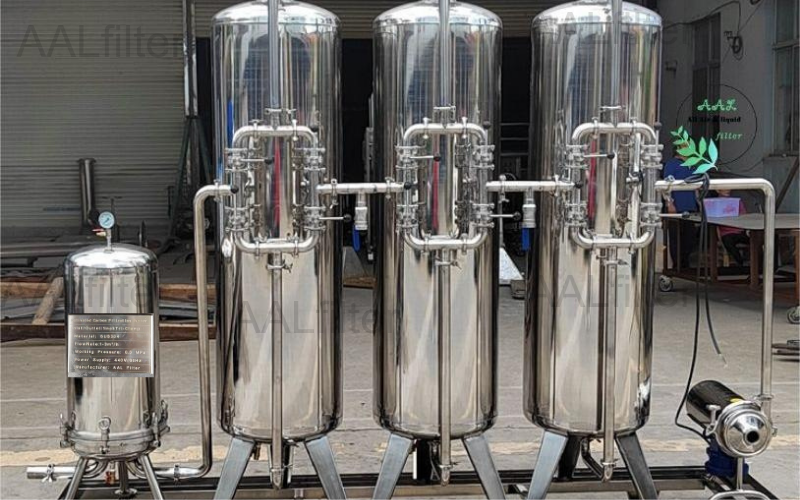
Overview of the 3-Stage Activated Carbon + PP Pleated Filtration System
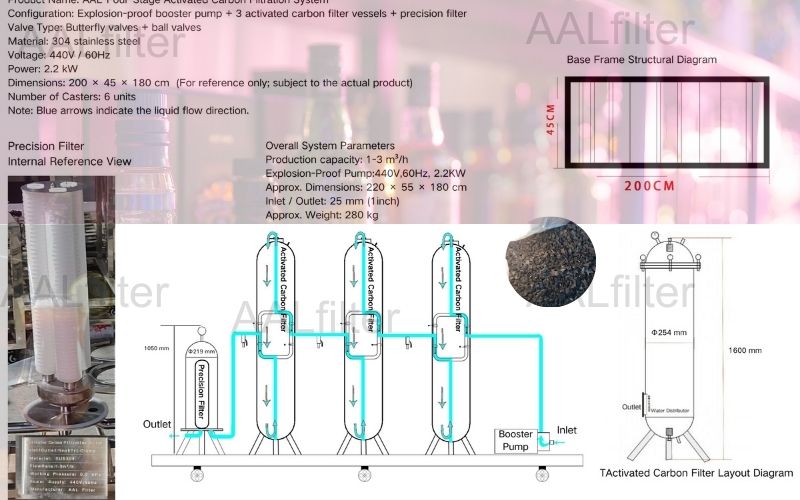
This alcohol filtration system is designed as a polishing and clarification unit for spirits and neutral alcohols. The system typically consists of:
Stage 1: Coarse Activated Carbon Filtration
Stage 2: Intermediate Activated Carbon Filtration
Stage 3: Fine Activated Carbon Polishing
Final Stage: PP Pleated Membrane Filtration
The equipment is suitable for a wide range of applications, including:
Vodka and neutral spirits
Grain alcohol
Fruit-based spirits
Alcohol destined for blending or bottling
It is commonly installed after distillation and before storage or bottling, depending on the production process.
Function of Each Filtration Stage
First Stage – Bulk Impurity Reduction with Activated Carbon
The first activated carbon stage is designed to handle higher impurity loads. Its primary functions include:
Removing larger organic compounds
Reducing strong odors and color bodies
Stabilizing incoming alcohol quality
By eliminating bulk impurities at an early stage, this step protects downstream carbon filters and improves overall system efficiency.
Second Stage – Deep Adsorption and Flavor Refinement
The second stage focuses on deeper adsorption, targeting:
Fusel oils
Unwanted esters and aldehydes
Residual off-flavors
At this stage, contact time and carbon selection are optimized to refine the alcohol profile without excessive adsorption. This ensures improved smoothness and consistency while maintaining the desired character of the spirit.
Third Stage – Fine Activated Carbon Polishing
The third activated carbon stage acts as a final polishing step before membrane filtration. Its role is to:
Remove trace-level organic impurities
Eliminate subtle residual odors
Ensure uniform quality before final clarification
This staged design minimizes the risk of over-filtration, helping distilleries achieve a clean and stable product without stripping essential flavor components.
Final Stage – PP Pleated Membrane Filtration
After carbon adsorption, the alcohol passes through a PP pleated membrane filter cartridge, which performs mechanical filtration. This final stage removes:
Activated carbon fines
Suspended particles
Micron-level contaminants
PP pleated filters are widely used in alcohol filtration due to their advantages:
Food-grade polypropylene construction
High flow rate with low pressure drop
Chemical compatibility with alcohol
No impact on alcohol content or taste
This step ensures the alcohol is clear, stable, and ready for downstream processing or bottling.
Key Features of the Alcohol Filtration Equipment
This multi-stage activated carbon filtration system is engineered for industrial distillery environments and offers several key features:
Modular multi-stage design
Stainless steel filter housings (304 or 316L optional)
Food-grade sealing materials
Alcohol-resistant construction
Easy maintenance and filter replacement
The system can be customized based on:
Required flow rate
Carbon type and particle size
Filter cartridge dimensions
Micron ratings for final membrane filtration
How the Filtration System Is Used in Distillery Operations
Typical Installation Points
After distillation, before storage tanks
After blending, before bottling lines
Operating Modes
Continuous inline filtration
Batch filtration for controlled processing
The system can be integrated with existing distillery infrastructure, including storage tanks, transfer pumps, and bottling lines. Where required, it can also be adapted for CIP-compatible operations.
Benefits for Distilleries
By adopting a 3-stage activated carbon filtration system with PP pleated membrane filtration, distilleries can achieve:
Stable and repeatable alcohol quality
Improved clarity and visual appearance
Consistent flavor profile across batches
Extended filter service life
Reduced operational and replacement costs
Compliance with food and beverage hygiene standards
These benefits are particularly valuable for distilleries producing alcohol for export or premium markets.
Typical Applications and Use Cases
This alcohol filtration equipment is widely used in:
Medium to large-scale distilleries
Neutral spirit production lines
High-purity alcohol polishing
Quality control before bottling
It is especially suitable for operations requiring tight quality control and scalable filtration performance.
Customization Options for Different Alcohol Products
Different alcohol products require different filtration strategies. This system can be customized by adjusting:
Activated carbon type (granular or customized grades)
Carbon contact time
Final membrane micron rating
System capacity and housing configuration
This flexibility allows distilleries to tailor filtration performance to specific alcohol types and quality goals.
Conclusion: A Reliable Filtration Solution for Consistent Alcohol Quality
A 3-stage activated carbon filtration system combined with a PP pleated membrane filter provides distilleries with a balanced and reliable approach to alcohol filtration. By separating impurity removal into multiple controlled stages and finishing with precise membrane filtration, this solution ensures high clarity, stable quality, and consistent flavor.
For distilleries seeking scalable, efficient, and customizable alcohol filtration equipment, multi-stage activated carbon filtration represents a proven and practical solution.