
Filtration vs. Separation: Key Differences and Industrial Applications
1. Introduction
In almost every industrial process—whether it is producing clean water, ensuring sterile air in pharmaceutical facilities, or removing contaminants from petrochemical gases—the ability to separate unwanted materials from valuable fluids is critical. Two terms often used in this context are filtration and separation. While closely related, they are not identical.
Understanding the difference between filtration and separation is essential for engineers, operators, and procurement managers who need to choose the right solution for water treatment, air purification, or gas processing. This article explores the differences between the two concepts, compares their industrial applications, and highlights where products such as filter cartridges, filter bags, filter housings, air filters, and coalescing filters play a role.
2. What is Separation?
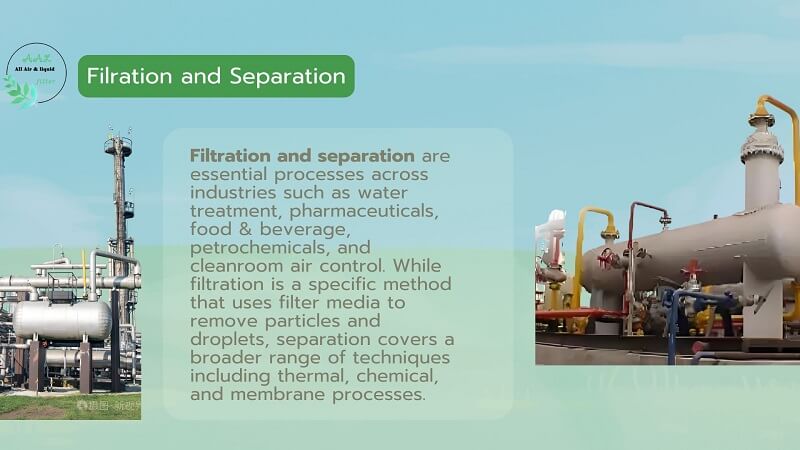
Separation is a broad term that refers to any process in which a mixture is divided into two or more distinct parts. The goal is to isolate useful components and remove impurities. Separation techniques can be based on mechanical, physical, or chemical principles.
Common separation methods include:
Mechanical separation: such as filtration, sedimentation, or centrifugation.
Thermal separation: including distillation, evaporation, and crystallization.
Membrane separation: ultrafiltration, nanofiltration, and reverse osmosis.
Chemical separation: extraction, adsorption, and ion exchange.
In gas industries, separation can involve removing sulfur compounds from natural gas, or purifying oxygen and nitrogen from air. In water treatment, separation may involve removing salts via reverse osmosis.
3. What is Filtration?
Filtration is a specific type of separation that relies on a physical barrier—known as a filter medium—to remove solid particles, droplets, or other contaminants from a fluid stream. Filtration can be applied to both liquids and gases.
Key characteristics of filtration:
Relies on porous filter media such as membranes, fibers, or fabrics.
Designed to remove suspended solids, dust, microorganisms, or oil droplets.
Can be classified by efficiency: coarse filtration, fine filtration, and high-efficiency or absolute filtration.
Typical filtration products include:
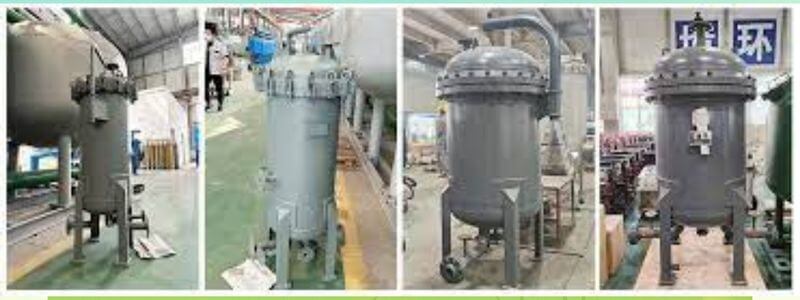
Liquid filters: melt-blown cartridges, string wound cartridges, pleated filter cartridges, filter bags, and bag filter housings.
Air filters: primary, medium, and HEPA filters for HVAC and cleanroom environments.
Gas filters: coalescing filters for compressed air and process gases.
4. Filtration vs. Separation: Key Differences
While filtration and separation are related, there are clear distinctions between them.
Aspect | Filtration | Separation |
Definition | A specific method of separation using filter media to remove particles or droplets. | A broad category of processes that divide mixtures into components. |
Scope | Primarily used for solid-liquid and solid-gas separation. | Can apply to solid-solid, liquid-liquid, gas-gas, and gas-liquid systems. |
Techniques | Physical barrier (filter media, pore size, depth filtration). | Mechanical, thermal, chemical, and membrane-based methods. |
Examples | Water purification with filter cartridges, HVAC air filters, coalescing filters in compressed air. | Distillation of alcohol and water, reverse osmosis desalination, natural gas sweetening. |
Equipment | Filter cartridges, filter bags, filter housings, air filters. | Membrane systems, distillation columns, centrifuges, separators. |
In short: Filtration is a subset of separation. Every filtration process is a separation, but not every separation is filtration.
5. Industrial Applications
Liquid Filtration
Liquid filtration is essential in industries that require clean and particle-free water or process fluids.
Water treatment: Melt-blown and string wound filter cartridges remove sand, rust, and suspended solids.
Food & Beverage: Pleated filter cartridges ensure clarity and safety in beer, wine, juices, and bottled water.
Pharmaceuticals: High-purity filters maintain sterile conditions and protect production quality.
Industrial manufacturing: Filter bags and housings handle large flow rates in cooling water and wastewater treatment.
Air Filtration
Air quality is a critical factor in industrial and commercial environments.
Primary and medium filters: Capture dust and large particles in HVAC systems.
HEPA filters: Achieve high-efficiency filtration in cleanrooms, hospitals, and microelectronics production.
Industrial air purification: Protect sensitive equipment and ensure compliance with air quality standards.
Gas Filtration and Coalescing Filters
In gas processing, the presence of oil mist, aerosols, and water vapor can damage equipment and compromise product quality. This is where coalescing filters are vital.
How coalescing filters work:
They capture fine aerosols and liquid droplets suspended in gas streams. These tiny droplets then coalesce into larger drops, which are separated by gravity and drained away.
Applications of coalescing filters:
Compressed air purification – removing oil and water to protect pneumatic tools and instrumentation.
Natural gas treatment – eliminating liquid contaminants that could corrode pipelines or foul downstream processes.
Petrochemical processes – ensuring clean, dry gases for stable and safe production.
Coalescing filters highlight the intersection of filtration and separation. They trap particles like a filter while also performing gas-liquid separation, making them indispensable in the gas industry.
6. Choosing Between Filtration and Separation
The decision to use filtration or another type of separation depends on:
Nature of the fluid: water, air, gas, or complex mixtures.
Target contaminants: solids, dissolved salts, oils, microorganisms.
Required purity: coarse cleaning vs. sterile or ultrapure standards.
Operational costs: filter replacement vs. large-scale membrane or distillation systems.
Examples:
Removing suspended particles from industrial water → Filtration (melt-blown or string wound cartridges).
Producing drinking water from seawater → Separation (reverse osmosis).
Eliminating oil mist from compressed air → Filtration + Separation (coalescing filters).
7. Our Solutions
As a professional manufacturer of filtration products, we provide solutions across liquid, air, and gas industries:
Liquid filtration: Melt-blown cartridges, string wound cartridges, pleated cartridges, filter bags, and filter housings.
Air filtration: Primary, medium, and HEPA filters for industrial HVAC and cleanroom applications.
Gas filtration: Coalescing filters for compressed air and petrochemical processes.
Our products are designed for industries including pharmaceuticals, food & beverage, petrochemicals, microelectronics, automotive, and water treatment.
8. Conclusion
Both filtration and separation are critical to modern industry. Filtration is a specific method within the broader concept of separation, mainly used for removing particles and droplets from fluids. Separation encompasses a wider range of techniques, from distillation to membrane processes.
By understanding the difference between the two, industries can make informed decisions and select the most cost-effective and efficient solution. Whether you need liquid filtration for water treatment, air filters for cleanrooms, or coalescing filters for gas separation, the right choice ensures reliability, compliance, and operational excellence.