
How to Choose Between Basket Strainer and Self Cleaning Filter
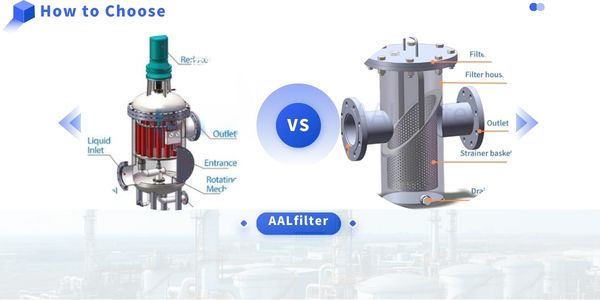
In industrial liquid filtration systems, removing solid contaminants is essential to protect pumps, valves, heat exchangers, and downstream equipment. Among the most widely used filtration devices are the Basket Strainer and the Self Cleaning Filter.
Although both filtration systems remove particles from liquids, their operating principles, maintenance requirements, and long-term costs are very different.
A simple way to understand the difference is through a daily-life comparison:
A Basket Strainer is like washing socks by hand.
A Self Cleaning Filter is like using a fully automatic washing machine.
Both can clean effectively, but the level of automation and labor involved is completely different.
In this article, we will explain:
l What a Basket Strainer is
l What a Self Cleaning Filter is
l The key differences between the two systems
l How to choose the right filtration solution for your industrial process
What Is a Basket Strainer?
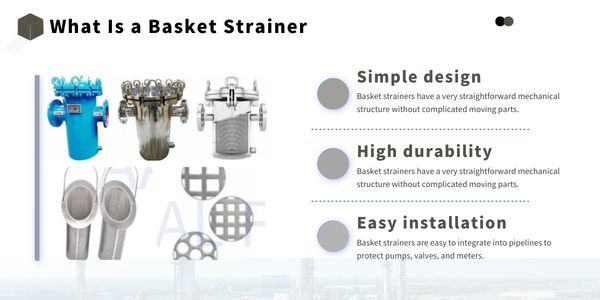
A Basket Strainer is a mechanical filtration device designed to remove solid particles from liquid pipelines. Inside the housing is a removable basket-shaped filter element, usually made of stainless steel perforated plate or mesh.-
How to Choose the Right Mesh Size for Strainer
As liquid flows through the strainer, contaminants are captured in the basket while the filtered fluid continues downstream.
You can explore a typical industrial Basket Strainer design used in pipeline protection systems here:
How a Basket Strainer Works
The operating principle is simple and reliable.
1. Liquid enters the strainer housing from the inlet.
2. The fluid passes through the filter basket.
3. Solid particles are trapped inside the basket.
4. Clean liquid exits through the outlet.
Over time, particles accumulate in the basket, which increases the pressure drop across the filter.
When the differential pressure becomes too high, the basket must be removed and cleaned manually.
If you want to learn more about the structure and selection of strainers, you can read this detailed guide about basket strainers:
The Ultimate Guide to Basket Strainers
Advantages of Basket Strainers
Basket strainers remain one of the most common filtration devices in industrial systems because they offer several important advantages.
Simple design
Basket strainers have a very straightforward mechanical structure without complicated moving parts.
Low initial cost
Compared with automated filtration equipment, basket strainers are much more affordable.
High durability
Because they contain no motors or electronic components, they can operate reliably for many years.
Easy installation
Basket strainers are easy to integrate into pipelines to protect pumps, valves, and meters.
Limitations of Basket Strainers
Despite their reliability, basket strainers have several limitations.
The most important drawback is that cleaning requires manual intervention.
To clean the filter basket, operators must:
l Stop the system flow
l Depressurize the housing
l Open the cover
l Remove the basket
l Wash or replace the element
This process can cause system downtime and production interruptions.
If the liquid contains a high concentration of suspended solids, frequent cleaning becomes inefficient. In such situations, a Self Cleaning Filter may be a better solution.
What Is a Self Cleaning Filter?
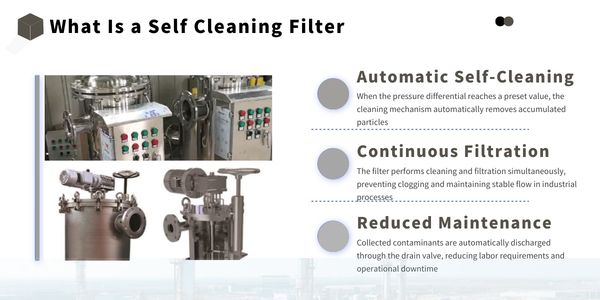
A Self Cleaning Filter is an automated filtration system designed to remove accumulated contaminants without stopping the filtration process.
Unlike manual strainers, self-cleaning systems automatically remove debris from the filter screen when a preset pressure differential or time interval is reached.
You can see an example of an industrial Self Cleaning Filter used in high-solids filtration systems here:
Scraper-Type-Self-Cleaning-Filter
Automatic-Brush-Self-Cleaning-Filter-Housing
How a Self Cleaning Filter Works
The filtration process begins similarly to a basket strainer.
1. Liquid flows through the filter screen.
2. Solid particles accumulate on the surface of the screen.
3. As debris builds up, the differential pressure increases.
When the pressure difference reaches a preset value, the filter automatically starts a cleaning cycle.
During this process:
l A scraper, brush, or suction scanner removes particles from the screen.
l A drain valve opens to discharge concentrated waste.
l Filtration continues without interruption.
Because the system does not require shutdown, a Self Cleaning Filter is ideal for continuous industrial processes.
Common Types of Self Cleaning Filters
Self-cleaning filtration systems use different cleaning mechanisms depending on the application.
Brush Self Cleaning Filters
Brush systems use rotating brushes to remove debris from the screen surface. These filters are widely used in industrial water filtration and cooling water systems.
Scraper Self Cleaning Filters
Scraper filters use mechanical blades to continuously scrape contaminants from the screen surface. They are particularly effective for high viscosity liquids or oil filtration.
You can see an example of this technology in the Scraper Type Self Cleaning Filter used in petrochemical filtration systems.
Another widely used automatic filtration technology is the backwash filter, which you can learn about in this article:
How-Automatic-Backwash-Filters-Improve-Industrial-Filtration
Basket Strainer vs Self Cleaning Filter: Key Differences
Although both filtration systems remove solid particles, they differ significantly in operation and maintenance.
Feature | Basket Strainer | Self Cleaning Filter |
Automation | Manual | Fully automatic |
Cleaning method | Basket removal | Automatic cleaning cycle |
Operation | May require shutdown | Continuous operation |
Initial cost | Low | Higher |
Maintenance | Frequent manual cleaning | Minimal maintenance |
Suitable solids level | Low to medium | Medium to high |
Fluid loss during cleaning | Higher | Minimal |
In simple terms, Basket Strainers are manual filtration devices, while Self Cleaning Filters provide automated filtration.
A Simple Example: Manual Washing vs Washing Machine
A practical analogy can help illustrate the difference.
A Basket Strainer works like washing socks by hand.
When the socks become dirty, you must stop and wash them manually.
A Self Cleaning Filter works like a washing machine.
It automatically cleans the socks while you continue doing other tasks.
The same idea applies to industrial filtration systems.
When Should You Choose a Self Cleaning Filter?
A Self Cleaning Filter is recommended when:
l Continuous production cannot tolerate downtime
l The liquid contains a high concentration of solids
l Flow rates are large
l Maintenance labor is limited
l The filtration system operates in remote locations
Typical applications include:
l Cooling water filtration systems
l Industrial water treatment plants
l Seawater intake filtration
l Oilfield produced water treatment
l Petrochemical processing systems
When Should You Choose a Basket Strainer?
A Basket Strainer remains the most economical choice when:
l The fluid contains relatively low solids
l Cleaning frequency is low
l The process can tolerate temporary shutdowns
l The project budget is limited
Basket strainers are commonly used for:
l Pump protection
l Pipeline filtration
l Chemical process systems
l Utility water filtration
In some systems, engineers also compare basket strainers with Y-strainers depending on pipeline configuration. You can read more about that comparison here:
basket-strainers-vs-y-strainers-key-differences-in-industrial-pipeline-filtration
Cost Comparison: Initial Investment vs Long-Term Cost
When selecting filtration equipment, it is important to consider both capital cost (CAPEX) and operating cost (OPEX).
Cost Factor | Basket Strainer | Self Cleaning Filter |
Purchase cost | Low | Higher |
Labor cost | Higher | Very low |
Downtime risk | Possible | None |
Maintenance frequency | Frequent | Minimal |
Long-term operating cost | Higher in some cases | Lower |
In many industrial facilities, the higher initial cost of a Self Cleaning Filter is offset by lower maintenance and reduced production downtime.
Conclusion: How to Choose the Right Filtration System
Choosing between a Basket Strainer and a Self Cleaning Filter depends on your process conditions.
If your system requires continuous operation and handles high levels of solids, a Self Cleaning Filter is usually the best solution.
If your system has low contamination levels and a limited budget, a Basket Strainer provides a reliable and economical option.
In simple terms:
High solids, continuous operation, and minimal maintenance → choose a Self Cleaning Filter.
Low solids, limited budget, and occasional maintenance → choose a Basket Strainer.
By understanding the differences between these two filtration technologies, engineers can select the most efficient solution for their industrial filtration systems.
FAQ: Basket Strainer & Self Cleaning Filter
1. How often should a Basket Strainer be cleaned?
Cleaning frequency depends on solid load. For low-contaminant water, monthly cleaning may be sufficient; high solids require more frequent attention.
2. Can Self Cleaning Filters operate without electricity?
Most self-cleaning filters require electric or pneumatic power to drive the cleaning mechanism, though some low-flow designs can use hydraulic or pressure-driven systems.
3. Do Self Cleaning Filters reduce fluid loss during cleaning?
Yes, unlike basket strainers, only a small portion of concentrated waste is discharged, keeping the main flow continuous.
4. Are Self Cleaning Filters suitable for viscous liquids?
Yes, especially scraper-type filters, which handle high-viscosity or oily fluids more efficiently than brush or suction types.
5. Can Basket Strainers protect pumps and valves?
Absolutely. They are simple and reliable for pump protection, valve safety, and general pipeline filtration where occasional maintenance is acceptable.
6. Which filter is better for continuous industrial operation?
For systems that cannot tolerate downtime and handle medium-to-high solids, a Self Cleaning Filter is the preferred choice.