
The Killer of High-Viscosity and Harsh Conditions: Scraper Self-Cleaning Filter Case Study Analysis
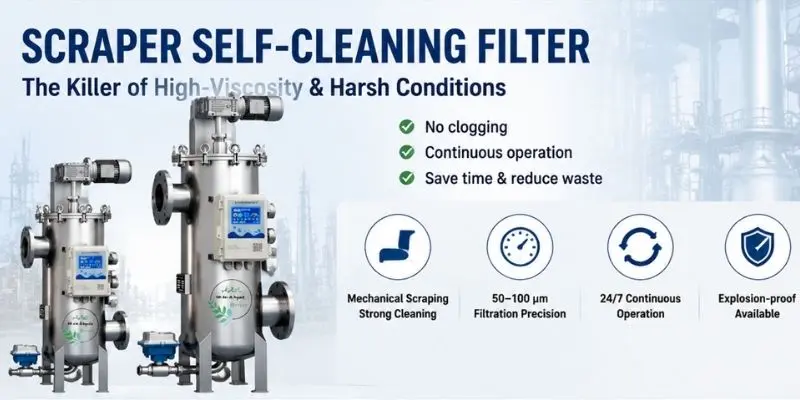
In modern industrial fluid filtration, “clogging” and “downtime” are silent profit killers. When dealing with high-viscosity fluids, sticky media, or strongly adhesive impurities, traditional filter bags, cartridges, and even standard self-cleaning systems can fail almost immediately.
We previously discussed the brush-type self-cleaning filter designed for high flow and fibrous contaminants. Today, we focus on one of the toughest industrial challenges—high viscosity, coking, and agglomerating media—and explore how the Scraper Self-Cleaning Filter achieves continuous, non-stop filtration through robust mechanical scraping technology.
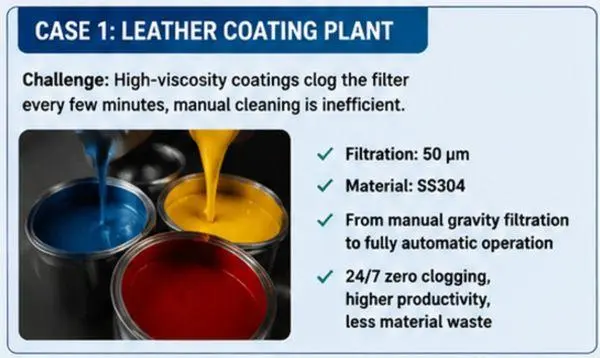
Case 1: Automatic Upgrade in a Leather Surface Coating Plant
— From Gravity Filtration to High-Efficiency Continuous Operation
1. Customer Background and Challenges
The customer is a well-known leather chemical manufacturer producing a complete range of leather surface finishing products, including high-end leather coatings, varnishes, and glazing materials.
In the final production stage, strict filtration is required to ensure no agglomerates or particles affect coating quality. However, the customer previously relied on manual gravity filtration.
Due to the high viscosity of coatings and varnishes, and their tendency to form surface skins when exposed to air, the filter screen clogged every few minutes. Frequent manual cleaning, material loss, and slow production made filtration a critical bottleneck.
2. Scraper Self-Cleaning Solution
For this sticky and clog-prone application, we provided a customized Scraper Self-Cleaning Filter:
Key parameters: Filtration rating 50 μm | Housing material: SS304 stainless steel
Working principle:
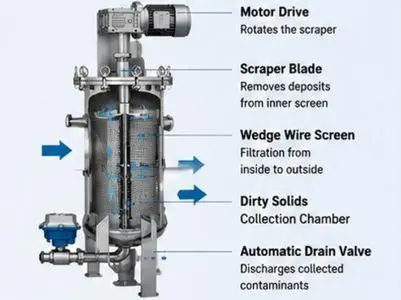
Fluid flows from inside to outside through a wedge wire screen. When viscous contaminants accumulate on the inner surface, the system activates based on time or differential pressure. A high-strength rigid scraper rotates along the screen surface, continuously removing deposits and pushing them into the bottom collection chamber without interrupting filtration.
3. Performance Improvement After Retrofit
Zero clogging, continuous operation:
Precise 50 μm scraping prevents blockage from coating buildup, enabling 24/7 uninterrupted production.
Significant capacity increase:
Replaced manual gravity filtration with a fully enclosed automatic system, improving production efficiency several times while reducing material waste caused by exposure and skin formation.
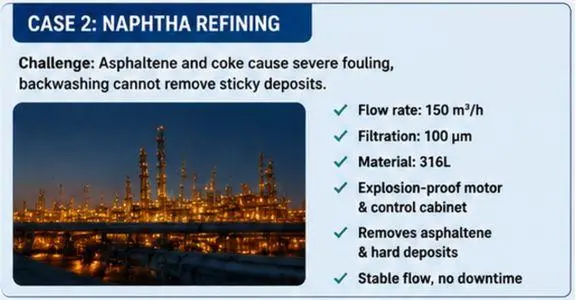
Case 2: Heavy Challenge in Naphtha Refining
— Fully Automatic Operation in Hazardous, Explosion-Proof Environments
1. Customer Background and Process Requirements
In the petrochemical industry, a refinery faced serious challenges during naphtha filtration. The medium contained extremely sticky asphaltene solids.
These impurities not only adhere strongly but also tend to coke and harden at certain temperatures. Once attached, conventional backwashing cannot remove them.
Initial conditions:
Flow rate 150 m³/h | Filtration rating 100 μm | Material: 316L stainless steel | Explosion-proof area
2. Scraper Self-Cleaning Solution
For this high-risk, high-adhesion petrochemical application, we supplied a heavy-duty Industrial Scraper Self-Cleaning Filter:
Explosion-proof configuration:
Equipped with Ex-rated explosion-proof motor and control cabinet, ensuring safe operation in flammable environments.
High-strength mechanical scraping:
Like a “bulldozer,” the scraper periodically removes hardened asphaltene deposits embedded in the mesh. The removed solids are discharged automatically through the bottom drain valve.
3. Operational Results
The system operates fully enclosed and leak-free under stable explosion-proof motor control.
The 100 μm screen remains continuously clean, effectively removing all asphaltene solids while maintaining stable downstream flow and eliminating frequent shutdowns for manual cleaning.
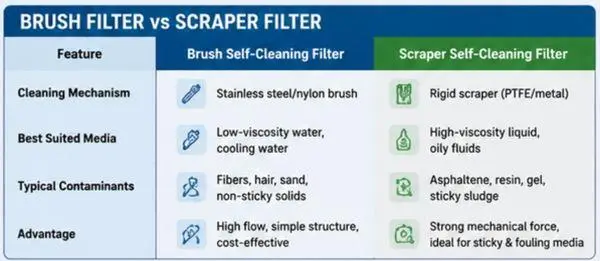
Technical Insight: Why Scraper Type is Essential in These Applications
To help with selection, here is a simple comparison between brush-type and scraper-type self-cleaning filters:
Feature | Brush Self-Cleaning Filter | Scraper Self-Cleaning Filter |
Cleaning mechanism | Stainless steel/nylon brush removes particles | Rigid scraper mechanically removes deposits |
Best suited media | Low-viscosity water, cooling water | High-viscosity liquids, oily fluids |
Typical contaminants | Fibers, hair, sand, non-sticky solids | Asphaltene, resin, gel, sticky sludge |
Advantage | High flow, simple structure, cost-effective | Strong mechanical force for sticky & fouling media |
Conclusion: Keeping Your Process Running Without Interruption
Whether upgrading a leather coating plant from inefficient manual filtration to automation, or handling sticky asphaltene in naphtha refining, the Scraper Self-Cleaning Filter proves its value as a true “high-viscosity killer.”
No material waste. No unnecessary downtime. Continuous, stable production—that is the power of automated filtration.
Is your production line suffering from sticky media, frequent clogging, or constant manual cleaning?
Visit our Scraper Self-Cleaning Filter product page to learn more.
Or contact our filtration engineers directly. We can design a customized 304/316L self-cleaning solution based on your flow rate (0.5–1200 m³/h), media characteristics, and explosion-proof requirements.