
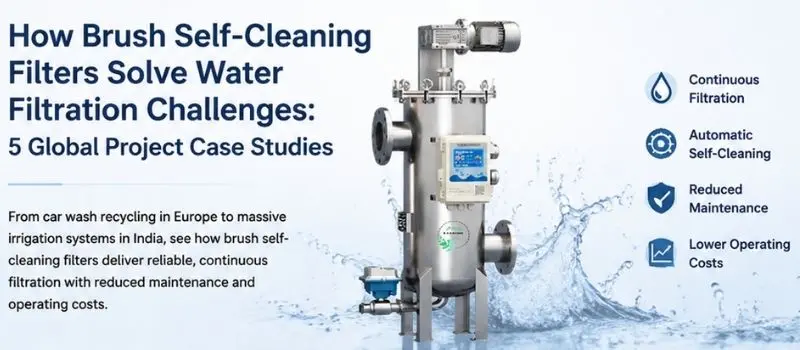
How Brush Self-Cleaning Filters Solve Water Filtration Challenges: 5 Global Project Case Studies
Introduction
In water filtration systems across industries, the most common challenges are not just filtering particles—they are maintaining continuous operation, reducing maintenance costs, and ensuring system reliability under variable water quality and flow conditions. Traditional filtration solutions often struggle with clogging, labor-intensive cleaning, and downtime, which can significantly impact operational efficiency.
To demonstrate how brush self-cleaning filters effectively address these issues, we present five real-world project case studies from around the globe. For clarity, we have grouped the cases into three industry categories, each with its own operational challenges and design considerations:
Commercial Car Wash & Municipal Water Supply
Key Challenges: Low energy consumption, minimal manual maintenance
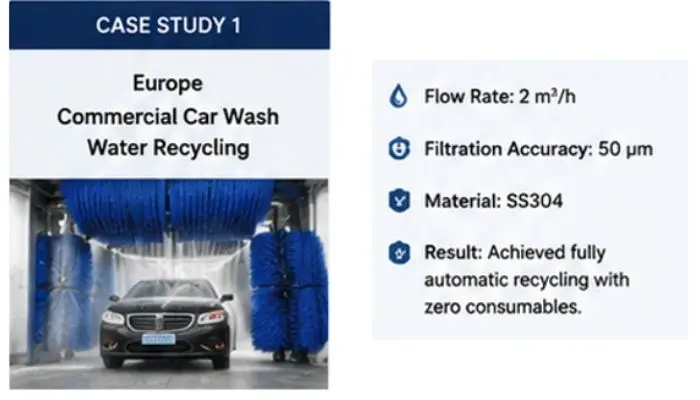
Case Study 1: Commercial Car Wash Water Recycling System in Europe
Industry Challenge
Environmental regulations in Europe are extremely strict, and car wash wastewater cannot be discharged directly. At the same time, water costs are high, making water recycling essential.
However, car wash wastewater contains large amounts of sand, dirt, and suspended solids. Conventional filter bags often become clogged several times per day, resulting in excessive maintenance costs and operational interruptions.
Project Parameters
Application: Car wash wastewater recycling system
Filtration Requirement: Reduce suspended solids from 450 mg/L to 50 mg/L
Solution:
· 2 m³/h brush self-cleaning filter
· SS304 stainless steel construction
· 50 μm filtration rating
Results
Although compact in size, the system achieved fully automatic online cleaning and discharge. The treated water consistently met car wash reuse standards, allowing the facility to operate a fully automated water recycling system without disposable filter consumables.
Why a Brush Self-Cleaning Filter Was Chosen
The application required continuous operation and frequent removal of suspended solids. Automatic cleaning eliminated repeated filter bag replacement while maintaining stable filtration performance.
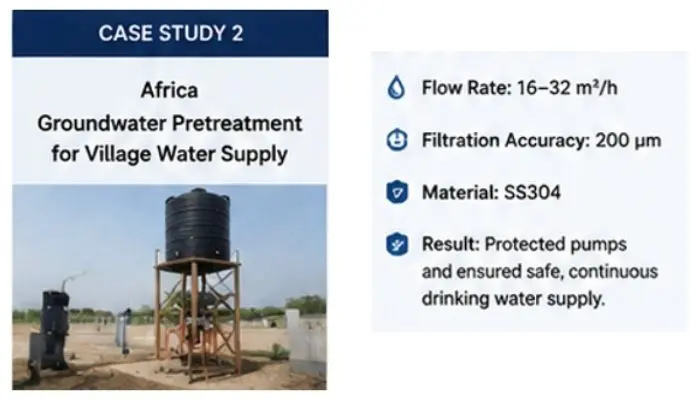
Case Study 2: Groundwater Pretreatment for Village Drinking Water Supply in Africa
Industry Challenge
Many rural communities in Africa rely on deep-well groundwater for drinking water. Groundwater often contains sand particles and red soil sediments.
If these particles enter booster pumps and downstream disinfection systems, they can cause severe pump wear, equipment damage, and even water supply interruptions.
Project Parameters
Application: Pretreatment between well pumps and village water supply booster stations
Solution:
· 16–32 m³/h brush self-cleaning filter
· SS304 stainless steel construction
· 200 μm filtration rating
Results
In regions where maintenance resources and technical support are limited, the filter utilized system pressure and PLC-controlled automatic cleaning to remove accumulated solids without manual intervention. This helped ensure a continuous and reliable drinking water supply for local communities.
Why a Brush Self-Cleaning Filter Was Chosen
The project required dependable operation with minimal maintenance. Automatic cleaning reduced labor requirements while providing effective protection for pumps and downstream treatment equipment.
Industrial High-Hardness Water & Extreme Rainwater Interception
Key Challenges: Prevent scaling, withstand high-flow surges
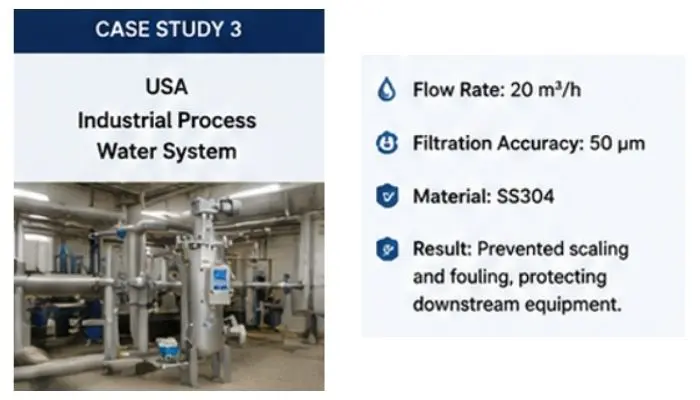
Case Study 3: Industrial Process Water System in the United States
Industry Challenge
Many industrial water treatment systems receive water that has already undergone preliminary iron removal and softening. However, residual hardness and trace iron content can still create serious filtration challenges.
If filtration equipment is not properly designed, mineral scaling and iron deposits can rapidly accumulate on filter screens, resulting in blockage and reduced performance.
Project Parameters
Application: Industrial process water filtration
Water Flow: 20 m³/h
Water Quality Before Filtration:
· Iron (Fe): < 1 mg/L
· Hardness: approximately 500 mg/L
Solution:
· Model AAL-219-AC50 brush self-cleaning filter
· 20 m³/h treatment capacity
· SS304 stainless steel construction
· 50 μm filtration rating
Results
The stainless steel brushing mechanism effectively prevented hard-water scale and iron deposits from accumulating on the wedge wire screen. Combined with 50 μm filtration accuracy, the system provided reliable protection for downstream process equipment.
Why a Brush Self-Cleaning Filter Was Chosen
The application demanded both fine filtration and resistance to scaling. Continuous mechanical brushing helped maintain screen cleanliness and stable filtration efficiency.
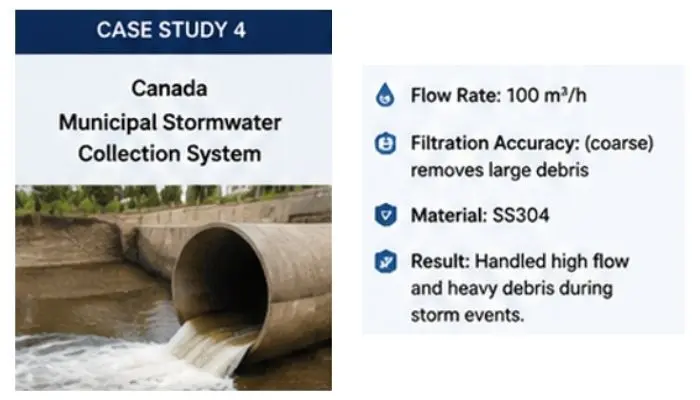
Case Study 4: Municipal Stormwater Collection System in Canada
Industry Challenge
Stormwater systems face unique operating conditions. During heavy rainfall events, flow rates increase dramatically while large quantities of leaves, plastic debris, gravel, and other contaminants enter the collection network.
Traditional coarse screens can become blocked rapidly, increasing the risk of overflow and urban flooding.
Project Parameters
Application: Municipal stormwater and rainwater collection pipelines
Solution:
· Customized 100 m³/h brush self-cleaning filter
· Full SS304 stainless steel construction
Results
During storm seasons, the system demonstrated excellent resistance to heavy debris loading. Large particles were continuously removed by the brushing mechanism and discharged through a large drain valve, helping maintain uninterrupted flow through the stormwater network.
Why a Brush Self-Cleaning Filter Was Chosen
The project required a filtration system capable of handling sudden flow surges and large debris loads without frequent manual cleaning.
Large-Scale Agricultural Irrigation Systems
Key Challenges: Cost-effectiveness, durable performance in extreme conditions
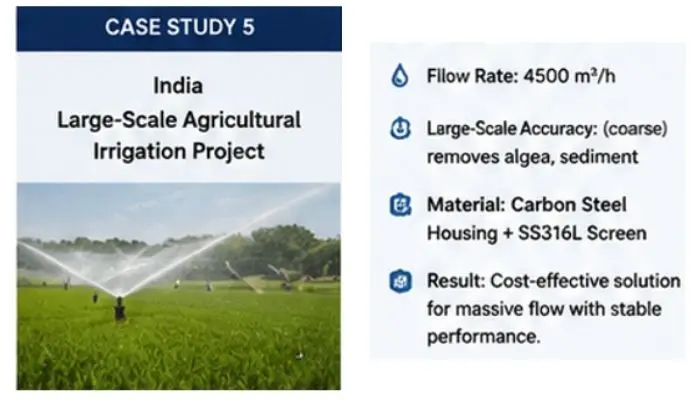
Case Study 5: Large-Scale Agricultural Irrigation Project in India
Industry Challenge
Agricultural irrigation systems commonly draw water from rivers, canals, and open reservoirs. These sources contain large quantities of algae, sediment, and organic matter.
Without proper filtration, drip irrigation emitters and sprinkler nozzles can quickly become blocked. However, when flow rates reach several thousand cubic meters per hour, constructing the entire filtration system from stainless steel becomes economically impractical.
Project Parameters
Application: Large-scale agricultural and landscape irrigation
Flow Rate: 4500 m³/h
Solution:
· Carbon steel housing with protective anti-corrosion coating
· SS316L stainless steel filter screen
· Heavy-duty brush self-cleaning mechanism
Results
The system has operated reliably under demanding field conditions. By combining a carbon steel housing with a high-performance SS316L screen, the customer significantly reduced capital investment while achieving continuous automatic filtration of algae, sediment, and suspended solids.
Why a Brush Self-Cleaning Filter Was Chosen
The project required a cost-effective solution capable of processing extremely large flow volumes while maintaining reliable filtration performance.
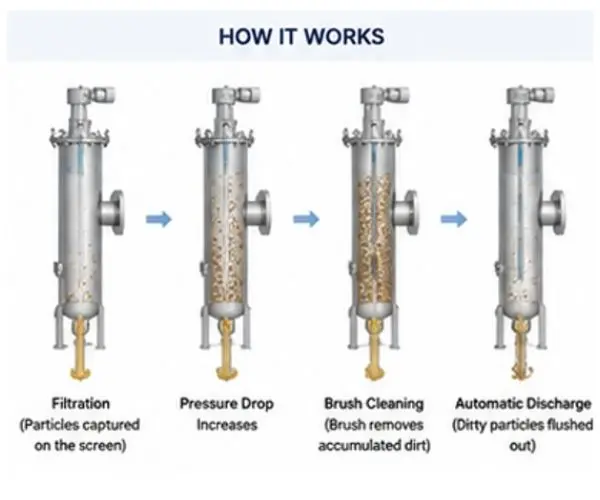
Lessons Learned from These 5 Projects
Different Applications Require Different Filtration Ratings
The required filtration accuracy depends largely on the contaminants being removed and the equipment being protected.
· 50 μm filtration is commonly used for fine suspended solids removal and downstream equipment protection, as seen in the European car wash and U.S. industrial water projects.
· 100–200 μm filtration is often sufficient for removing sand and larger particles while protecting pumps and pipelines, as demonstrated in the African groundwater and Canadian stormwater projects.
Material Selection Plays a Critical Role
Choosing the right material can significantly impact both performance and project cost.
SS304 Stainless Steel
Suitable for:
· Groundwater systems
· Rainwater harvesting
· Water recycling applications
SS316L Stainless Steel
Recommended for:
· Seawater applications
· Desalination plants
· High-corrosion environments
· Chemical processing facilities
Carbon Steel + Stainless Steel Screen
Ideal for:
· Large-scale irrigation projects
· High-flow applications
· Budget-sensitive projects
Automatic Cleaning Reduces Operating Costs
Across all five projects, one common benefit was the reduction of maintenance requirements.
Brush self-cleaning filters help operators:
· Eliminate disposable filter bags and cartridges
· Reduce labor costs
· Minimize downtime
· Maintain stable filtration performance
· Improve system reliability
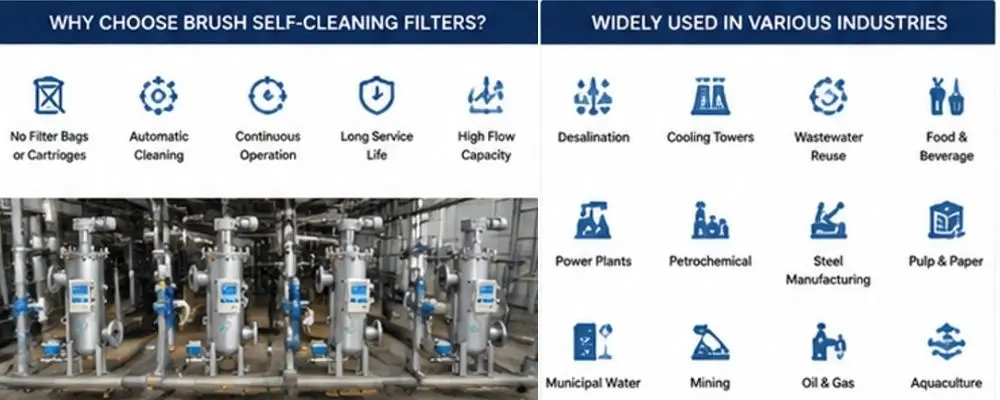
Additional Industries Using Brush Self-Cleaning Filters
Beyond the projects discussed above, brush self-cleaning filters are widely used in many other industries.
l Seawater Desalination Pretreatment
l Cooling Tower Water Systems
l Industrial Wastewater Reuse
l Food and Beverage Processing
l Power Plants
l Petrochemical Facilities
l Steel Manufacturing
l Pulp and Paper Industry
Looking for the Right Brush Self-Cleaning Filter?
Every water filtration project has unique requirements. Selecting the correct brush self-cleaning filter depends on several key factors:
· Flow rate
· Water source
· Filtration micron
· Pipe size
· Operating pressure
· Water quality characteristics
Whether your application requires a compact 2 m³/h filtration unit or a large-scale 4500 m³/h irrigation filtration system, our engineering team can help design the most suitable solution for your operating conditions.
Contact us today to discuss your project requirements and receive a customized filtration recommendation.