
Cost-Effective Corrosion Solutions: UPVC vs PPH Bag Filters for Industrial Water Treatment
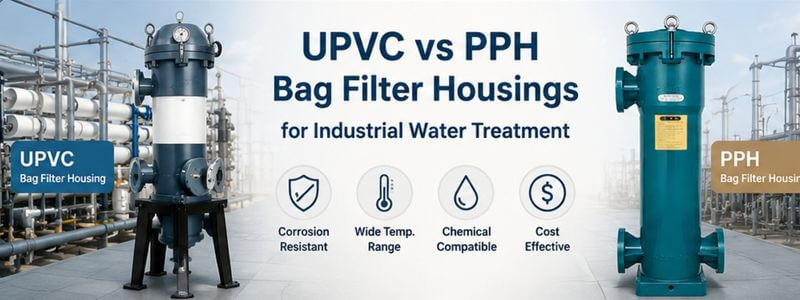
In modern industrial water treatment systems, managing highly corrosive liquids is one of the most critical challenges for EPC contractors and plant engineers. Whether dealing with high-salinity seawater, aggressive electroplating acids, or complex environmental chemicals, equipment longevity directly impacts both operational profits and system reliability.
For decades, Stainless Steel (SS304 or SS316L) was considered the default material for liquid filtration. However, in aggressive chemical or high-chloride environments, even premium stainless steel is highly susceptible to pitting corrosion and stress cracking. This results in frequent component failures, costly production downtime, and contaminated filter elements.
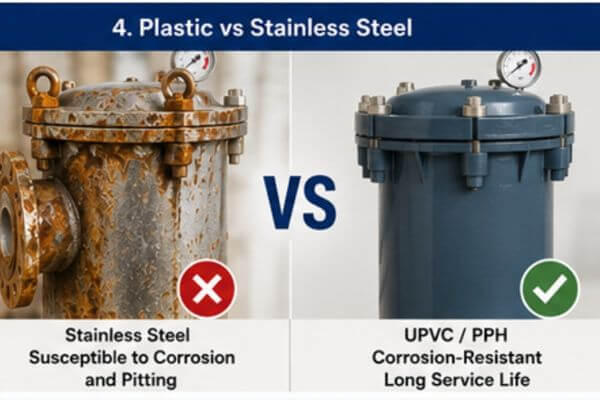
To bridge this gap, thermoplastic materials—specifically UPVC (Unplasticized Polyvinyl Chloride) and PPH (Polypropylene Homopolymer)—have emerged as the ultimate cost-effective, zero-corrosion alternatives for industrial bag filter housings.
1. Material Analysis: UPVC vs. PPH Bag Filter Housings
Choosing the right thermoplastic polymer requires a deep understanding of your operational environment. While both materials offer absolute immunity to rust, they behave differently under varying temperatures and chemical concentrations.
UPVC Bag Filter Housings: The Economical Champion
UPVC is a highly rigid, unplasticized polymer known for its exceptional mechanical strength and chemical stability at ambient temperatures.
Key Strengths
· Outstanding resistance to a wide range of acids, alkalis, salts, and chlorinated water
· Extremely smooth interior surfaces that minimize friction loss (low pressure drop)
· Prevents mineral scaling and bio-fouling
Best Applied In
Ambient temperature operations up to 50°C (122°F). It is the most budget-friendly option for handling high-volume water purification where thermal strain is not a factor.
PPH Bag Filter Housings: The Heavy-Duty Fighter
PPH is a homopolymer polypropylene that features a modified crystalline structure, giving it superior impact strength and thermal resistance.
Key Strengths
· Excellent performance in harsh environments involving high-concentration chemical acids
· Resistant to sulfuric acid, hydrochloric acid, and specific organic solvents
· Maintains high tensile strength and structural integrity under prolonged mechanical stress
Best Applied In
Elevated temperature operations reaching up to 90°C (194°F). It is the material of choice for aggressive industrial processing loops where UPVC reaches its thermal limitations.
�� Engineering Note: Not sure about chemical compatibility for your specific liquid concentration (e.g., specific acids or sulfuric acid)?
Contact us for more details.
2. Technical Specification & Selection Matrix
To assist engineers in immediate sizing and technical evaluation, the following matrix contrasts the essential engineering parameters of UPVC and PPH bag filter housings.
Feature / Parameter | UPVC Bag Filter Housing | PPH Bag Filter Housing |
Chemical Compatibility | Excellent (Salts, Dilute Acids/Alkalis) | Superior (Concentrated Acids, Solvents) |
Max Working Temperature | Up to 50°C (122°F) | Up to 90°C (194°F) |
Max Operating Pressure | Typically 0.6 - 1.0 MPa (at 20°C) | Typically 0.6 - 1.0 MPa (at 20°C) |
Jointing / Piping Connection | Socket Bonding / Flange | Socket Fusion / Butt Welding / Flange |
UV Resistance | High (Often treated for outdoor use) | Moderate (Best suited for indoor/sheltered use) |
Relative Material Cost | Lowest / Most Economical | Moderate / Premium Performance |
3. Real-World Application Scenarios in Industrial Water Treatment
To demonstrate how these thermoplastic systems perform in the field, let’s explore three distinct industrial scenarios where UPVC and PPH bag filters outperform metal alternatives.
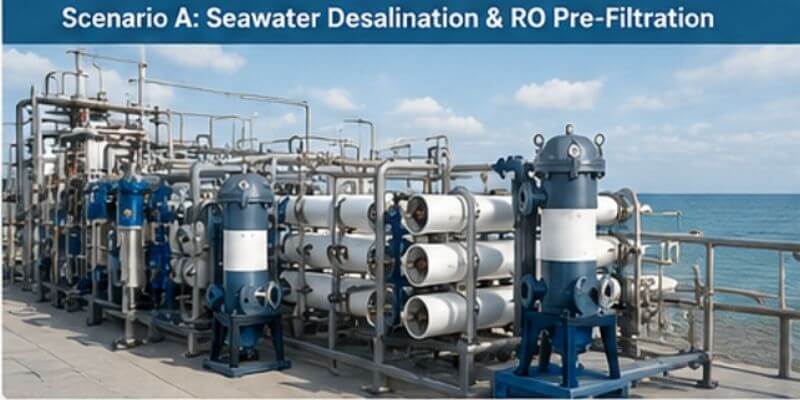
Multistage Pre-filtration Layout for High-Salinity Water Treatment.In seawater desalination (as illustrated in the automated multi-stage system layout above), raw seawater must pass through intensive primary filtration before reaching the high-pressure reverse osmosis membranes. Utilizing our non-corrosive UPVC bag filter housings at this precise stage eliminates the risk of chloride-pitting corrosion common in metal housings, ensuring 100% rust-free protection for downstream SWRO membranes.
Scenario A: Seawater Desalination & RO Pre-Filtration
In seawater reverse osmosis (SWRO) desalination plants, chloride levels are exceptionally high. Traditional stainless steel housings degrade rapidly due to chloride-induced pitting unless expensive specialty alloys (like Duplex or Titanium) are used.
The Solution
UPVC bag filter housings provide an ideal, rust-free alternative for the multi-media filter and cartridge/bag pre-filtration stages. Working at ambient sea temperatures, UPVC delivers a zero-corrosion lifetime at a fraction of the capital expense (CAPEX) of exotic metal alloys.
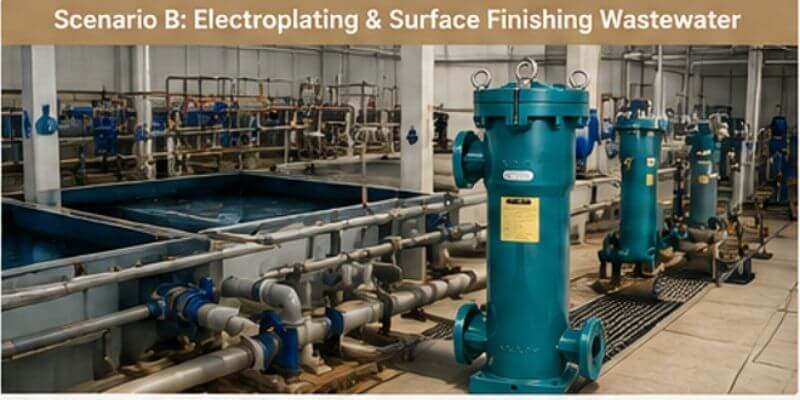
Automated Chemical & Heavy Metal Recovery Filtration Circuit.When dealing with electroplating rinses or spent acid baths, the filtration architecture must withstand thermal and chemical shocks. As mapped out in the process diagram above, placing heavy-duty PPH bag filter housings in the chemical clarification and metal recovery stages allows the system to continuously filter aggressive acids at temperatures up to 90°C without any risk of structural degradation or liquid contamination.
Scenario B: Electroplating & Surface Finishing Wastewater
Electroplating lines generate complex rinse waters and spent baths containing heavy metal complexes, aggressive acids (such as chromic or nitric acid), and harsh alkalis. Furthermore, these process liquids often run at elevated temperatures.
The Solution
PPH bag filter housings are perfectly tailored for this scenario. Thanks to its 90°C thermal threshold and superior chemical resistance, a PPH housing handles hot acid-pickling filtration and heavy metal recovery loops seamlessly without leaching impurities into the chemical bath.
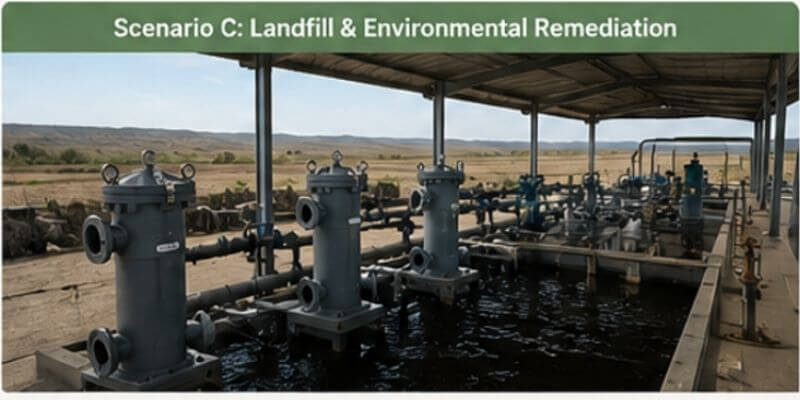
Complex Leachate & Groundwater Remediation Process Flow.Landfill leachate and contaminated groundwater require a highly resilient multi-stage treatment setup to tackle unpredictable chemical spikes. As demonstrated in this environmental remediation architecture, our UPVC and PPH plastic housings serve as critical protective barriers right before the advanced membrane filtration modules, trapping suspended solids and ensuring the entire system runs smoothly with zero structural maintenance.
Scenario C: Landfill & Environmental Remediation Projects
Landfill leachate is a highly concentrated, toxic liquid formed when rainwater percolates through waste. It is heavily loaded with volatile organic compounds (VOCs), high ammonia-nitrogen, dissolved solids, and complex heavy metal salts.
Similarly, in brownfield environmental remediation, contaminated groundwater must be pumped and treated using advanced oxidation processes (AOP) or membrane separation.
The Solution
Thermoplastic bag filters act as critical protective barriers in these multi-stage systems. Heavy-duty PPH and UPVC filter housings are used as pre-filters before ultrafiltration (UF) or disc-tube reverse osmosis (DTRO) units.
They capture suspended solids and prevent scaling on expensive membranes. Because these polymers do not react with the erratic chemical spikes typical of leachate and remediation sites, they require virtually no structural maintenance.
4. Financial Benefits: Cutting the Total Lifecycle Cost
When calculating the return on investment (ROI) for industrial water treatment equipment, procurement teams must evaluate both upfront costs and long-term maintenance.
Drastic CAPEX Reduction
Specifying a high-quality UPVC or PPH bag filter housing instead of Super Duplex stainless steel can slash upfront equipment procurement costs by 40% to 70%.
Minimized Operational Expense (OPEX)
Metal housings that suffer from internal rusting shed micro-particles, which prematurely blind and clog filter bags.
Thermoplastic filters remain 100% clean internally, ensuring that you utilize the full dirt-holding capacity of your filter bags, thereby extending consumable life and reducing labor maintenance intervals.
Zero Downtime
Plastic housings eliminate the catastrophic failures caused by chemical corrosion, keeping your industrial water treatment plant running smoothly year after year.
Conclusion
Maximizing efficiency in industrial water treatment requires aligning liquid chemistry with the correct equipment material.
For ambient, highly saline, or moderately acidic water streams, UPVC bag filters provide unmatched cost efficiency.
When the process demands high chemical purity at elevated temperatures, PPH bag filters offer the necessary industrial resilience.
Looking for a reliable industrial filtration partner?
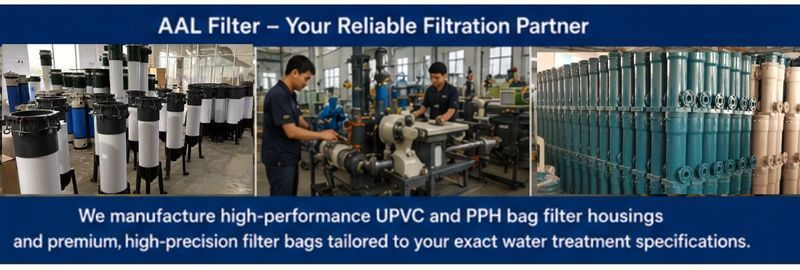
At AAL Filter, we manufacture high-performance UPVC and PPH bag filter housings along with premium, high-precision filter bags tailored to your exact water treatment specifications.
Contact the AAL Filter technical team today for a free sizing consultation, material compatibility assessment, and competitive factory quotes.
Related UPVC and PPH filter housing Articles:
How to Select the Right UPVC Filter Housing
Why PPH Plastic Bag Filter Housings Are the Top Choice for Industrial Liquid Filtration