
High Flow Filter Cartridges: Why They Are an Efficient Solution for Industrial Water Filtration
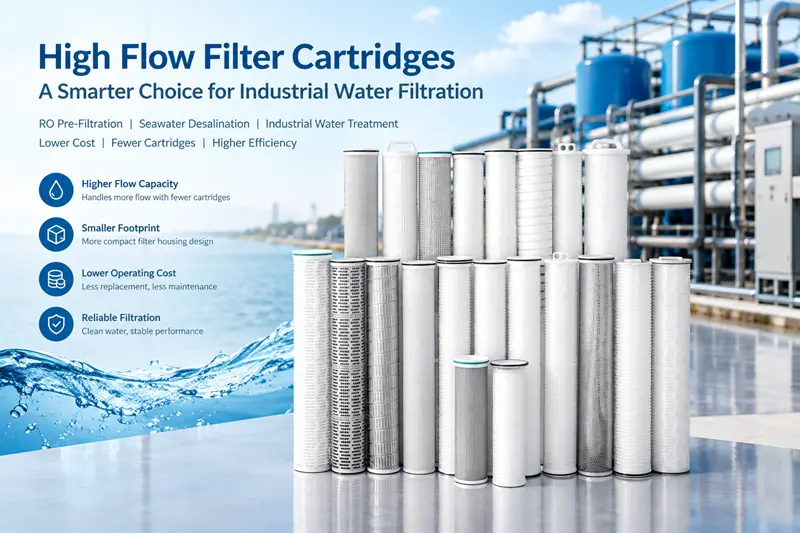
In industrial water treatment, RO pre-filtration, seawater desalination, power plants, food and beverage processing, and other high-flow liquid filtration applications, High Flow Filter Cartridges are becoming an increasingly popular filtration solution.
As system flow rates increase, conventional 2.5" × 40" filter cartridges may require a large number of cartridges, larger filter housings, and more frequent maintenance.
This is where High Flow Filter Cartridges can provide an important advantage.
Instead of simply asking, “Which filter cartridge has the highest flow rate?”, engineers and purchasing teams should consider a broader question:
Which filtration configuration provides the best balance of flow capacity, filter life, footprint, maintenance requirements, and total operating cost?
This guide explains how High Flow Filter Cartridges work, when they are suitable, how to size them, and what to consider when replacing existing cartridges.
What Are High Flow Filter Cartridges?
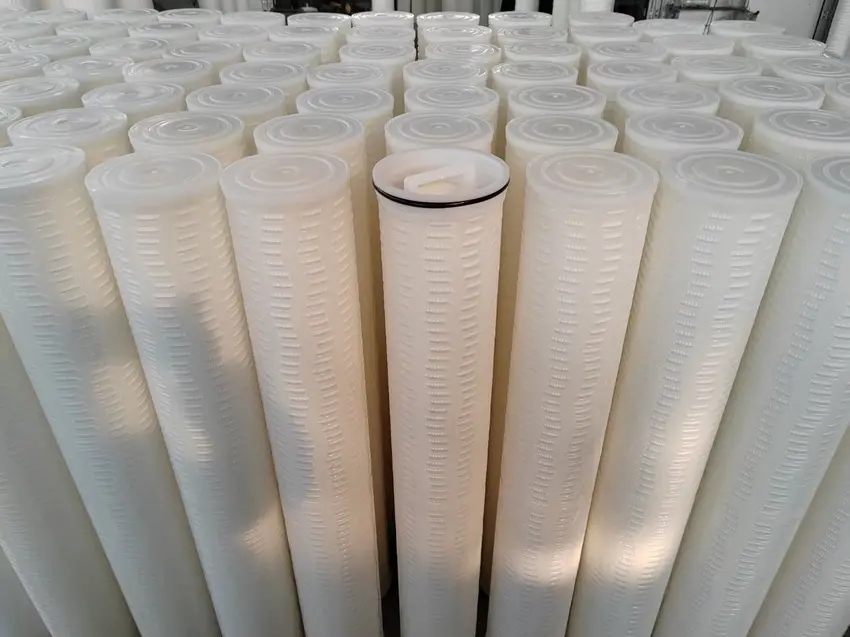
High Flow Filter Cartridges are large-capacity liquid filter cartridges designed to handle higher flow rates with fewer cartridges than conventional small-diameter filter cartridges.
Compared with standard 2.5" or similar cartridges, high flow cartridges typically provide a larger filtration area and higher flow capacity per cartridge. This makes them particularly suitable for industrial filtration systems where large volumes of water or process liquid need to be treated continuously.
Common features of High Flow Filter Cartridges include:
· Large-diameter cartridge construction
· High filtration area
· Polypropylene (PP) filter media
· Multi-layer or gradient filtration structures
· Inside-to-outside flow configuration
· High-flow filter housing compatibility
· Multiple cartridge lengths and micron ratings
· OEM and customized configurations
Depending on the cartridge design and application, High Flow Filter Cartridges can be used for:
· RO pre-filtration
· Seawater desalination
· Industrial water treatment
· Power plant water treatment
· Process water filtration
· Food and beverage filtration
· Municipal water treatment
· Cooling water filtration
The main advantage of high flow filtration is therefore not simply “higher flow.” It is the ability to handle a large amount of liquid while potentially reducing the number of cartridges and simplifying the overall filtration system.
High Flow Filter Cartridges vs. Standard 2.5" Filter Cartridges
When selecting a filtration system, it is important not to compare cartridges only by their individual purchase price.
The entire filtration configuration should be evaluated.
Comparison | Standard 2.5" Filter Cartridges | High Flow Filter Cartridges |
Cartridge Diameter | Smaller | Larger |
Flow Capacity per Cartridge | Lower | Higher |
Number of Cartridges Required | Usually higher | Usually lower |
Housing Configuration | More cartridges may be required | Can be more compact |
Cartridge Replacement | More cartridges to replace | Fewer cartridges to replace |
Maintenance Work | Relatively higher | Potentially lower |
Typical Applications | Low to medium flow | Medium to high flow |
RO Pre-Filtration | Common | Highly suitable for high-flow systems |
Large Industrial Systems | More cartridges may be required | Often more efficient |
However, High Flow Filter Cartridges are not automatically the most economical choice for every application.
The right solution depends on several factors, including:
· System flow rate
· Required micron rating
· Feed water quality
· Contaminant loading
· Filter life
· Initial pressure drop
· Filter housing capacity
· Cartridge replacement cost
· Labor requirements
· Waste disposal
· Spare cartridge inventory
A proper comparison should therefore focus on the total filtration cost, rather than the price of one cartridge.
Why Use High Flow Filter Cartridges for Industrial Filtration?
1. Fewer Filter Cartridges for High-Flow Applications
One of the most important advantages of High Flow Filter Cartridges is their ability to handle a large volume of liquid with fewer cartridges.
For high-flow industrial water treatment systems, using conventional cartridges may require a large number of filter elements.
As the number of cartridges increases, the system may also require:
· A larger filter housing
· More installation space
· More replacement work
· More spare cartridges
· More maintenance time
· More used filter cartridges for disposal
By providing higher filtration capacity per cartridge, a high flow filtration system can help reduce the number of filter elements required for a given application.
This makes High Flow Filter Cartridges particularly attractive for large-scale industrial water filtration and RO pre-filtration systems.
2. Optimize Filter Housing Footprint
Filter housing footprint is another important consideration in industrial equipment design.
A conventional multi-cartridge filter housing may need to accommodate a large number of standard cartridges. This increases the physical size of the filtration equipment and may make piping and maintenance access more complicated.
Using High Flow Filter Cartridges can help engineers optimize:
· Filter housing size
· Installation space
· Piping layout
· Maintenance clearance
· Skid footprint
For RO skids, seawater desalination systems, and industrial filtration equipment where installation space is limited, reducing the number of cartridges can be a valuable design advantage.
Can High Flow Filter Cartridges Reduce Filtration OPEX?
When purchasing filter cartridges, many buyers initially focus on one question:How much does one cartridge cost?
For an industrial filtration system, however, this is only part of the total cost.
A more complete calculation should consider:
Total Filtration Cost = Cartridge Cost + Replacement Labor + Downtime + Disposal + Inventory
Even if an individual High Flow Filter Cartridge has a higher purchase price than a standard cartridge, the overall filtration cost may be lower if the system requires fewer cartridges or less maintenance.
Potential cost-saving factors include:
· Fewer cartridges per housing
· Fewer cartridges to replace
· Reduced maintenance labor
· Reduced downtime
· Lower spare cartridge inventory
· Simplified cartridge replacement
· Potentially lower waste disposal volume
For this reason, high flow filter cartridge cost should be evaluated together with cartridge life and maintenance requirements.
High Flow Filter Cartridge Sizing: What Should You Check?
Correct High Flow Filter Cartridge sizing is essential for achieving reliable filtration performance.
Selecting a cartridge based only on its length or micron rating is not enough.
At least five major factors should be evaluated.
1. System Flow Rate
The first step is to determine the actual required system flow rate.
Flow may be specified as:
· m³/h
· L/min
· GPM
The required flow rate determines the approximate number and configuration of High Flow Filter Cartridges needed.
It is important to distinguish between the normal operating flow and the maximum possible system flow.
2. Required Micron Rating
High Flow Filter Cartridges are available in different filtration ratings, depending on the filter media and construction.
Common nominal filtration ratings may include:
· 1 μm
· 3 μm
· 5 μm
· 10 μm
· 20 μm
· 40 μm
· 70 μm
· 100 μm
The appropriate micron rating should be selected according to the actual water quality, contaminant size, downstream equipment, and process requirements.
For RO pre-filtration, for example, the goal is not simply to select the smallest possible micron rating.
An excessively fine filter may increase initial pressure drop and result in more frequent cartridge replacement.
The correct choice should balance:
Filtration Efficiency + Pressure Drop + Dirt Holding Capacity + Filter Life
3. Filter Life and Dirt Holding Capacity
A high initial flow rate does not necessarily mean that a filter cartridge is the most economical solution.
If a cartridge loads quickly and reaches its terminal pressure drop soon after installation, replacement frequency may increase.
Therefore, high flow filter cartridge selection should consider both:
· Flow capacity
· Dirt holding capacity
A good filtration solution should provide suitable performance throughout the expected service life rather than focusing only on initial performance.
4. Pressure Drop
Pressure drop is another critical factor when sizing a High Flow Filter Cartridge system.
As flow rate increases, pressure drop across the filter may also increase.
Therefore, cartridge selection should not be based only on the manufacturer’s maximum flow specification.
Engineers should evaluate the expected pressure drop at the actual operating flow rate.
Important parameters include:
· Initial pressure drop
· Operating pressure
· Maximum allowable pressure drop
· Filter replacement pressure
· Liquid viscosity
· Temperature
5. Existing Filter Housing
If the project is a replacement application, the existing filter housing should be checked before selecting a new cartridge.
Important compatibility points include:
· Cartridge length
· Cartridge outside diameter
· End cap configuration
· Connection type
· O-ring or gasket
· Flow direction
· Cartridge locking mechanism
· Housing sealing structure
This is especially important when replacing cartridges from another manufacturer.
Inside-to-Outside Flow: Why Does It Matter?
Many High Flow Filter Cartridges use an inside-to-outside flow configuration.
In this design, liquid enters through the inner core of the cartridge and flows outward through the filter media.
One important benefit is that contaminants captured by the filter media are retained within the cartridge structure rather than being directly exposed to the downstream clean-liquid side.
For applications such as RO pre-filtration and industrial water treatment, flow direction is therefore an important specification to verify.
When selecting a high flow cartridge, engineers should also check:
· Flow direction
· End cap design
· Sealing structure
· O-ring material
· Filter media
· Inner core construction
· Housing connection
· Overall cartridge dimensions
A cartridge that looks similar externally may not necessarily be a direct replacement if its internal structure or connection design is different.
Polypropylene High Flow Filter Cartridges: When Should You Choose PP?
Polypropylene (PP) is one of the commonly used materials for industrial liquid filtration.
Polypropylene High Flow Filter Cartridges can be used for a wide range of applications, including:
· Industrial water filtration
· RO pre-filtration
· Seawater pretreatment
· Process water filtration
· Cooling water filtration
· General liquid filtration
Depending on the required filtration performance, PP filter media can be manufactured in different structures, such as:
· Melt blown PP
· Pleated PP
· Multi-layer PP
· Gradient-density PP
The appropriate filter media should be selected according to:
· Liquid composition
· Operating temperature
· Contaminant characteristics
· Required micron rating
· Required flow rate
· Chemical compatibility
For special chemical liquids, high-temperature applications, or food and beverage processing, material compatibility and applicable regulatory requirements should also be verified.
High Flow Filter Cartridges for RO Pre-Filtration
RO pre-filtration is one of the key applications for High Flow Filter Cartridges.
Reverse osmosis membranes require suitable pretreatment to reduce suspended solids, particles, and other contaminants that could negatively affect downstream membrane operation.
As RO system capacity increases, conventional filter cartridges may require a large number of cartridges.
A high flow filtration system can provide an alternative approach by increasing the filtration capacity per cartridge.
A typical water treatment process may include:
Raw Water
→ Pretreatment
→ High Flow Filtration
→ RO Membrane System
→ Post-Treatment
High Flow Filter Cartridges are therefore not a replacement for the entire pretreatment system. Instead, they serve as an important filtration stage within the overall water treatment process.
For RO applications, cartridge selection should consider the actual raw water quality, SDI requirements, suspended solids, operating flow rate, and RO membrane protection requirements.
High Flow Filter Cartridge Replacement: OEM or Alternative?
For many industrial buyers, High Flow Filter Cartridge Replacement is an important purchasing requirement.
A filtration system may already be equipped with cartridges from a particular manufacturer, but customers may later encounter:
· High original cartridge prices
· Long lead times
· Limited local inventory
· Difficult replacement sourcing
· Rising maintenance costs
· Need for an alternative supplier
In these situations, a compatible High Flow Filter Cartridge may be worth evaluating.
However:A compatible cartridge should not be selected based on dimensions alone.
Before replacing an existing cartridge, buyers should verify the following:
Compatibility Check | What to Verify |
Length | Overall cartridge length |
Diameter | Cartridge outside diameter |
End Cap | End cap configuration |
Connection | Adapter or connection design |
Seal | O-ring / gasket specification |
Flow Direction | Inside-to-outside or other configuration |
Micron Rating | Required filtration rating |
Filter Media | PP or other material |
Flow Capacity | Required operating flow |
Housing | Existing housing compatibility |
This is particularly important when customers are looking for alternatives to established brands such as Pall, 3M, or Parker.
The best approach is to compare the original cartridge’s model, dimensions, end cap, sealing structure, filtration media, micron rating, and application requirements before confirming a replacement.
How to Choose the Right High Flow Filter Cartridge
If you are selecting High Flow Filter Cartridges for an industrial filtration system, the following process can help.
Step 1: Confirm the System Flow Rate
Determine the normal operating flow rate and required filtration capacity.
Step 2: Check the Existing Filter Housing
For replacement projects, confirm that the new cartridge can physically and functionally fit the existing housing.
Step 3: Determine the Required Micron Rating
Select the filtration rating according to the actual contaminant load and downstream process requirements.
Step 4: Evaluate Pressure Drop
Check the expected pressure drop at the actual operating flow rate.
Step 5: Compare Filter Life
Consider dirt holding capacity and expected service life rather than only the initial cartridge price.
Step 6: Calculate Total Filtration Cost
Compare:
Cartridge Cost + Labor + Downtime + Disposal + Inventory
instead of comparing cartridge prices alone.
Step 7: Confirm Replacement Compatibility
For OEM replacement projects, verify dimensions, end caps, seals, flow direction, filtration media, and housing compatibility.
High Flow Filter Cartridges vs. Standard Filters: Which Is Better?
There is no universal answer.
High Flow Filter Cartridges are not necessarily better for every filtration system.
For relatively small flow rates, conventional 2.5" filter cartridges may already provide an economical and practical solution.
However, High Flow Filter Cartridges deserve serious consideration when a system has:
· High flow rates
· Large water treatment capacity
· Frequent cartridge replacement
· High cartridge consumption
· Limited installation space
· High maintenance labor requirements
· RO pre-filtration requirements
· Seawater desalination applications
· Large-scale industrial water treatment
The better question is therefore not:
“Are High Flow Filter Cartridges better than standard cartridges?”
It is:
“Which filtration configuration provides the best balance of flow capacity, filter life, footprint, maintenance, and total operating cost?”
Why Work with a High Flow Filter Cartridge Manufacturer?
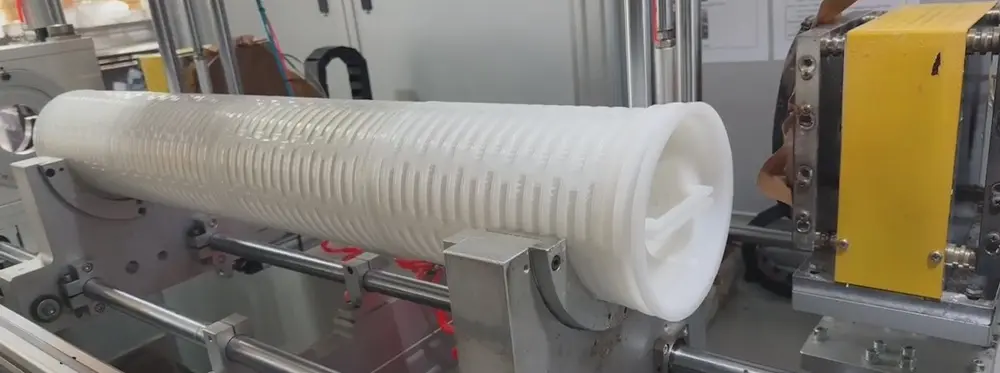
For industrial customers purchasing High Flow Filter Cartridges, the supplier’s technical support and customization capability can be just as important as the cartridge itself.
A professional high flow filter cartridge manufacturer should be able to provide more than standard products.
Depending on the project, support may include:
· Cartridge dimension matching
· End cap customization
· O-ring selection
· Filter media selection
· Micron rating selection
· Flow requirement analysis
· Existing housing compatibility evaluation
· OEM production
· ODM development
This is particularly important for replacement projects.
If an existing filtration system is already in operation, the key question is not simply:
“Can the supplier manufacture a high flow cartridge?”
It is:
“Can the supplier accurately match the existing filtration system?”
Is It Time to Switch to High Flow Filter Cartridges?
For large-flow industrial filtration systems, the value of High Flow Filter Cartridges goes beyond higher flow capacity per cartridge.
A properly selected high flow filtration solution can help achieve:
Higher Flow Capacity
→ Fewer Filter Cartridges
→ Simplified Housing Configuration
→ Reduced Maintenance Work
→ Potentially Lower Total Filtration Cost
This makes High Flow Filter Cartridges an attractive option for RO pre-filtration, seawater desalination, industrial water treatment, process water filtration, and other high-flow liquid filtration applications.
However, the decision to switch should always be based on actual system requirements, including:
· Flow rate
· Filtration rating
· Feed water quality
· Contaminant loading
· Pressure drop
· Filter life
· Existing filter housing
· Total operating cost
If you are looking for High Flow Filter Cartridges or a compatible alternative to your existing cartridges from brands such as Pall, 3M, or Parker, AALFilter can evaluate your existing cartridge specifications and develop a suitable OEM/ODM filtration solution.
Partner with AALFilter for Your High Flow Filtration Solution
To help us evaluate your application, provide:
· Existing filter cartridge model
· Cartridge length and diameter
· Micron rating
· Required flow rate
· Existing filter housing information
· Application and liquid type
AALFilter can help evaluate your current filtration configuration and develop a compatible High Flow Filter Cartridge solution for your application.