
High Flow Filter Housings for Seawater Desalination: FRP vs UPVC Applications
1. Introduction: The Challenges of Pre-Treatment in SWRO
Seawater Reverse Osmosis (SWRO) systems represent one of the most demanding applications in modern water treatment engineering. Unlike brackish water or industrial wastewater systems, seawater brings extreme operating conditions that push every component to its limit.
At the heart of the system are two critical elements:
· The RO membrane system, which performs desalination
· The high-pressure pump, which drives seawater through the membranes at extreme pressure
Both of these components require extremely stable and clean feedwater. Even minor contamination—such as suspended solids, biofouling particles, or fine colloids—can lead to irreversible membrane damage, pressure drop increase, and expensive downtime.
However, SWRO pre-treatment faces two fundamental engineering challenges:
1. Extreme Corrosiveness of Seawater
With salinity often exceeding 40,000 ppm TDS and high chloride concentration, seawater aggressively attacks traditional materials. Even stainless steels such as SS316L suffer from:
· Pitting corrosion
· Crevice corrosion
· Micro-leakage over time
This makes traditional metal filter housings increasingly unreliable in long-term operation.
2. Demand for High Flow + Compact Footprint
Modern desalination plants are no longer limited to fixed industrial sites. They are now:
· Containerized systems
· Offshore platforms
· Modular expansion units
This creates a strong demand for:
· High flow capacity (hundreds of m³/h)
· Low footprint design
· Fast cartridge replacement
The Engineering Shift
To solve these problems, the industry is rapidly shifting toward:
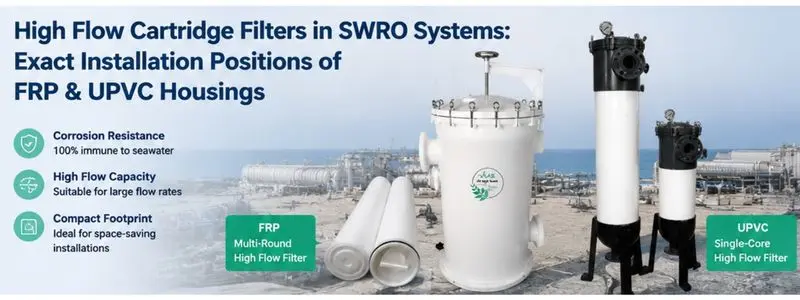
· FRP (Fiberglass Reinforced Plastic) Multi-Core High Flow Filter Housings
· UPVC (Unplasticized Polyvinyl Chloride) Single-Core High Flow Filters
These materials offer:
· Full seawater corrosion resistance
· Lightweight structure
· Cost efficiency vs duplex stainless steel
· Modular scalability
But the key engineering question remains:
�� Where exactly should these high flow filters be installed in a desalination plant?

2. Technical Guide: Exact Locations of High Flow Filters in a Desalination Plant
The Blueprint (Process Logic)
In SWRO system design, FRP and UPVC high flow filter housings are always installed in the:
Low-Pressure Section (≤ 0.3–1.0 MPa zone)
This is the region:
· After media filtration or UF
· Before high-pressure pump
· Before RO membrane racks
This positioning is critical because:
· It avoids mechanical stress from high pressure
· It ensures final polishing filtration before membranes
· It protects both pumps and membranes simultaneously
Position A: Main Security Filtration
This is the most critical installation point.
Located:
After MMF (Multi-Media Filters) or UF system
Before High-Pressure Pumps
Function:
· Final barrier before RO membranes
· Removes fine particles (1–5 μm)
· Stabilizes SDI (Silt Density Index)
· Protects high-pressure pumps from abrasive wear
In SWRO engineering, this is known as:
The Main Security Filter Stage
Even if upstream filtration fails slightly, this stage prevents catastrophic membrane damage.
Position B: Auxiliary & CIP Loops
High flow filters are also widely used in:
· Chemical dosing mixing lines
· UF backwash protection loops
· CIP (Clean-in-Place) circulation systems
· Rinse water polishing circuits
Function:
· Protects dosing pumps from particulate contamination
· Ensures CIP chemicals remain clean during circulation
· Prevents fouling redeposition during cleaning cycles
3. Case Study 1: FRP Multi-Cartridges High Flow Filter in a Mega SWRO Plant
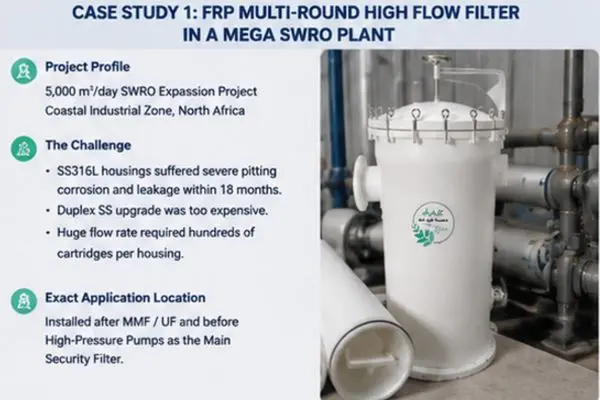
Project Profile:
· Project Capacity: 5,000m³/day Seawater Reverse Osmosis (SWRO) Expansion Project
· Location: Coastal Industrial Zone, North Africa
· Raw Water Source: High-salinity open intake seawater (TDS ≈ 41,000 ppm, rich in chloride ions)
The Challenge:
The plant originally used traditional Stainless Steel 316L cartridge filter housings for their pre-treatment stage. However, due to the aggressive nature of the warm seawater and localized stagnant zones, the SS316L housings suffered from severe pitting and crevice corrosion within just 18 months, leading to micro-leaks and unscheduled shutdowns.
Upgrading the entire system to Duplex Stainless Steel (such as 2205 or 2507) was one alternative, but the astronomical material costs threatened to push the project significantly over budget. Furthermore, because of the massive intake flow rate, using standard 2.5-inch melt-blown cartridges meant maintaining hundreds of filters per housing—a labor-intensive and time-consuming nightmare during maintenance turnarounds.
Exact Application Location:
Our engineering team recommended replacing the corroded metal housings with our FRP Multi-Cartridges High Flow Filter Housings.
In the process flow, these housings were installed directly after the Multi-Media Filters (MMF) / Ultrafiltration (UF) stage and immediately before the High-Pressure Pumps. In water treatment engineering, this is the definitive location for the Main Security Filter (Primary Cartridge Filter). It serves as the final barrier to catch any bypass suspended solids (1-5micron) before the seawater enters the high-pressure RO membrane loops.
4. Case Study 2: UPVC Single High Flow Filter in a Containerized Desalination Unit
Project Profile:
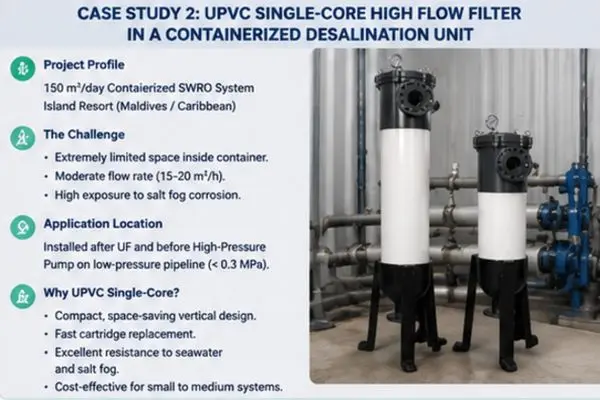
· Project Capacity: 150 m³/day Containerized SWRO System
· Location: Island Resort (Maldives / Caribbean distributed deployment)
· System Type: Modular containerized desalination unit
The Challenge:
The system was designed for decentralized deployment across remote island resorts. This introduced three major constraints:
· Extremely limited installation space inside containers
· Moderate flow demand (15–20 m³/h only)
· High exposure to marine salt fog corrosion externally
Traditional FRP housings were considered too large and over-engineered for this application, while stainless steel housings still suffered from external corrosion due to constant salt-laden coastal air.
Application Location:
The UPVC Single High Flow Filter was installed inside the containerized unit, positioned after the UF system and before the high-pressure pump on the low-pressure pipeline, operating under 0.3 MPa.
This location ensures:
· Final polishing protection for RO membranes
· Stable flow conditioning before pressurization
· Compact integration within confined container space
Why UPVC Filter Housing?
· Compact vertical design saves footprint
· Single-cartridge configuration simplifies maintenance
· Fully resistant to seawater and salt fog corrosion
· Extremely cost-effective for small-to-medium desalination systems
· Fast cartridge replacement during maintenance cycles
5. Summary Matrix: FRP vs. UPVC High Flow Filter Housings
Comparison | FRP Multi-Core Filter | UPVC Single-Core Filter |
Max Pressure | Up to 1.0 MPa | ≤ 0.3 MPa |
Flow Capacity | High (industrial scale) | Medium / small scale |
Best Application | Large SWRO plants | Containerized systems |
Footprint | Medium | Very compact |
Maintenance | Multi-cartridge replacement | Single-cartridge quick swap |
Cost Level | Medium | Low |
6. Pro Engineering Tips: Crucial Rules for Plastic Filters
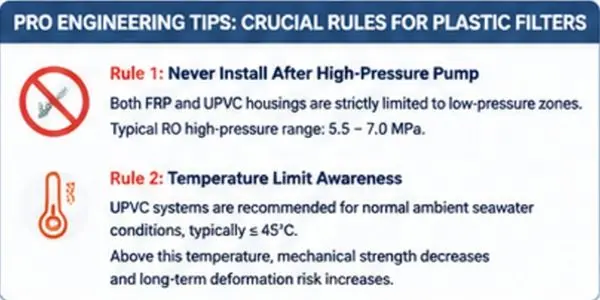
Rule 1: Never Install After High-Pressure Pump
Both FRP and UPVC housings are strictly limited to low-pressure zones.
Typical RO high-pressure range: 5.5–7.0 MPa
Installing plastic housings after the pump can lead to:
· Structural failure
· Leakage
· Safety hazards
Rule 2: Temperature Limit Awareness
UPVC systems are recommended for:
· Normal ambient seawater conditions
· Typically ≤ 45°C
Above this temperature:
· Mechanical strength decreases
· Long-term deformation risk increases
7. Conclusion & Call to Action
In modern seawater desalination engineering, system efficiency is no longer defined only by membrane performance—it is defined by the stability of the pre-treatment and protection layer.
FRP and UPVC high flow filter housings now play a critical role in:
· Protecting RO membranes
· Reducing operational downtime
· Lowering maintenance costs
· Enabling modular system design
As a manufacturer, we provide both:
· FRP Multi-Cartridges High Flow Filter Housings for large SWRO plants
· UPVC High Flow Filter Housing for compact systems
They are not competing solutions—they are complementary engineering tools designed for different system scales.