
Liquid Filtration Systems: From Cartridge and Bag Filters to Membranes
Introduction
Liquid filtration is a critical process across multiple industries, ensuring that liquids remain clean, safe, and efficient for downstream applications. Whether in food and beverage processing, pharmaceuticals, chemical production, water treatment, or petrochemicals, the right filtration system helps protect equipment, maintain product quality, and ensure regulatory compliance.
While many separation technologies exist, liquid filters remain one of the most effective and versatile solutions for removing suspended solids, colloids, and microorganisms. In this article, we will explore what liquid filters are, how they work, their methods, types, industry standards, and real-world applications to guide you in selecting the right solution for your industrial process filtration.
Chapter 1 – What are Liquid Filters?
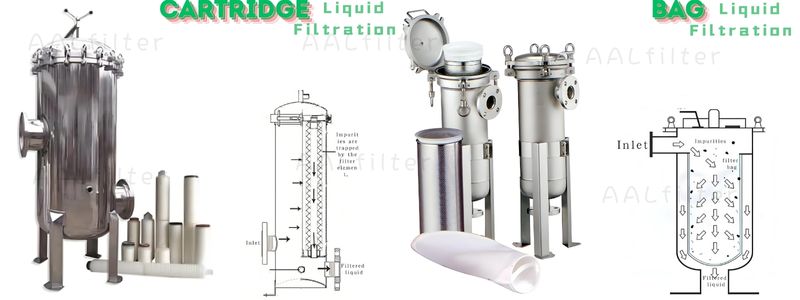
Liquid filters are devices that remove solid particles and contaminants from fluids by forcing the liquid through a porous medium. Unlike clarifiers or centrifuges that rely on gravity or centrifugal force, liquid filters depend on physical media—such as filter cartridges, bags, membranes, or granular layers—to trap unwanted particles.
In industrial operations, filters are often the first line of defense, preventing particles from damaging pumps, pipelines, heat exchangers, or sensitive downstream equipment. They also serve as pre-treatment systems, preparing liquids for advanced purification technologies like ultrafiltration, nanofiltration, or reverse osmosis.
Common industrial uses include:
Ensuring sterility in pharmaceutical manufacturing
Enhancing clarity and taste in food and beverage production
Protecting membranes in water treatment plants
Removing impurities from chemicals and petrochemical products
Chapter 2 – Operating Principles of Liquid Filters
Liquid filtration works on a simple principle: the liquid flows through a filter medium that allows the fluid to pass while capturing particles.
As solids accumulate, they form a filter cake on the medium’s surface. Initially, this adds resistance, but over time it also improves fine particle retention. The challenge lies in balancing efficiency with flow capacity—too much buildup increases pressure drop, requiring filter replacement or cleaning.
Two common operational modes are used:
Constant Rate Filtration – Flow rate is maintained by increasing pressure as resistance rises.
Constant Pressure Filtration – Pressure remains steady, but flow rate gradually decreases as solids accumulate.
The choice depends on the process: high-volume industrial plants may require constant rate operation, while delicate pharmaceutical or biotech applications may benefit from constant pressure to preserve product integrity.
Chapter 3 – Methods of Liquid Filtration
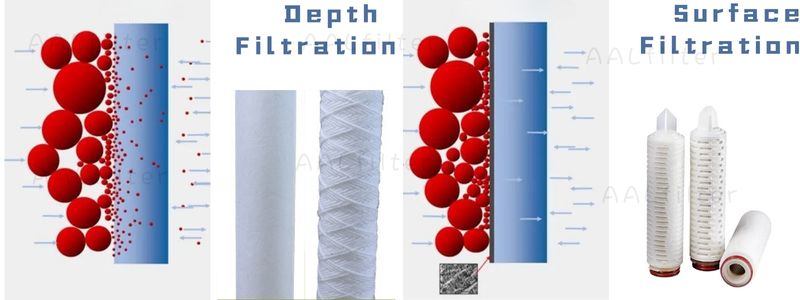
1. Surface Filtration
Particles are trapped on the surface of the medium. For more details, see our article on Surface vs. Depth filtration.
This method offers consistent pore size but limited dirt-holding capacity.
Application: beverage clarification, semiconductor ultrapure water.
2. Depth Filtration
Particles are captured within the thickness of the filter media. This is the principle behind many melt blown filter cartridges.
Application: industrial liquid filtration in pharmaceuticals and petrochemicals.
3. Membrane Filtration
Includes microfiltration, ultrafiltration, nanofiltration, and reverse osmosis. This is widely used in industrial water treatment and wastewater treatment. For more details, see our article on Filtration vs. Reverse Osmosis.
Application: desalination, high-purity water systems.
4. Specialized Methods
Sand filtration – for large-scale water treatment.
Hot/cold filtration – in the food and beverage industry.
Self-cleaning filters – for continuous high-flow industrial processes.
Chapter 4 – Types of Liquid Filters and Their Applications
Filter Type | Advantages | Limitations | Best Applications |
Cartridge Filters | High precision, low initial cost | Frequent replacement | Medical, beverages, labs |
Bag Filters | High dirt-holding, economical for large volumes | Lower precision | Chemicals, coatings, wastewater |
CIP / Self-Cleaning Filters | Automated, reduce labor and downtime | Higher upfront investment | Pharma, petrochemical, food |
High Flow Filters | Large flow capacity, extended lifespan | Higher material cost | Desalination, power generation |
By selecting the right type, companies can balance performance, cost, and compliance.
Chapter 5 – Industry Standards & Compliance
Unlike many general discussions, it’s important to emphasize that industrial liquid filtration must meet strict regulatory standards:
Food & Beverage – NSF/ANSI 42, 53, and 61 for drinking water safety.
Pharmaceutical & Biotech – USP Class VI and FDA-approved materials for sterility and biocompatibility.
Water Treatment – WHO and EPA drinking water guidelines.
Chemical & Petrochemical – ISO and ASTM standards for corrosion resistance, high-temperature stability, and pressure safety.
Compliance ensures not only product quality but also regulatory approval and brand credibility.
Chapter 6 – Key Considerations in Selecting Liquid Filters
When selecting a industrial liquid filtration system, companies must evaluate:
Flow Rate & Pressure – Can the filter handle your system’s capacity?
Particle Size & Micron Rating – Absolute vs. nominal ratings affect precision.
Liquid Properties – Viscosity, temperature, and chemical compatibility.
Operation Mode – Batch vs. continuous production requirements.
Lifecycle Costs – Initial investment vs. consumable replacements.
Sustainability – Waste disposal, recyclable filter elements, energy efficiency.
For example, a SS liquid filter housing designed for high pressure will be necessary in petrochemical applications, while a PP bag filter may be more cost-effective for wastewater treatment.
Chapter 7 – Application Examples & Case Studies
Desalination Plants
High flow cartridge filters protect reverse osmosis membranes by removing suspended solids in seawater.
Pharmaceutical Manufacturing
Sterile-grade cartridge filters ensure particle- and bacteria-free solutions, critical for injectable drugs and vaccines.
Food & Beverage Production
Bag and cartridge filters safeguard taste, clarity, and product shelf life by removing sediment and microbial contaminants.
Petrochemical Industry
Specialized glass fiber or stainless-steel filters withstand high temperatures and corrosive fluids in refining processes.
Industrial Wastewater Treatment
Bag filters, filter housings, and MBR/MBBR membrane systems enable industries to meet discharge regulations and support water reuse.
more about application, please visit-Top 10 Liquid Filtration Applications
Conclusion
The global liquid filtration industry is expected to grow steadily in the coming decade, driven by increasing environmental regulations, rising demand for clean water, and stricter product quality standards in industries such as food, pharmaceuticals, and electronics. According to market research, the liquid filtration market is projected to expand at a CAGR of 6–7% from 2024 to 2030, with Asia-Pacific and North America as the fastest-growing regions.
Liquid filtration is far more than a mechanical process—it is a strategic necessity for industries seeking to maintain quality, safety, and efficiency. From extending equipment lifespan to ensuring compliance with international standards, the right filtration system makes a measurable difference in performance and cost savings.
At AALfilter, we provide a wide range of filtration solutions, including filter cartridges, bag filters, housings, and membrane systems, tailored to the needs of water treatment, pharmaceuticals, petrochemicals, and food industries. By understanding your specific challenges, we deliver customized solutions that transform your filtration process into a competitive advantage.